Segment ABM is all about identifying clusters of accounts with similar contexts, drivers and priorities — so that you can build a focused marketing plan and personalise your execution to the point where each stakeholder in each account feels like you’re speaking directly to them, in their language. Done well, this kind of relevance cuts right through the broader, less targeted communications buyers receive every day from other suppliers.
But how do you actually identify those clusters in practice?
Using a heat map to find common ground
One of the most effective approaches is to build a heat map across the customers and prospects you’ve prioritised for ABM, looking for where they share common strategic priorities. This is typically done across accounts within the same industry sector, since that vertical context gives you a natural starting point.
The good news is that what used to take days of research can now be accelerated significantly with AI. It’s now fairly straightforward to feed public information about several companies’ strategic priorities — from website copy, latest news, annual reports, or shareholder presentations — into a model like ChatGPT and ask it to identify where companies have priorities in common. The illustrative table below shows the kind of output you’re looking for.
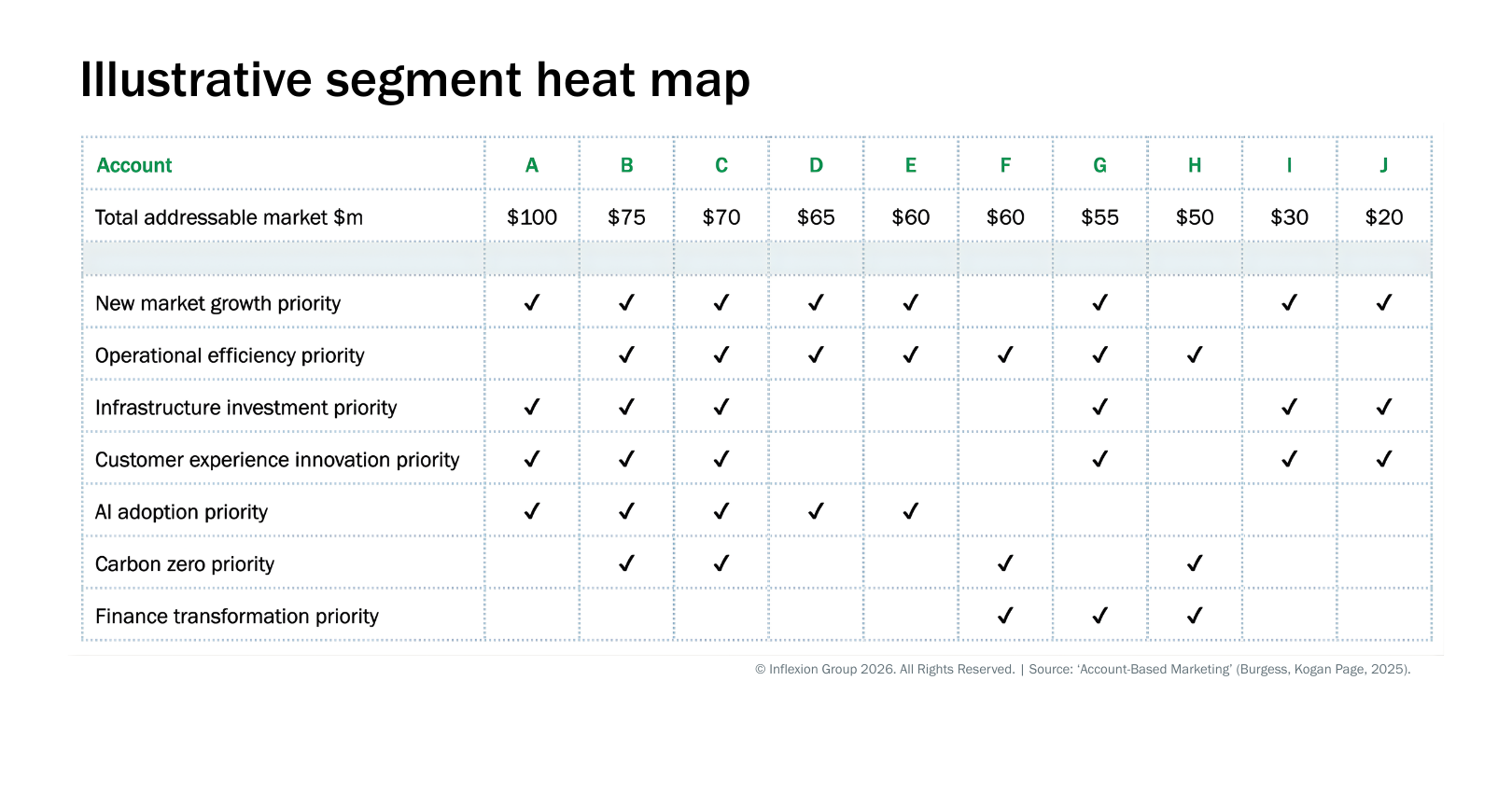
From this example, you might decide to create a Segment ABM plan for the eight companies that share a priority around new market growth — or target the slightly different cluster of seven companies focused on operational efficiency. The heat map makes those choices visible and defensible.
Starting with a ‘grandfather’ account
An alternative approach is to build your segment around what ABM practitioners call a ‘grandfather’ account — an existing customer already receiving a Strategic ABM approach, used as the archetype around which to build a cluster of lookalike accounts. These are usually in the same industry sector or sub-sector, with similar challenges and priorities.
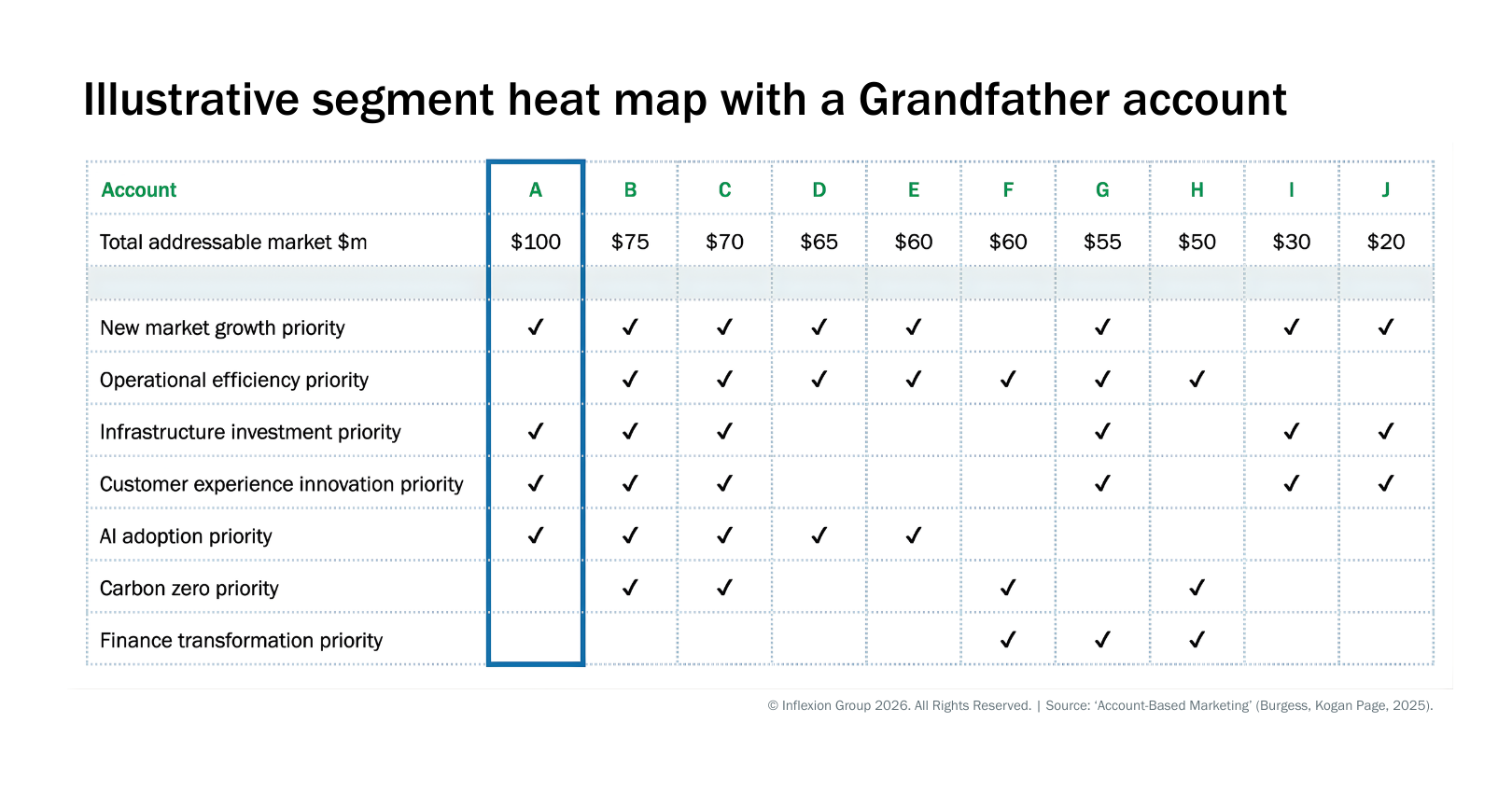
The real advantage of this approach is that you’ve already done the hard work. You’ve built actionable insight into the issues and priorities facing this type of account, shaped your value proposition, identified the key decision-makers and influencers, and developed your content assets, communications plan and success metrics. Identifying lookalike accounts then becomes a process of building out the cluster, not starting from scratch, and tailoring your messaging for each account.
In the illustrative example above, you might focus your first campaign on the common priority around new market growth. Or you might build it around infrastructure investment, which six of the accounts share, followed by a campaign on customer experience innovation, also of interest to that same group.
Again, the heat map is a great starting point for your discussion with the business around where to focus your resources.
Read more about this approach in ‘Account-Based Growth’ (Burgess and Shercliff, Kogan Page, 2022) and ‘Account-Based Marketing’ (Burgess, Kogan Page, 2025), or take the on-demand course on Prioritising Accounts for ABM from the ABM Academy.
Catch up on our last ABM-er’s toolkit on prioritising accounts for ABM.