Inflexion Group’s 2026 ABM benchmarking study drew on 16 in-depth interviews and a survey of 40 global organisations. Across the five areas of our ABM Programme Framework, five themes emerge.
Growth is the non-negotiable mandate
ABM is being judged on hard commercial outcomes, and expanding existing accounts and supporting specific opportunities are chief among them. Leaders are building measurement frameworks that link buying group engagement to pipeline impact, creating a growth narrative that resonates with sales and the C-suite alike. The question this raises is whether ABM is becoming central to the growth narrative within marketing, or whether it still sits at the edge of it.
Coverage models are increasingly sophisticated
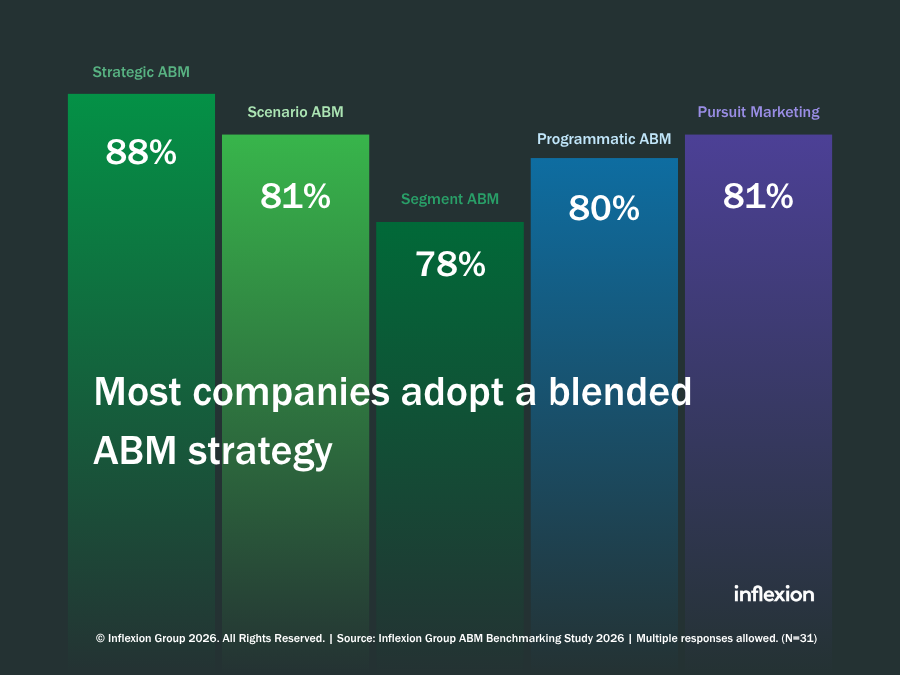
Strategic ABM remains the backbone of most programmes, deployed by 88% of respondents. Pursuit Marketing, Scenario ABM and Segment ABM extend reach for around 80% of programmes without diluting focus. But sophistication in design does not always translate into clarity of execution. As coverage models grow more complex, the risk of spreading investment too thin – without a coherent logic for doing so – grows with them.
Execution is being industrialised
Activation is shifting from bespoke craft to repeatable playbooks, templates and standard processes, especially in Strategic ABM and Pursuit Marketing. Just 37% of programmes handle all execution internally today; agencies still play a role, but increasingly a selective one. The shift toward repeatability is necessary, but it creates its own tension: how do programmes maintain the genuine personalisation that justifies ABM’s investment as they scale?
AI is rewiring the ABM stack
AI already supports insight generation, planning, content creation and journey orchestration across the majority of programmes – 70% actively use AI for content creation. But the next phase of value lies not in chasing the next AI feature, but in orchestrating data, tools and agents coherently, with clear governance. That coherent orchestration remains elusive for most, and the gap between programmes experimenting with AI features and those building genuine AI capability is widening fast.
Operating models are in flux
Nearly 20% of marketing resources are dedicated to ABM, and investment is steady or growing. But the research is clear: success now depends more on how programmes are organised and skilled than on how much they spend. Small ABM CoE hubs, clearer global–local operating models, and ABM-ers who blend strategic marketing, commercial acumen and AI literacy are defining the next wave of leaders.
What do senior buyers actually want?
At our May Forum meeting in London, two senior customer executives joined us for a candid conversation behind closed doors. Together, they oversee procurement decisions totalling more than £30 billion. What follows is drawn directly from that conversation – in their words, as far as possible. It is among the most direct and actionable guidance for ABM practitioners I have heard in a long time.
What is changing for executive buyers?
Both executives were clear that the organisational and human challenges of transformation are greater than the technical ones. Legacy integration into modern technology stacks remains a persistent challenge, and suppliers who understand this are more credible than those who lead with their own technology story.
AI is already reshaping the buying process itself – being used to write tender documents and specifications, design scoring systems, read submissions and conduct first-round assessments. The relationships are still what matter, but the process around them is changing fast.
Two other themes stood out. First, complacency is the enemy of strategic relationships: buyers always have an alternative supplier in mind. Second, buyers are increasingly guarded with information and access. The days of open-door relationships are giving way to something more measured and more risk-conscious, with ESG and reputational factors now actively influencing procurement decisions.
What do executives want from strategic suppliers?
When asked directly, the answers were striking in their simplicity – and their ambition:
- Relationships first, everything else second. Build relationships at every level, not just with your senior sponsor.
- Demonstrate strategic consistency over the long term. Buyers notice when suppliers change strategy, messaging or personnel frequently – and it undermines trust.
- Think and behave like a genuine partner, not a vendor. ‘Your team is part of our company’ – this is the expectation, not an aspiration.
- Understand their world and their quirks. Genuine organisational insight – who really makes decisions, what the internal politics are, what keeps leaders awake – is what separates the best suppliers from the rest.
- Help them navigate internally. The internal complexity of large organisations is as much a challenge for buyers as it is for suppliers. Help them align their own stakeholders.
- No surprises. Proactive communication is not optional. Being blindsided destroys trust quickly and rebuilds it slowly.
- Work through the numbers together. Commercial transparency and joint problem-solving on the business case are valued, not just headline claims about ROI.
What information do executives value?
Again, the answers were clear:
- Help them connect the dots across technologies and suppliers, bringing synthesis and perspective, not just information.
- Bring examples from other sectors. Cross-industry learning is highly valued and significantly under-used.
- Share practical, relevant AI use cases. AI in the abstract is not interesting; AI applied to their specific challenges is.
- Be honest about failure. ‘Show me what went wrong before with others’ is the ask, and this honesty about failure builds far more trust than curated success stories.
- Executive briefing centres and senior engagement programmes are genuinely valued when done well.
- Help customers educate themselves and their teams. Knowledge-sharing and capability development are valued forms of partnership.
The implications for ABM are direct: the quality of strategic relationships – not pipeline metrics – is how I believe ABM’s value should be articulated to the business. The human moment matters more than ever.
So, what next for ABM?
I won’t share the specifics of our Forum discussion – it operates under Chatham House rules – but here are four themes it crystallised for me, set alongside the research and customer perspectives, are these.
- Account-based thinking will become the operating model across all of sales and marketing. ABM as a distinct function may dissolve, not because it has failed, but because it has succeeded.
- The 1-1/1-Few/1-Many taxonomy I helped shape will give way to something more dynamic and lifecycle-oriented, where AI, properly orchestrated, can make a real difference.
- The ABM-er’s primary role will shift from campaigner to orchestrator. And paradoxically, AI handling more of the routine work will make the human moments of genuine connection more valuable, not less.
- And the gap between our ambition for tomorrow and our ability to execute – fragmented data, immature AI governance, skills shortages – is the problem to solve now, not later.
I find myself more optimistic than anxious. The fundamentals of ABM are not going away. Our job is to build the capabilities and the operating models to deliver on them.
Read my previous ABM-er article on how the world of the account director is changing.