2026 ABM Benchmarking Study finds that sharper orchestration, stronger capability and disciplined AI adoption are now defining the world’s most successful ABM programmes
Inflexion Group today published its 2026 ABM Benchmarking Study, the most comprehensive study of ABM programme practice among global B2B enterprises to date. Drawing on 16 in-depth qualitative interviews and an extensive online survey of 40 large enterprises across technology, professional services and other B2B sectors, the study reveals how leading organisations are transforming their go-to-market models through disciplined, account-based thinking.
The research, conducted between February and April 2026, examines 20 success factors across five areas of ABM programme design: objectives, metrics and governance; strategy and account coverage; activation; infrastructure; and talent, organisation and funding.
Growth is the non-negotiable mandate
The study opens with a clear statement of commercial intent. Growing existing accounts is the primary objective for 91% of programmes, followed by supporting specific deals (76%) and winning new customers (62%). More than six in ten (63%) rank existing account growth as their single most important priority, with pursuit or deal-based marketing coming second (39%).
Measurement has matured significantly. ABM teams are adopting the 3Rs framework — revenue, relationships and reputation — linking buying group engagement and pipeline impact to build a growth narrative that resonates with sales leadership and the C-suite. Senior sponsorship is widespread, with CMOs partnering with sales to sponsor ABM in 59% of programmes.
Coverage models have moved beyond the traditional taxonomy
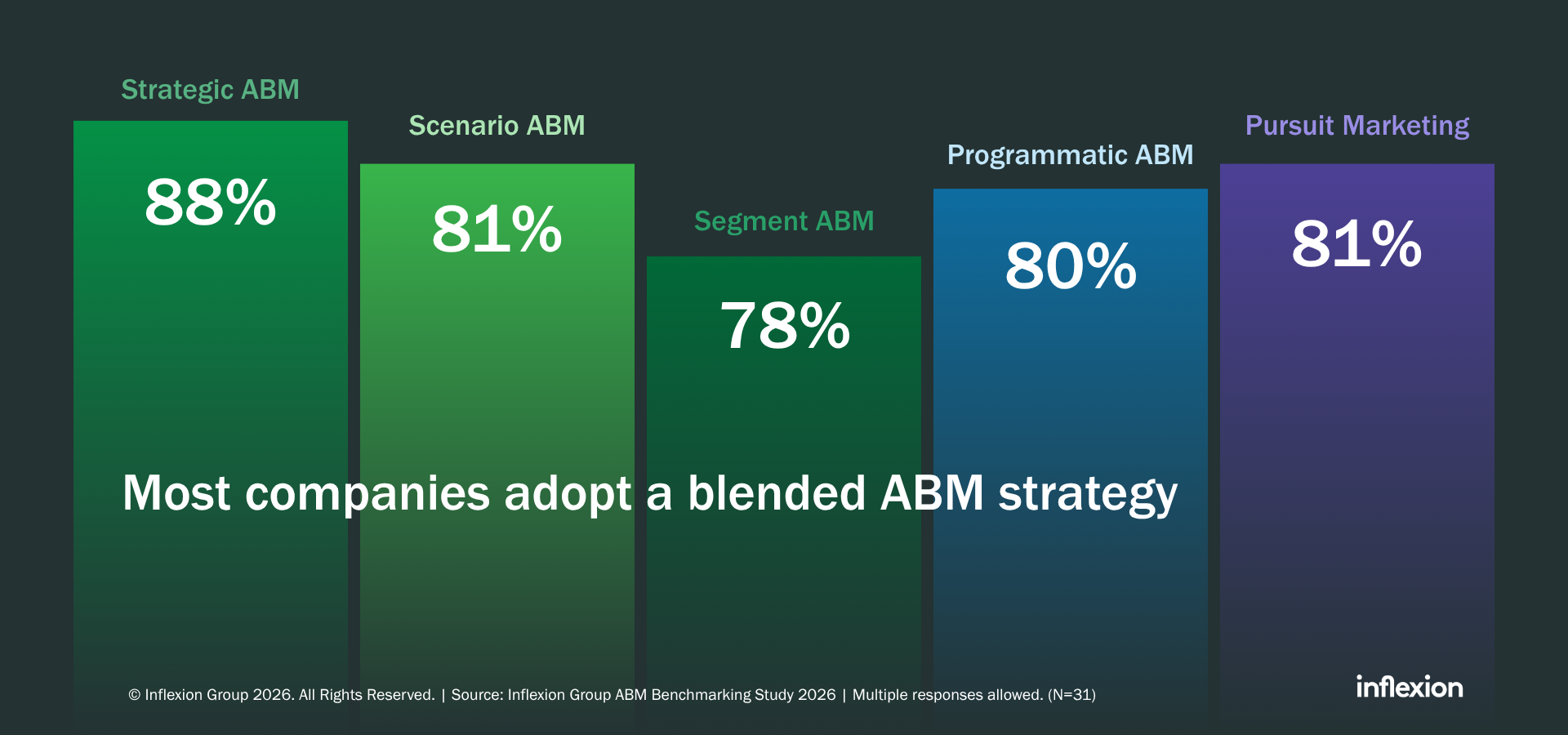
One of the study’s most striking findings is the degree to which ABM teams have evolved their coverage strategies. Most companies now operate blended models that have moved away from the conventional 1:1/1:Few/1:Many taxonomy. Strategic ABM remains the backbone, deployed by 88% of companies, while Pursuit Marketing, Scenario ABM and Segment ABM extend reach for around 80% of programmes, without diluting focus on the highest-value accounts.
Key data points on strategy and coverage include:
97% cite future growth potential as the primary account prioritisation criterion
88% of programmes use Strategic ABM for their most important accounts
65% include executive engagement strength in prioritisation decisions
16% rely on predictive scoring – human judgement still leads the process
Account prioritisation criteria remain consistent year on year: future growth potential (97%), current revenues (77%), competitive strength (68%) and executive engagement (65%) dominate. The business continues to lead prioritisation, with ABM practitioners using data-led scoring models to support collaborative investment decisions.
Execution is being industrialised
As ABM programmes scale, activation is shifting from bespoke craft to repeatable, codified process. Playbooks, templates and standard workflows – especially in Strategic ABM and Pursuit Marketing – are enabling teams to deliver more without proportional increases in resource. Most ABM programmes choose to tailor existing content for their audiences, and yet custom content remains the preferred approach for Strategic ABM (86% of programmes).
The most effective mix of tactics integrates digital with high touch experiences, including bespoke landing pages, paid social, executive engagement programmes, VIP event experiences, innovation workshops and digital advertising. Just 37% of teams handle all activation entirely in-house. However, the direction of travel is clear: ABM practitioners expect to rely less on external agencies, moving towards more selective use of partners for strategic, specialist and AI-enablement support.
AI is rewiring the ABM stack — but governance and integration lag behind
Artificial intelligence is already embedded across many ABM workflows. Today, 70% of programmes actively use AI for content creation, while insight generation, planning and journey orchestration are also common applications. Looking ahead, 63% plan to invest in AI-powered journey orchestration in the coming year, and 52% in AI-powered content creation platforms.
But the picture is not uniformly optimistic:
60% of client-facing teams still lack a single source of truth for data
47% say data governance could be improved
While 22% have an active interest in agentic AI (super agents) for ABM in 2026, the study finds that AI-enabled orchestration is outpacing what traditional tech stacks can support, with integration remaining the critical challenge. Inflexion Group’s conclusion is unambiguous: the next phase of AI value will come not from adopting the next feature, but from orchestrating data, tools and agents coherently, within a clear governance framework.
Operating models are in flux
Nearly 20% of marketing budgets and 14% of marketing headcount are dedicated to ABM on average, with investment stable or growing for the overwhelming majority of programmes. Resource allocation is holding firm: 86% report the same or greater budget year on year, and 96% report the same or greater headcount.
Yet how programmes are organised varies widely. Operating models span centralised (38%), decentralised (43%) and hybrid (19%) structures, with many ABM practitioners holding blended field roles (54%). The trend is towards small, central ABM hubs or Centres of Excellence. Where these are absent, the study finds ABM is typically more fragmented, slower to respond, and less visible at the senior table.
Skills gaps are emerging as a strategic risk. AI literacy and commercial acumen are the two areas where ABM teams consistently rate themselves lowest; precisely the capabilities that will define competitive advantage in the next phase of programme development. The study signals that success now depends more on how programmes are organised and skilled than on how much they spend.
Commentary from Inflexion Group
“This research confirms what we’ve been seeing in our work with some of the world’s most advanced growth marketing and ABM programme leaders: the question is no longer whether to do ABM, but how to do it at scale, with discipline, with the right operating model, and with AI integrated in a way that genuinely serves the programme rather than adding complexity.”
Bev Burgess, CEO, Inflexion Group
“The most effective ABM leaders we spoke to are thinking very clearly about three things: where to invest for greater account coverage, how to build repeatable, personalised execution at scale, and how to develop the commercial and AI skills their teams need to lead the next chapter of ABM. That’s the agenda we’re helping our clients and ABM Academy participants work through right now.”
Louise Jefferson, Managing Principal and ABM Academy Director, Inflexion Group
About the research
The 2026 ABM Benchmarking Study was conducted by Inflexion Group between February and April 2026. The qualitative phase comprised 16 in-depth interviews with global ABM programme leaders, drawn initially from members of Inflexion Group’s ABM Leadership Forum. The quantitative phase comprised an online survey of 40 companies, covering all five areas of Inflexion Group’s ABM programme framework across 22 questions. Respondents represented global and regional programmes mostly at large enterprises (80% over 5,000 employees, 95% over 1,000 employees). Industries represented include technology services (35%), professional services and consulting (18%), enterprise software (15%), cloud services (13%), and other B2B sectors. All individual responses remain anonymous.
About Inflexion Group
Inflexion Group is the world’s leading independent account-based marketing consultancy, bringing together a deeper bench of experienced ABM practitioners than any other firm. Co-founded by Bev Burgess — a globally recognised ABM authority, originator of the term ‘account-based marketing’ and author of Account-Based Marketing: The Definitive Handbook for B2B Marketers (Kogan Page, 2025) — with Louise Jefferson and Tim Shercliff, the firm combines strategic advisory, practitioner-led research and the ABM Academy, providing certified training and mentoring from introductory to expert level. The Inflexion Group faculty has trained over 10,000 marketers and worked with more than 50 global organisations including Accenture, AWS, IBM, PwC, Salesforce and Vodafone.
Media and enquiries
Website: inflexiongroup.com
Research enquiries and live briefings: bev@inflexiongroup.com
LinkedIn: Follow Inflexion Group and subscribe to The ABM-er newsletter