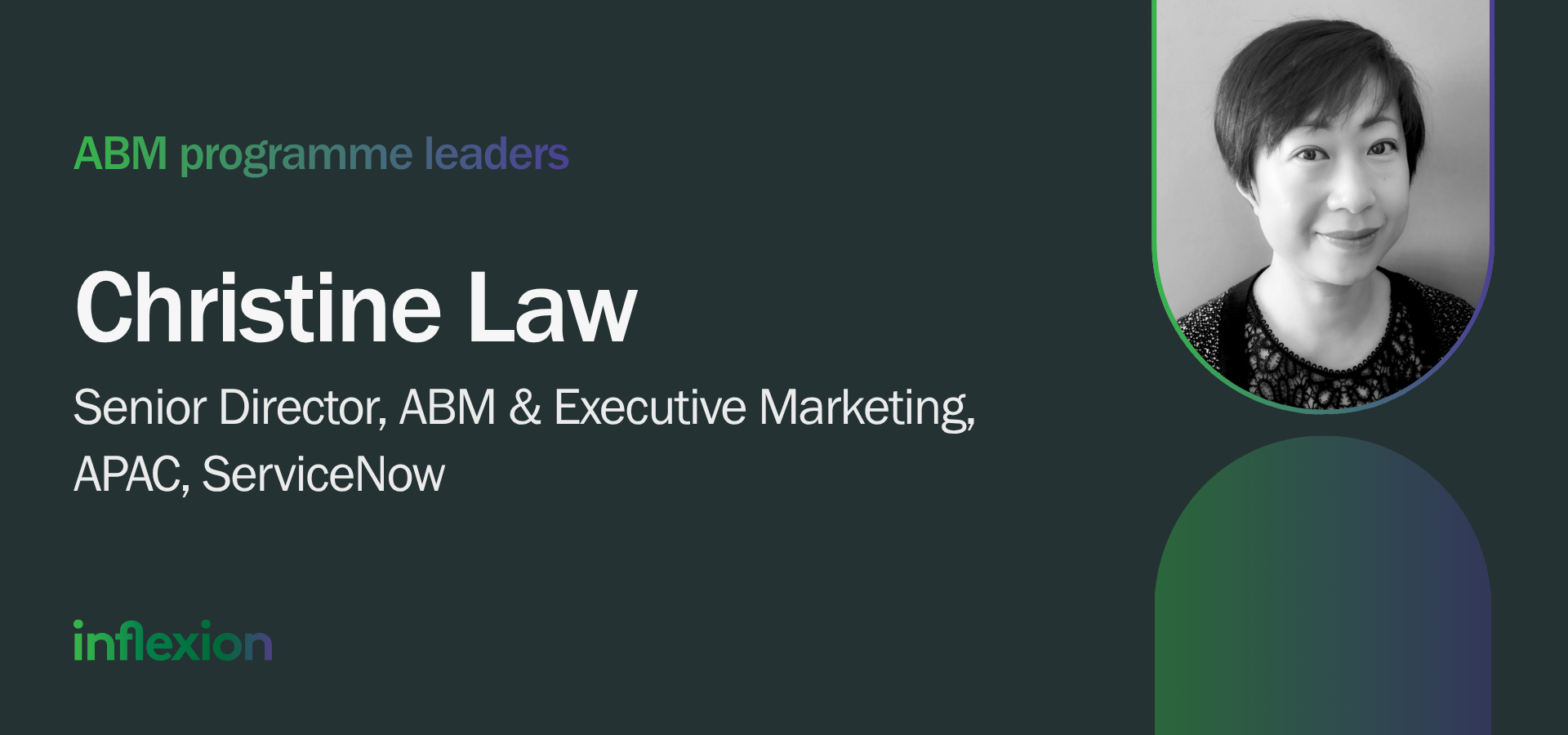
In our first interview in a new series featuring ABM programme leaders from around the world, we speak with Christine Law, Senior Director, ABM & Executive Marketing, APAC, at ServiceNow. Christine is someone who has spent years navigating the intersection of marketing and sales to drive long-term account growth across one of the world’s most complex B2B markets.
Christine is also a member of Inflexion Group’s ABM Leadership Forum, a global group of programme leaders who collaborate to solve some of the most pressing challenges in applying ABM to drive sustainable growth.
Christine speaks candidly about what it takes to move ABM from a programme to a business priority, the strategic tensions that define the ABM leadership role today, and what she believes will set great ABM leaders apart in the years ahead.
An interview with Christine Law
1. When ABM is making an impact, what is different about the way it is being led?
When ABM is working well, marketing is embedded in the account team — not operating as a separate function.
In the strongest programmes, you’re not working from a briefing or a ‘download’. You are part of the conversation. That’s what allows you to ask better questions, bring new ideas, and shape the approach rather than respond to requests.
Sales teams don’t always know what’s possible from marketing. They don’t know what they don’t know. If you wait to be asked, you stay in execution. When you’re embedded, ABM becomes part of how the account grows, not something that sits on the side of the conversation.
2. What did it take to move ABM from a programme to a business priority?
The shift happens when ABM is treated as part of the account strategy, not just a marketing initiative.
Structure plays a role. Where ABM sits, how it is funded, and how closely it is aligned to sales all make a difference. But there isn’t a single model that works in every context.
What matters more is staying connected across both the account and the wider marketing ecosystem. ABM needs to operate as a bridge, with the access and credibility of the account team, while still drawing on the full marketing ecosystem.
Alongside that, there is a shift in mindset. The relationship with the business changes — from asking marketing to deliver activities, to bringing problems to solve. That’s when ABM moves from support to partner.
Without that shift, ABM stays constrained. With it, it becomes part of how the business grows.
3. Where do you have to make the most important strategic decisions as an ABM leader?
The most important strategic decision is where to invest between long-term account growth and in-quarter deal support.
On one hand, you need to invest deeply in a small number of strategic accounts, often without seeing results for 12–24 months. On the other, there is constant pressure to support active deals where impact is more immediate and measurable.
You can’t do both at scale. So, you are always making a choice about where to place your bets and asking the business to trust that investment decision before the results are visible.
That tension is only increasing. As AI makes parts of ABM faster, there is a growing expectation that you should be able to do more and support a greater number of accounts. But faster execution doesn’t necessarily mean you can operate at the same level of depth.
The constraint is not execution. It’s how well you understand the account.
4. What has stretched you most in leading ABM and how have you navigated it?
One of the ongoing challenges in ABM is building and enabling strong talent.
The role sits at a unique intersection, bringing together commercial thinking, relationship-building and marketing creativity in one person. Being fluent in AI and new tools is now part of that baseline.
I often think of strong ABM-ers as a rare breed; people who move seamlessly between sales and marketing worlds and operate credibly in both.
As a leader, a big part of the role is how you develop and support that blend, because it doesn’t follow a traditional path. You can’t rely on standard marketing or sales development routes, so you have to be deliberate in how you build that capability across the team.
5. What role does ABM play in shaping business strategy and decision-making, and where has it had the most unexpected impact?
ABM contributes by bringing a more end-to-end view of the customer beyond the immediate sales cycle.
Sales teams are often focused on the deal in front of them. ABM looks across the full lifecycle: from engagement, through implementation, to adoption, satisfaction and growth. That more holistic perspective helps connect what can otherwise become fragmented.
In practice, that means influencing more broadly across the account — not just aligned to sales, but helping shape how different stakeholders are engaged. That includes senior decision-makers, as well as the teams responsible for implementing and using a solution day-to-day. In some cases, this also changes how customers engage. Without an immediate sales agenda, there is more space for open conversations and a deeper understanding of the account.
It also brings a more account-led mindset into the wider marketing organisation, shaping how programmes are prioritised and designed. In APAC at ServiceNow, we’ve taken this a step further by bringing ABM and Executive Marketing together within the same team. It’s not a typical structure, but it strengthens that connection, ensuring executive engagement is closely aligned to account priorities and integrated with ABM programmes. It’s now starting to be looked at more broadly across other markets.
ABM doesn’t own the overall account strategy, but it plays an important role in shaping it, often acting as the thread that connects it and bringing a more joined-up view of how the account grows.
6. Looking ahead, how do you see ABM evolving? What will be different?
ABM is evolving under increasing pressure, as expectations of marketing continue to shift.
Long-term investment has always been part of ABM, but it’s becoming harder to justify. Stakeholders move, priorities shift, and the value built in an account can reset quickly. That makes multi-year investment models more difficult to sustain.
At the same time, there is an expectation of greater speed. AI is making parts of ABM faster, which raises the question of whether the overall model should move faster as well, with shorter cycles and more frequent pivots.
The challenge is how to balance that. How do you maintain depth in key accounts while becoming more agile in how you invest and respond?
How that balance is resolved will be central to how the ABM model evolves from here.
7. What skills and capabilities will define a great ABM leader and team in the next few years?
One of the defining capabilities is the ability to adapt while maintaining momentum.
The pace of change is high, and priorities change constantly. One day the focus is on deals, the next it’s long-term account growth. And then it changes again. Leaders need to be comfortable adjusting quickly and not always having clear answers.
That requires resilience. You have to be willing to try, fail, reset and go again; even when it’s difficult, and even when your confidence takes a knock.
There’s also a shift in where capability sits. In some areas, younger talent is already ahead — particularly in how quickly they adopt new tools and ways of working. At times, they are simply better, and as a leader, you have to be open to that and keep learning.
Ultimately, it’s how you respond to constant change that sets leaders apart.
Key takeaways
Christine Law’s perspective offers a grounded view of the tensions shaping modern ABM leadership.
She describes a discipline increasingly embedded in the account itself, operating as a bridge between the account team and the wider marketing ecosystem, influencing how stakeholders engage, and connecting what can otherwise become fragmented. In some cases, that also changes how customers engage.
She also highlights the growing tension between long-term account investment and pressure to move faster, support more accounts and constantly adapt. What comes through most strongly is the mindset required to lead through that complexity: resilience, commercial judgement and a willingness to keep learning.
Look out for our next ABM programme leader interview, and read a bit more about our ABM Leadership Forum in our ‘Give to Gain’ International Women’s Day article.