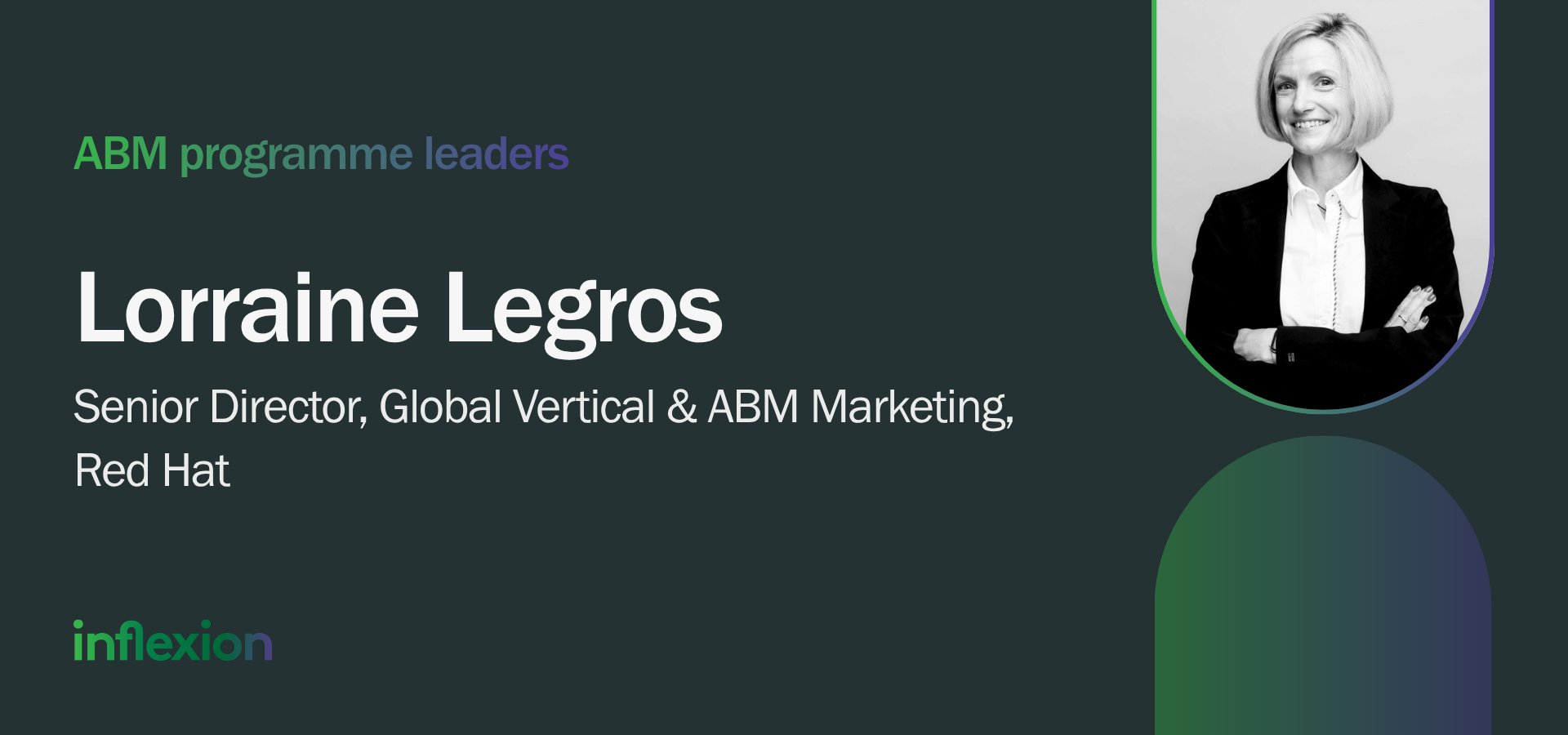
For the fourth interview in our series featuring ABM programme leaders from around the world, we speak with Lorraine Legros, Senior Director, Global Vertical & ABM Marketing at Red Hat.
Lorraine has led the global ABM programme alongside vertical marketing and executive engagement at Red Hat for almost four years. She brings a candid view of what it takes to establish ABM as a discipline in its own right: the constant communication it demands, the tough calls on account selection, and the tenacity needed to keep teams focused on the accounts that matter most.
In this conversation, she reflects on how ABM moved from a programme to a business priority, the strategic decisions that carry the most weight, and how agents and AI-infused ABX will change the work of ABM teams.
An interview with Lorraine Legros
When ABM is making an impact, what is different about the way it is being led?
That all depends on your organisational structure. Is it a separate entity? Is ABM integrated into field marketing? And is it part of sales? Whatever your operating model, it still needs to retain its core objective. At Red Hat, I firmly believe our ABM team is regarded as a team of account-marketing experts. When strategic ABM delivers exceptional client experience and business value focused on our top performing accounts, it goes without saying that it’s seen as a completely different discipline to field marketing.
It should be led differently to other marketing teams, with a close alignment to sales and the right resources to support those top accounts. Success metrics are also different. The best ABM leaders are change agents, who push boundaries and drive different perceptions of marketing. Not everyone understands what ABM is. So it’s all about communication.
What did it take to move ABM from a programme to a business priority?
Tremendous effort! I took on the role when ABM was ‘the thing’. It was still relatively new to Red Hat and we were generally left alone to get on with it. The metrics were always relationships, reputation and revenue but today the emphasis placed on each has shifted and we are increasingly being asked to demonstrate business value in terms of pipeline and deal progression.
So, we focused in on the most strategic accounts: those with the largest current revenues and added in their potential for growth, and this gave us a unique model for sales and marketing alignment in the company. In fact, it’s not just sales. We align with our business value practice, tech sales, subject matter experts, and deal-maker teams. It has taken a lot of communication to help those teams understand what ABM is, why ABM is important and how it can help with an account-based growth strategy.
The other thing that moved the needle for us was senior sponsorship, from the CMO and CRO. They have been engaged and incredibly supportive, which has made a huge difference.
Where do you have to make the most important strategic decisions as an ABM leader?
Account selection is really important. Telling people ‘these accounts get investment but yours won’t’ is tough. This is especially true where global priority accounts aren’t the same as local priority accounts. Why would a team in France support ABM marketing efforts for a US-headquartered bank, for example? It’s the right decision for the company as a whole, but that may not be a priority for the local team.
Being clear on your strategy, your account priorities, the ABM approach, and resourcing model is key.
What has stretched you most in leading ABM, and how have you navigated it?
Ongoing change management: being a change agent in the business. This is continuous. Trying to ensure ABM-ers aren’t pulled into broad-based field marketing but stay focused on top accounts and on the agreed outcomes they’re driving in those accounts. Helping them decide when to say no.
Enablement is one way to do this. We’ve certified all of our ABM-ers but recently rolled out a dedicated learning path which we’ve also made available to other teams. It’s a great way to navigate the need for communication and a different way to convey our objectives and goals.
Continuous education about what ABM is/isn’t can be exhausting, but it’s working. You need to be tenacious!
What role does ABM play in shaping business strategy and decision-making, and where has it had the most unexpected impact?
The unexpected outcome has been the alignment of the business around the same account prioritisation model. Our CRO is clear about the accounts that matter, and those that don’t matter as much. That change was led by marketing.
Another unexpected impact was focusing on those top accounts to increase membership to our Strategic Advisory Board. Using the same prioritisation model, we have successfully expanded our executive community. Last year we had our most successful in-person Strategic Advisory Board ever, with confirmed numbers for this year’s virtual session significantly up. We’re doing the right things for the right people.
Looking ahead, how do you see ABM evolving? What will be different?
It will be agentic everything! We’re moving from traditional ABM to AI-infused ABX. We’re defining what ABM and Executive Engagement agents should do and what skills they need to do the work. This is focused on blueprint-able, repetitive tasks, that could be automated freeing up time for our ABM-ers to work on the vision and strategy for our priority accounts.
Inevitably, some people would rather not change. I think we are seeing this everywhere in the AI space. There are those who are worried about job security. But we have to lean into this shift, and see it as an opportunity, not a threat. And it’s not a one and done. The technology is evolving so fast, we have to evolve with it.
What skills and capabilities will define a great ABM leader and team in the next few years?
It will increasingly be about strategic orchestration. ABM-ers should be the CMO for their account(s), but they were also very hands-on, executing on the account plans they developed. Now we’re building agents to do a lot of the low-value, repetitive tasks, which means that creativity, judgement and the ability to build relationships will become more important. Those things can’t be done by agents.
Key takeaways
Lorraine Legros’s perspective is shaped by almost four years of leading ABM as a distinct discipline inside a large global organisation. What comes through most clearly is her conviction that ABM must be led differently to other marketing teams, with close sales alignment, senior sponsorship and relentless communication about what it is for.
She describes ABM leadership as a continuous exercise in change management: making the tough calls on account selection, keeping ABM-ers focused on the outcomes that matter, and using enablement to help the wider business understand the value of ABM. One of her most striking observations is that a marketing-led prioritisation model ended up aligning the whole business around the same set of accounts.
Looking ahead, she sees agents taking on the repetitive, blueprint-able work so that ABM-ers can concentrate on vision and strategy. The leaders who will define the next era are those who lean into that shift while investing in the creativity, judgement and relationships that agents cannot replace.
Read our previous ABM Programme Leader interviews with Rachael Bell from NTT DATA, Helen Nicholas from Accenture Australia and Christine Law from ServiceNow.