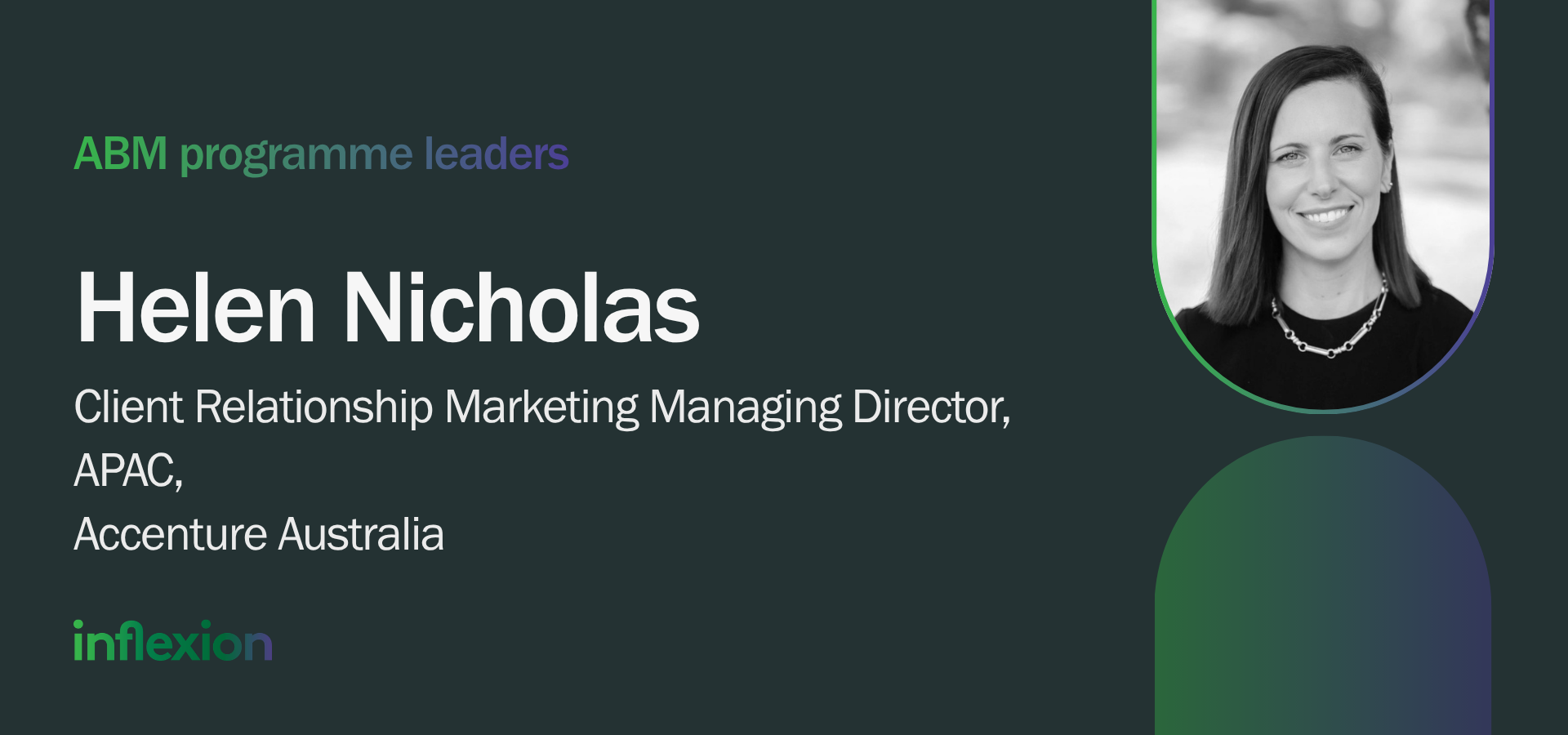
For the second interview in our series featuring ABM programme leaders from around the world, we speak with Helen Nicholas, Client Relationship Marketing Managing Director, APAC at Accenture Australia.
Helen is recognised for combining innovation, curiosity and people-centred leadership with a relentless focus on client relationships and business growth, challenging conventional approaches and continuously evolving the role account-based thinking plays in shaping decisions and creating value.
In this conversation, she shares her perspective on how ABM earns influence within the business, the leadership challenges that matter most, and why the future of the discipline will depend as much on human judgement as technology.
An interview with Helen Nicholas
1. When ABM is making an impact, what is different about the way it is being led?
The most successful ABM leaders do three things well: they focus on the skills and engagement of their people, stay close to the business, and are willing to challenge the status quo. That’s where the biggest shift happens. There’s value in consistency, but also in continually asking what needs to change so we can have greater impact and create more pride and joy for our people.
That mindset creates an environment where innovation becomes democratised. Ideas can come from everyone, and in our team, we welcome and test all ideas — and operationalise the ones that work. Sometimes that can be big changes — like adding new “types” of ABM. That flexibility unlocks significant impact.
2. What did it take to move ABM from a programme to a business priority?
We only committed to accounts where the account lead was willing to give us a seat at the leadership table. That early positioning made it clear that we weren’t there to support around the edges, but to act as a strategic adviser.
Once we had that seat, how we showed up in conversations mattered. We earned credibility by showing up in a decidedly data‑led way. We could go to account teams and say: our data is telling us we need to build a relationship with this person — even when they hadn’t previously been on anyone’s radar. Asking those questions — and backing them with insight — changed the dynamic.
Demonstrating impact was equally important. We anchored everything back to clearly defined KPIs and outcomes. Historically, B2B marketing hasn’t always been able to point to that level of accountability. Having that discipline — and returning to it consistently — helped ABM shift from something the business experimented with, to something it relied on.
3. Where do you have to make the most important strategic decisions as an ABM leader?
Decisions about where to focus and which accounts to prioritise are becoming less contentious, thanks to better data and our ability to analyse it. That doesn’t remove judgement, but it does mean we’re making those calls with far greater confidence.
The more complex challenges are around people. Ensuring our team continues to grow and develop — remaining engaged, challenged and learning — is critically important, and requires deliberate choices about how we work.
Knowing what to test — and when to stop — has become an increasingly important leadership judgement. With more data and more analytical capability, it’s easy to disappear down rabbit holes of hypothesis‑building and experimentation. Knowing when deeper exploration will unlock insight, and when attention is better directed elsewhere, has become an increasingly important leadership call.
4. What has stretched you most in leading ABM and how have you navigated it?
The speed of change has stretched me most — both in how quickly our capability has improved and in how quickly the future keeps re‑forming in front of us. It’s required me to constantly reimagine what great could look like, often before we’ve fully finished operationalising the last version.
My team’s ability to imagine what’s possible is extraordinary. The way they can now use data, insight and scale opens possibilities that weren’t imaginable even a short time ago. What makes this such a positive stretch is that we don’t just imagine what’s possible; we get to operationalise it in real time. Traditional constraints — time, tooling and scale — are no longer the limiting factors they once were, which removes excuses and raises the bar for leadership.
Leading in that environment has required me to lean into that pace, embrace constant reinvention, and create the conditions for the team to take advantage of what’s possible. It’s demanding, but it’s an incredibly energising place to lead from — and one I feel very fortunate to be in.
5. What role does ABM play in shaping business strategy and decision-making, and where has it had the most unexpected impact?
ABM brings discipline to prioritisation. The understanding built through ABM — particularly the strength, structure and health of business relationships — can inform how account teams think about their next moves. While ABM doesn’t dictate strategy, it provides a grounded lens that can shape conversations and decisions.
ABM has also introduced stronger rigour around collecting data, analysing patterns of engagement, and an evidence‑based view of what works in complex accounts. Over time, this has helped teams question assumptions and make more considered choices about how they show up with clients.
6. Looking ahead, how do you see ABM evolving? What will be different?
The biggest change will be the level of precision ABM can provide at scale. Increasingly, ABM’s value will come from helping organisations show up in exactly the right places — with the right clients, the right messages and the right channels — at the moments that matter most.
ABM is moving from a focus on activity to a focus on decision intelligence. Signals will matter more than volume: understanding what they tell us, how they combine, and how confidently we can act on them. The organisations doing ABM well will be those that can translate insight into direction — dynamically and in real time — rather than simply executing against static plans.
This evolution will be powered by stronger tooling and analytical capability, but the human component won’t go away. If anything, it becomes more important. As precision increases, so does the need for judgement. ABM leaders will increasingly operate as strategic advisers — helping guide choices, challenge assumptions and provide clarity in complex commercial environments.
A deep understanding of return on effort and return on investment will become increasingly important. As ABM becomes more targeted and more integrated into business decision‑making, confidence in where impact is truly created will be critical.
7. What skills and capabilities will define a great ABM leader and team in the next few years?
A great ABM leader in the coming years will need to be visionary. The leaders who stand out will be those who can imagine what’s possible, define what “great” could look like next, and inspire teams to move towards it.
Alongside that vision sits deep fluency in data, tools and insight — but not blind faith in them. The ability to understand data, form hypotheses, test ideas, and critically evaluate outcomes will become increasingly important. As AI and advanced analytics become more prevalent, discernment becomes a differentiator. The strongest ABM leaders won’t simply accept what technology serves up; they’ll question it, contextualise it and combine it with human judgement.
Understanding the human dimension will remain essential. As engagement approaches become more sophisticated, there is a real risk of sameness. Standing out, differentiating meaningfully, and creating genuinely human connections will require creativity, curiosity and empathy.
Leadership capability will matter just as much as technical skill. Growing people, helping them stretch, and creating pride in the work are critical. Building high‑performing ABM teams means fostering ambition, encouraging experimentation, and supporting individuals to do work that challenges and fulfils them.
Key takeaways
For Helen, ABM has always been about earning influence, not claiming it. That starts with securing a seat at the leadership table, bringing evidence into conversations, and demonstrating impact through clear business outcomes.
As the discipline matures, she believes the hardest leadership decisions are becoming less about account selection and more about people. Building teams that remain curious, engaged and willing to challenge convention is increasingly where differentiation is created.
Looking ahead, Helen sees ABM evolving from a discipline focused on activity to one centred on decision-making. As organisations gain access to richer signals, stronger analytics and AI-powered capabilities, success will depend on knowing where to focus, what to prioritise and when to act. Technology will expand what is possible, but leadership judgement and a deep understanding of people will remain at the heart of great ABM.
Read our previous ABM Programme Leader interview with Christine Law from ServiceNow, who shared her perspective on building credibility, balancing long-term and short-term priorities, and what it takes to lead ABM in a rapidly changing environment.