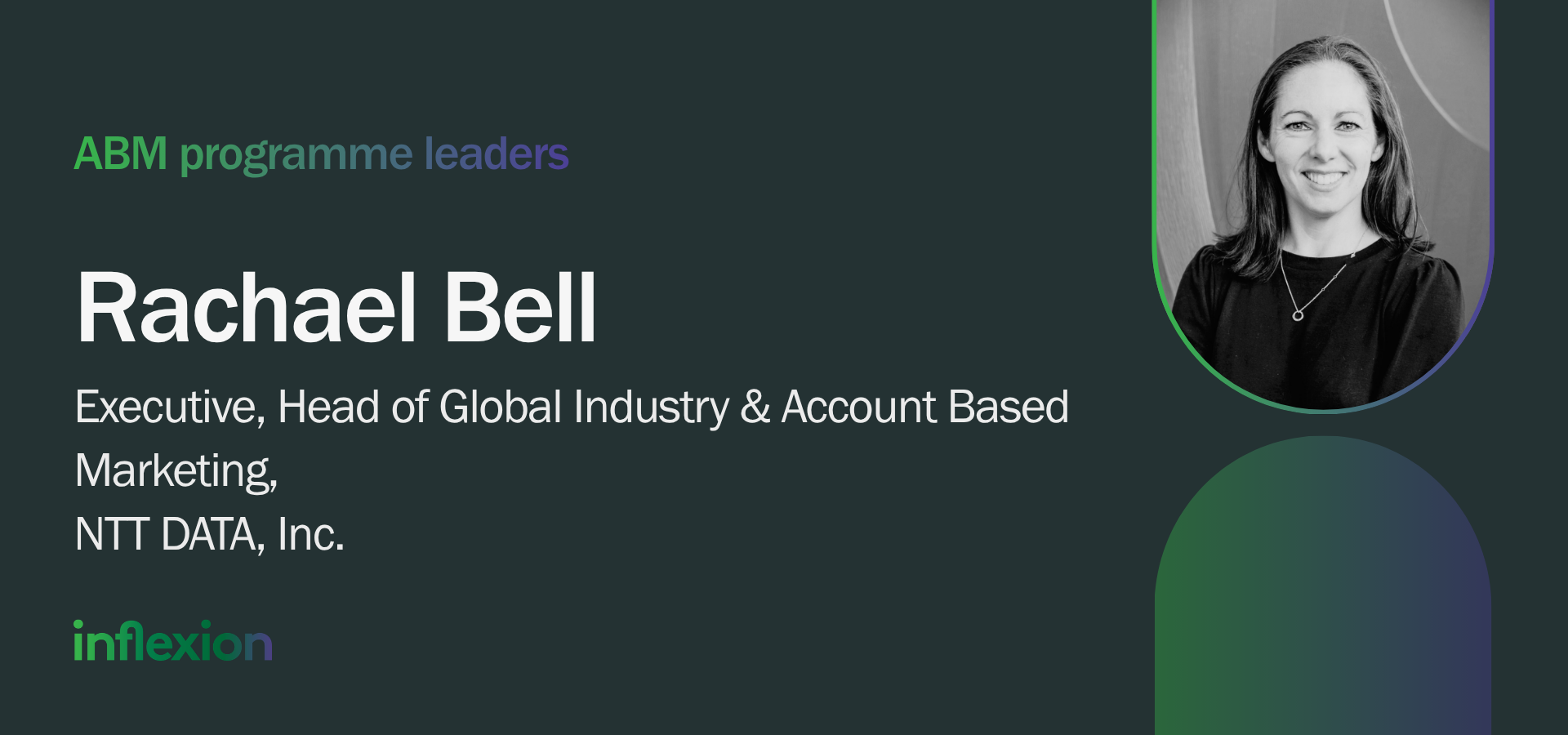
For the third interview in our series featuring ABM programme leaders from around the world, we speak with Rachael Bell, Executive, Head of Global Industry & Account Based Marketing at NTT DATA.
Rachael leads ABM at a company that serves some of the world’s most complex enterprise clients, from global banks and healthcare systems to government bodies. She brings a direct, experience-grounded perspective on what genuine ABM leadership looks like: the patience it demands, the internal battles it requires, and the sharp instincts needed to keep focus on what actually matters.
In this conversation, she reflects on how ABM earns its place as a business priority, the leadership decisions that carry the most weight, and how the discipline needs to evolve to stay meaningful in an AI-shaped future.
An interview with Rachael Bell
When ABM is making an impact, what is different about the way it is being led?
ABM is a mindset and a different way of looking at your clients. It’s about being part of the sales team and helping them think differently about the account — not just personalising content or monitoring buying signals but delivering programmes where both sales and marketing are aligned and accountable.
The shift that signals real maturity is when the conversation stops being about what pipeline marketing delivered and becomes about what we have done together to move the account forward. That change in ownership and mindset across sales and marketing is the clearest indicator that something different is happening.
NTT DATA serves complex enterprise clients — global banks, healthcare systems, government bodies — where deals can take 18 to 36 months to close. Leading ABM well in that environment means being patient, and keeping the team focused and motivated without the short-term dopamine hit of high-volume lead generation.
What did it take to move ABM from a programme to a business priority?
Proof and patience, and the patience was harder.
The proof part was non-negotiable. In the early days, ABM was seen as a marketing programme and there was real scepticism around the value. We had to prove why it works, play the long game, and show enough short-term wins to maintain focus before the real value hit. That meant demonstrating pipeline influence, relationship building and revenue impact tied to specific named accounts and individuals in a way the business could not argue with.
The patience was tested hardest when there was pressure to show volume — MQLs, pipeline coverage, campaign reach — against which ABM can look underwhelming. We had to hold our nerve and make the case internally, repeatedly, that depth beats breadth when your target universe is 50 or 100 accounts, not 50,000.
A Global Client Partner told me the ABM programme made them think differently about their account and opened up new areas of growth. That’s the moment the business started to recognise ABM as something other than clever marketing.
Where do you have to make the most important strategic decisions as an ABM leader?
Where you focus your attention and what you prioritise. Some of the accounts we work on have so much potential that you could be a full-time ABM-er on just one of them and still not get everything done. You have to be really clear on how you prioritise for the biggest impact. Do you focus on short-term plays to get in-year growth, or hold your nerve for the longer-term, even bigger opportunities?
It is also about deciding to do the right thing for the client, not what the business wants. That means being willing to push back or say no when someone wants you to push a portfolio into an account, and instead choosing to promote the solution that best addresses the client’s challenge.
What has stretched you most in leading ABM and how have you navigated it?
Aligning a global, matrixed organisation around a model that demands local intimacy and real-time agility. Ensuring our global clients receive a consistent set of messages aligned to their business priorities, while maintaining the right level of focus on key accounts, is an ongoing challenge.
Keeping teams motivated and helping them understand their career path and continually develop their skills is equally demanding. ABM-ers have a different skill set to generalist marketers and need training on commercial and business acumen, as well as how to use marketing platforms and broader marketing skills.
And then there is AI. Balancing the expectation to scale and speed up ABM using AI with the need to upskill teams and embed new ways of working at the same time is something every ABM leader is navigating right now.
What role does ABM play in shaping business strategy and decision-making, and where has it had the most unexpected impact?
The intelligence and insights that ABM-ers can access enable us to help account teams think differently about their accounts, to step away from day-to-day service issues and start thinking about new opportunity areas and new buying groups.
Helping sales understand different stakeholders and delivering insight into how individuals like to be communicated with and what motivates them, has been a real game changer for some of our sellers. Account-level insight is one thing, but being able to really understand individuals is key. ABM at its heart is a people and relationship-driven initiative. It is designed to strengthen relationships and get clients trusting us and wanting to work with us, because people buy from people.
What’s been most unexpected is how far this reach extends beyond any single deal: those insights also help to shape business strategy and growth plans — where we should be investing marketing funds, what campaigns we should be running, and which programmes of engagement to prioritise. The executive briefing programmes ABM supports have deepened C-level relationships that have become genuinely strategic assets for the business, well beyond any individual deal.
Looking ahead, how do you see ABM evolving? What will be different?
With AI, everyone can claim they do ABM, so I see the definition blurring. For me, ABM has always meant 1:1 strategic marketing for the most strategic clients: the ability to deliver a joint sales and marketing strategy aligned to client outcomes, focused on building relationships and partnerships for the long term. Personalised ads served up based on intent is not ABM. That is just modern marketing.
ABM will naturally evolve with AI, giving us the ability to onboard clients faster, serve up content in real time, and provide client teams with real-time signals and buying behaviour insights so we can react faster. That helps us demonstrate to clients that we understand them, we have got their back and we can help them.
The most significant evolution will be in the intelligence layer. The ability to synthesise insights across news, regulatory shifts, financial disclosures, technology procurement signals, social intent data and relationship history in near real-time will fundamentally change the pace at which ABM operates. The teams that learn to harness this will have the advantage.
The other major shift will be in ABM’s scope. ABM will increasingly extend beyond pipeline generation into customer retention, expansion and advocacy. As buying cycles get longer and customer lifetime value becomes the primary commercial metric, ABM’s remit will naturally expand to cover the full lifecycle of the most strategic accounts, changing team composition, measurement models and the relationship with customer success and delivery functions.
What skills and capabilities will define a great ABM leader and team in the next few years?
AI, orchestration, resilience and the ability to adapt to change quickly.
AI is changing the way we work, talk to clients and show up in front of them. As an ABM leader you need to stay ahead, adapt and evolve, but also maintain the human in the loop and keep focus on the importance of relationships when it comes to your most strategic clients. People will always buy from people, especially for large transformational deals. Whilst you can use AI to increase speed to market and show up more relevantly in front of clients, it will never replace human interaction. As a leader, with all the noise around using AI to scale, personalise and drive efficiencies, you need to be willing to stand up and make the case for personal relationships, especially when talking about your most strategic accounts.
When dealing with big global accounts, you need to help manage cross-functional teams, ensure you are showing up consistently to clients across every market, cut through internal complexity and maintain focus on the client and their needs.
Finally, resilience. Hold the line that strategic ABM is a long game and, if you maintain focus, you reap the rewards. That means being willing to make the case for long-term strategic investment in accounts, to challenge conventional pipeline metrics, to say that a particular account is not right for us, and to sustain that position under commercial pressure. ABM is not for leaders who need immediate validation.
Key takeaways
Rachael Bell’s perspective is shaped by years of leading ABM in one of the most complex enterprise environments covered in this series. What comes through most clearly is her conviction that ABM is fundamentally a relationship discipline, and that no amount of technology changes that.
She describes ABM leadership as a combination of patience, proof and principle: the ability to hold a long-term position, demonstrate value in terms the business cannot dispute, and push back when short-term pressure threatens client-centred work.
Looking ahead, she sees AI reshaping the pace and precision of ABM without replacing its essence. The leaders who will define the next era of the discipline are those who can harness new intelligence capabilities while continuing to champion the human relationships that make strategic ABM worth doing.
Read our previous ABM Programme Leader interview with Helen Nicholas from Accenture Australia.