Hello everyone,
Welcome to November’s edition of The ABM-er. Earlier this month I had the pleasure of attending B2B Marketing’s Global ABM Conference in London chaired by the wonderful Richard O’Connor. I’ve been attending (and speaking at) this event since 2018, and this year it struck me that over that period, some things have changed and some things have stayed the same.
I want to explore some of those things for you this month. What is ABM’s role in wider go-to-market strategies? What challenges do ABM-ers face? How best to engage buyers?
I hope you find it useful. If you do, please subscribe.
Many thanks,
Bev
What is ABM’s role in go-to-market strategy?
Robert Norum, the ABM and demand generation expert for Propolis gave an opening keynote with Kate Philpot of the Institute of Sales Professionals on ABM as the go-to-market operating system. They suggested that ABM should move from a marketing operating system to a go-to-market model that is company-wide, account-centric and throughout the customer lifecycle.
This recognition that account-based thinking should shape your growth strategy is not new – I wrote about it with Tim Shercliff in ‘Account-Based Growth’ (Burgess and Shercliff, Kogan Page, 2022) and it was the focus of my 2022 keynote for the ABM conference. Tim had implemented it as a strategy in IBM in the early 2000s and I was part of the management team at Fujitsu that used it to deliver market-beating growth in the mid-2000s. We launched ABM in Fujitsu in 2006 and my colleague Louise Jefferson was the company’s first global ABM-er. Great to see it still going strong after 20 years as illustrated by Laura Rafferty at Fujitsu!
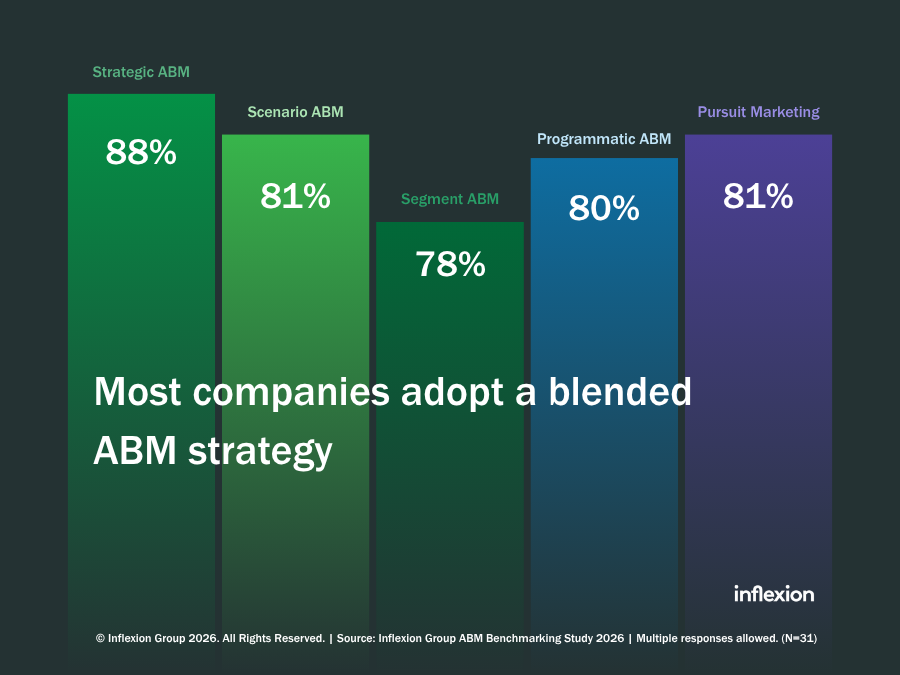
What also isn’t new is this idea that different types of ABM can apply to different tiers of customer. Our benchmarking research consistently shows that Strategic (or 1:1) ABM dominates in the top tier, while tiers two and three typically see a blend of approaches, including Scenario and Segment ABM.
What is new is the wider acceptance among B2B marketers that ABM is a crucial part of a wider account-based growth strategy that aligns sales, customer success or delivery, and your own executives as you all decide how and where to invest resources into different accounts. It’s great to see this thinking going more mainstream and to see ABM as part of wider account-based growth strategies. You can read more about this in my paper Account-based marketing’s next chapter: from programme to principle.
What challenges do ABM-ers face?
Many of them have barely changed since I first coined the term ‘account-based marketing’ in 2003.
My fireside chat at the conference with Tara Pritchett of SAIC explored how to do ABM in a less-than-ideal world. Tara discussed the difficulty of working with a lack of business and sales buy-in, incomplete CRM data, limited budgets, and the pressure to scale once the proof of concept was, well, proven.
What is new is the way ABM-ers are tackling these challenges. Susan Konings and Eva Croonen at Vodafone Ziggo secured business buy-in by setting up their programme as an account-based growth initiative co-owned by sales and marketing (going on to win a Sales Challenge award for their work). Tara herself switched from Strategic to Scenario ABM to meet demand from the business while still offering a 1:1 approach for clients and account teams. Samara Donald at AWS is leveraging repeatable journeys and AI to increase speed to market and maintain sales buy-in for her 1:Few model.
Others are using AI to address gaps in data and to do more with their limited budgets through more efficient execution. For example, Alice Clarke and the team at Google Cloud are taking an Agentic AI approach to ABM with a ‘super-agent’ orchestrator across strategy, planning, execution and measurement.
The other thing that is new is the need to decide how to tackle these perennial challenges while in operational flux as the wider marketing function transforms. Operating in constant change was the subject of last month’s ABM-er and is the focus of the CMO interview series I am running for Inflexion Group if you want to read more.
How best to engage buyers?
There was much talk about the way B2B buying is changing – more people involved in the decision, doing more of their research before talking to a salesperson and deciding who they want to work with before issuing an RFP. Is this really new? Nick Mason at Turtl shared a wonderful extract from Industrial Buying and Creative Marketing, a 1967 book by Patrick J. Robinson, Charles W. Faris, and Yoram Wind that examined organisational purchasing behaviour and B2B marketing management. Their research showed that, in an eight-phase buying process, requests for proposals only happened at phase five, after a need was recognised and characterised and a search and qualification of sources of potential solutions conducted. This book is even older than me!
What is new(er) is how widely marketers now accept the need to build awareness and preference early with the whole buying group, and to maintain it throughout their purchasing journey. Brand is having a resurgence in B2B marketing as a result. Does that mean the death of intent signals? I’m not sure. There were still many presentations on how AI is being used to track signals and qualify in accounts that are ready to engage. But these were balanced by conversations about the need to deliver great experiences for buyers and connect on a human level, building strong relationships that endure over many buying cycles.
So, while we all now know that AI allows us to build insights, personalise content, plan, orchestrate and track campaigns faster and at greater scale than ever before, the news that some customers deserve more special treatment than this is not really news at all.
Catch up on October’s ABM-er article on getting comfortable with change.