How are companies blending the five types of ABM to cover more priority accounts without diluting ROI?
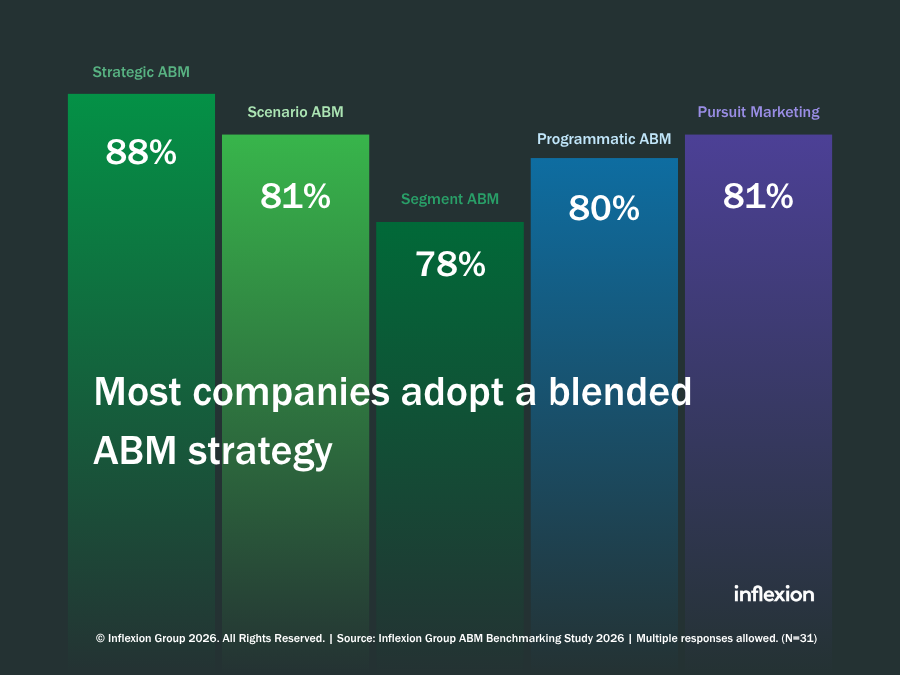
One of the clearest signals from our 2026 ABM Benchmarking Study is that ABM coverage models have grown significantly more sophisticated. Programme leaders are no longer relying on one or two types of ABM in their strategy, they are blending all five in use today to maximise return across the accounts that matter most to the business.
Here are some of the key findings.
Most programmes have moved beyond the 1-1, 1-Few, 1-Many taxonomy
The traditional framework has given way to a more nuanced model built around five distinct ABM types: Strategic, Scenario, Segment, and Programmatic ABM plus Pursuit Marketing. Companies are using these selectively, matching each type to account tier, stage of relationship, and commercial objective.
More resource-intensive types are concentrated on existing customers
Strategic ABM is used by 84% of programmes for existing accounts, and Scenario ABM by 88%. These approaches demand significant investment in insight, content, and relationship-building, making them most viable where there is already a commercial foundation to build on. For new business, Pursuit Marketing is deployed by 48% of programmes and Segment ABM by 43%.
Coverage ratios confirm the resource intensity of Strategic and Scenario ABM
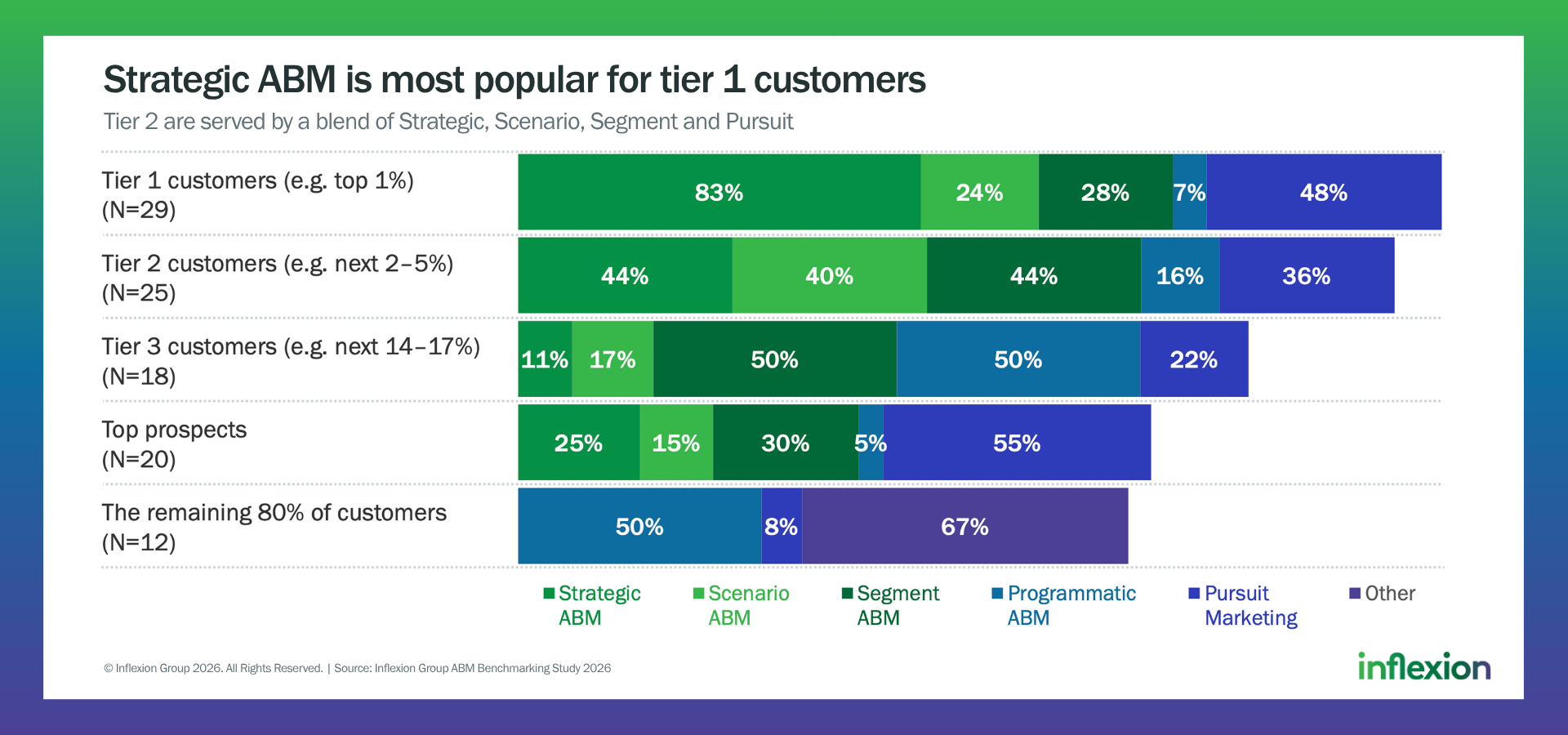
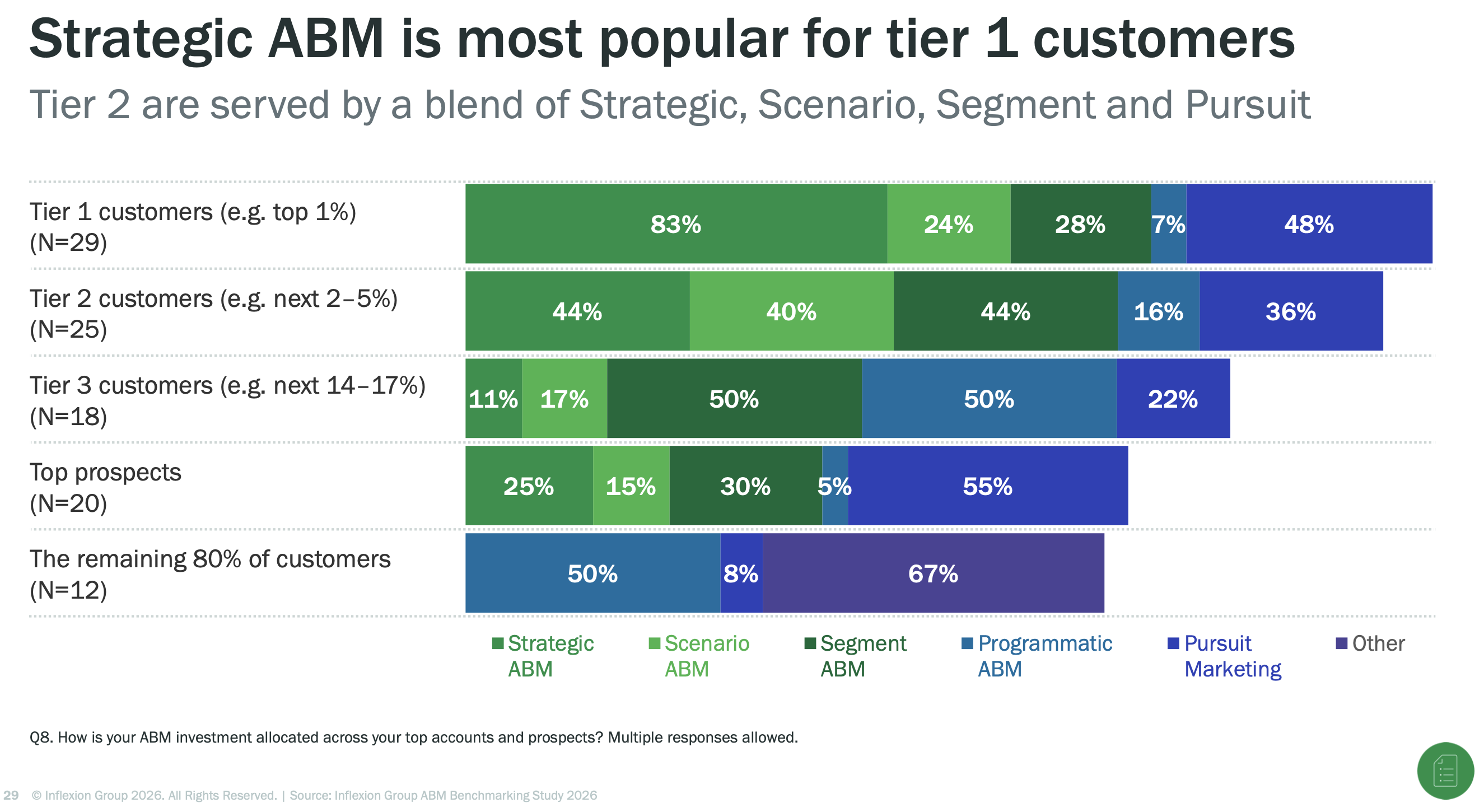
Strategic ABM remains the backbone of blended strategies, particularly for Tier 1 accounts. Tier 2 accounts are typically served by a combination of Strategic, Scenario, Segment, and Pursuit Marketing. Coverage ratios vary by vertical and region, and AI is increasingly being used to enable personalisation at scale across lower tiers.
Account prioritisation criteria are remarkably consistent
Future growth potential is cited by 97% of respondents as a prioritisation factor, followed by current revenues (77%), competitive strength (68%), and executive engagement (65%). Just 16% rely on predictive scoring, suggesting that human judgement and relationship context still dominate the process.
The business leads, but ABM-ers bring the rigour
Prioritisation is not happening in isolation within marketing. The business drives the prioritisation process, while ABM leaders use data-led scoring models to facilitate collaborative, well-evidenced investment decisions across the enterprise.
To read the full findings, visit the 2026 ABM Benchmarking Study.