Hello everyone,
Welcome to October’s edition of The ABM-er. This month I’m stepping back from programmes and operating models to talk about something more personal: how each of us gets comfortable with change.
Over the past year I’ve written a lot about the forces reshaping B2B go-to-market, from AI on both sides of the buying process to ABM’s shift from programme to principle. Whenever I share that picture with clients and colleagues, the next question is rarely about strategy. It’s some version of ‘how do I keep up?’
This edition is my answer. It’s in three parts: understand how you naturally respond to change, look after the things that keep you resilient, and take deliberate steps towards where you want to be.
I hope you find it useful. If you do, please subscribe.
Many thanks,
Bev
Change has no finish line
Most of the change models we grew up with assume a journey with a destination. You leave the old way of working, go through the uncertainty of transition, and arrive somewhere stable. That’s not the world we ABM-ers are working in today.
Several forces are remaking complex B2B go-to-market at the same time. AI is rewriting both sides of the buying process at the same time as growth is narrowing to fewer, deeper human relationships. And the boundaries of ABM itself are dissolving, as account-based thinking spreads across field, industry, customer and partner marketing.
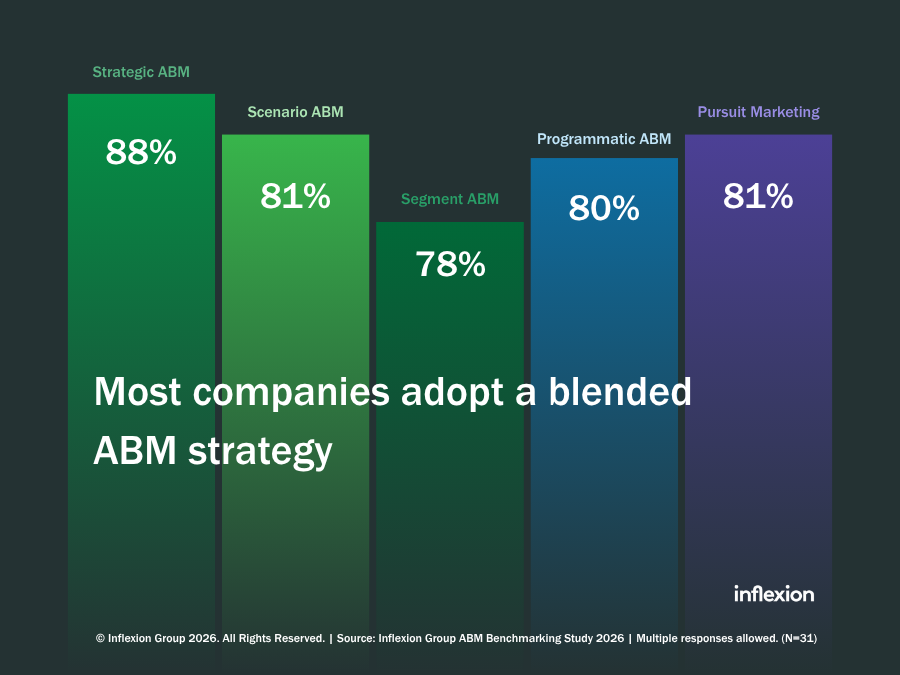
Our 2026 ABM Benchmarking Study shows what that looks like on the ground. Investment is holding up, with 96% of programmes reporting the same or greater headcount. But operating models vary widely. More than half of ABM-ers now hold blended field roles. In our new CMO interview series, I’ve been asking marketing leaders how their functions are transforming and how they manage the change around it. None of them describes a project with an end date.
As I wrote last month, this isn’t a single change programme. It’s a continuous one, and most of us are running it while still hitting our numbers. So the question shifts from ‘how do I get through this?’ to ‘how do I work well in a state of permanent flux?’
Know your own change profile
I’ve always loved Spencer Johnson’s little book Who Moved My Cheese? Four characters live in a maze and find their cheese every day at the same station, until one day it’s gone. Each responds differently, and I suspect most of us will recognise ourselves, and our stakeholders, in at least one of them.
- Sniff notices early. Sniff sees the cheese supply dwindling before it runs out and is already looking for the next source. In ABM terms, this is the practitioner who is reading the benchmark data, exploring best practices, experimenting with AI agents and spotting shifts in how customers are buying.
- Scurry acts fast. Scurry doesn’t overthink it and simply heads off into the maze. This is the ABM-er who pilots first and refines later. Energy and momentum are real strengths, as long as there’s direction behind them.
- Hem resists. Hem is convinced the cheese will come back and is angry that it was moved at all. We all have a bit of Hem in us when a familiar way of working, a trusted tool or even a job title disappears.
- Haw adapts, eventually. Haw is frightened at first, but chooses to move, and learns along the way. Haw’s journey is the most useful one, because it shows us that fear of change is usually worse than the change itself.
None of these profiles is fixed, and none is ‘wrong’. You might be a Sniff about AI and a Hem about a restructure. The point is to know your default, so you can catch it early. A few questions you could ask yourself are:
- When a big change is announced, is my first reaction curiosity, action, resistance or worry?
- Which recent change have I been slowest to accept, and why?
- Who in my team has a very different change profile from mine, and how could we help each other?
One criticism of the book is that it encourages people to accept whatever change is handed to them. I’d put it differently. Knowing your profile is only the starting point. The real move is deciding which cheese you want to go after, which I’ll come back to in a moment.
Stay resilient and keep perspective
Continuous change is tiring, and resilience isn’t something you either have or don’t. It’s something you build and maintain, like any other capability.
When I lost my husband, I learned how much the basics matter. My friends and family, sleeping well, eating well and getting outside in nature all helped me keep perspective and see my feelings in a wider context. And counselling helped too.
The same foundations hold for the much smaller upheavals of working life:
- Your people. Friends and family keep you grounded. At work, a peer network does the same job: people who are dealing with the same changes and can tell you honestly what’s working. That’s a big part of why our quarterly ABM Leadership Forum and the ABM Academy alumni network exist.
- Sleep, food and fresh air. They’re unglamorous, but they’re the first things to go when the pressure is on, and the first things that restore your judgement.
- Perspective. Step back and ask how much this change will matter in a year’s time. Most of the things that feel seismic in the moment turn out to be one chapter, not the whole story.
- Asking for help. Counselling, coaching and mentoring aren’t a last resort or a sign of weakness. They’re what effective people use to keep performing well.
Resilience doesn’t mean being positive all the time. It means having enough in the tank to notice how you’re responding, and choosing what to do next.
Take control of your destiny
The best antidote to feeling that change is happening to you is to decide where you want to be, and then work towards it. In a transforming marketing world, that starts with two questions: what will the role I want look like in two or three years’ time, and how far am I from it today?
The role of the ABM-er is changing fast. The competencies I set out in ‘Account-Based Marketing’ (Burgess, Kogan Page, 2025) still cover the technical core of the job: creating actionable insight, designing marketing strategy, developing key messages, planning and activating campaigns, and managing performance. But we’ve updated our framework to reflect where the role is heading, with AI and martech now running through the technical skills, and AI literacy sitting alongside collaboration, commercial acumen, stakeholder management and workstyle as a core soft skill.
A good starter for ten to find out where you are today is our free ABM competency assessment. It takes you through 40 behaviours across those ten areas, asking you to rate yourself from beginner to expert. You’ll be able to baseline your skills against your peers, see where your strengths lie and identify the areas you most want to develop. It then asks you the questions that turn reflection into action:
- What are your top three competencies or skills?
- Which one would you most like to develop?
- What actions can you take to develop it?
- What help do you need from your manager and colleagues?
- When will you review your progress?
It’s worth sharing your results with your manager, or asking a colleague to rate you too. The gap between how we see ourselves and how others see us is often where the most useful insight sits.
Once you know where you want to focus, the ABM Academy learning pathway shows how our courses build from foundations to advanced practice, to support you as you develop.
In the book, Haw eventually writes his lessons on the walls of the maze for others to follow. The cheese will keep moving. The ABM-ers who thrive will be the ones who know how they respond to change, look after themselves along the way, and choose where they’re heading next.
Read September’s ABM-er article – From programme to principle: where ABM goes next.