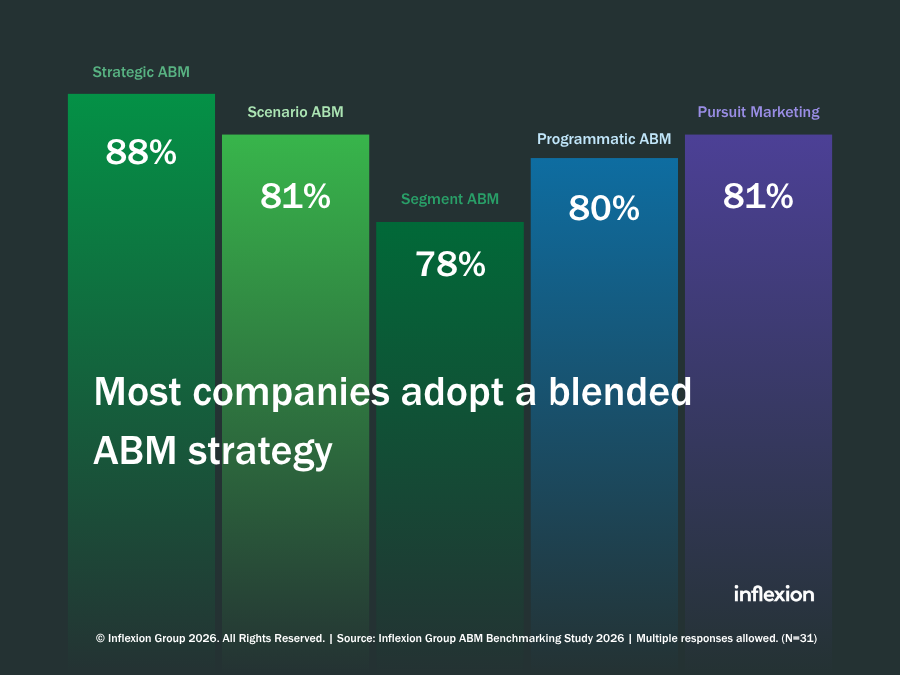
In our recent benchmark research among complex, global organisations we found that most companies have a blended ABM strategy. This reflects the maturity of many of these programmes and the fact that they are focused on building relationships to drive growth with existing customers. And despite a growing appetite to scale ABM combined with continued pressure on marketing budgets, these companies remain focused primarily on the most resource intensive types of ABM.

Cluster or Segment ABM
If we take a closer look at the types of ABM being used today, Cluster or Segment ABM is the most widely used with a huge 94% of respondents using this type. This is where an ABM-er builds and executes a marketing plan for a small group of accounts, usually 5-15, who share a similar context, issues or priorities, building a plan so that key stakeholders in each account feel like you are focused on them. The majority use this type of ABM for existing customers, but a significant number use it to target new prospects as part of their clusters.
This type of ABM is usually industry-led, with a strategic account often shaping the campaign for the cluster. The number of accounts in a cluster varies as does the execution approach. ‘Our 1-few model is usually for 10-12 accounts — never more than 15 — and usually around industry clusters. We build a plan for 1-1 primarily and then execute across the others,’ confirmed an ABM programme leader. While another said, ‘We have 7 clusters of 1-few (different ABM managers), where a grandfather account shapes the campaign for the cluster.’
Strategic ABM
Next comes Strategic ABM, with 84% of respondents deploying this more intensive type of ABM. This is where an ABM-er acts as a CMO, working closely with the account team to create and execute a marketing plan for just one account. This type of ABM is mostly used to drive growth with existing customers and the ABM-er creates highly customised or bespoke content.
Strategic ABM Lite (Scenario ABM)
A lighter version of this strategic approach comes next, with 77% of respondents using Strategic ABM Lite. We have found that companies are finding this lighter approach useful when trying to scale their programme. Here an ABM-er works with a small number of accounts, usually between 2-5, and builds a marketing plan for each one. This version of Strategic ABM usually relies on a more limited range of proven tactics or is focused on driving pre-defined, specific outcomes. In her recent blog, Bev Burgess called this emerging approach Scenario ABM. (The continuing evolution of ABM – Inflexion Group)
Pursuit or Deal-Based Marketing
The fourth type of ABM being used extensively by our research respondents is deal-based marketing (DBM), or pursuit marketing. DBM, where an ABM-er executes a marketing plan for a specific opportunity or deal is being used by 68% of respondents.
Programmatic ABM
The final type of ABM used as companies blend their approach is Programmatic ABM, with 48% of our respondents executing this type. A more technology driven approach, here an ABM-er builds and executes a marketing plan for a group of accounts based on their ideal customer profile and interest in specific topics or solutions.
As ABM turns 21 this year, one thing is clear: it continues to evolve and ABM-ers are getting creative with their blended strategies to cover more accounts. Watch this space!
Highlights from our full ABM benchmarking survey can be found here: http://bit.ly/3YhzJBX