Once you’ve agreed how your company can respond to the customer’s priorities, the next job is to set aligned objectives for your marketing campaign. Aligned objectives keep every part of the account team pointed at the same outcome, in language sales and the wider business will recognise as their own – and they stop marketing’s contribution being judged on revenue alone.
What is it and why do you need it?
In our previous toolkit article on crafting a messaging house, we looked at how to bring your brand promise and the customer’s priorities together into a single, agreed story. Setting aligned objectives is how you turn that story into a campaign plan: a set of SMART targets, agreed with the account team, that everyone can plan, resource and be measured against.
Aligned objectives matter because ABM is a team sport, played out across sales, marketing and often several business units at once. Without a shared set of objectives, tied explicitly to the business ambition and sales objectives already agreed for the account, it is easy for individual functions or regions to pursue their own version of success – some chasing awareness, others revenue – without the effort ever adding up to what the account plan actually needs.
Setting objectives this way also protects marketing’s contribution from being reduced to a single, often lagging, revenue figure. By working across relationships, reputation and revenue, you can show the value marketing is building throughout the buying journey, not just at the point a deal closes.
How do you use it?
Start your campaign plan by creating some SMART objectives (specific, measurable, achievable, relevant and time bound), which are aligned to the business ambition and sales objectives agreed for the account. Most ABM-ers create objectives and associated metrics in the three categories of relationships, reputation and revenue, as shown below.
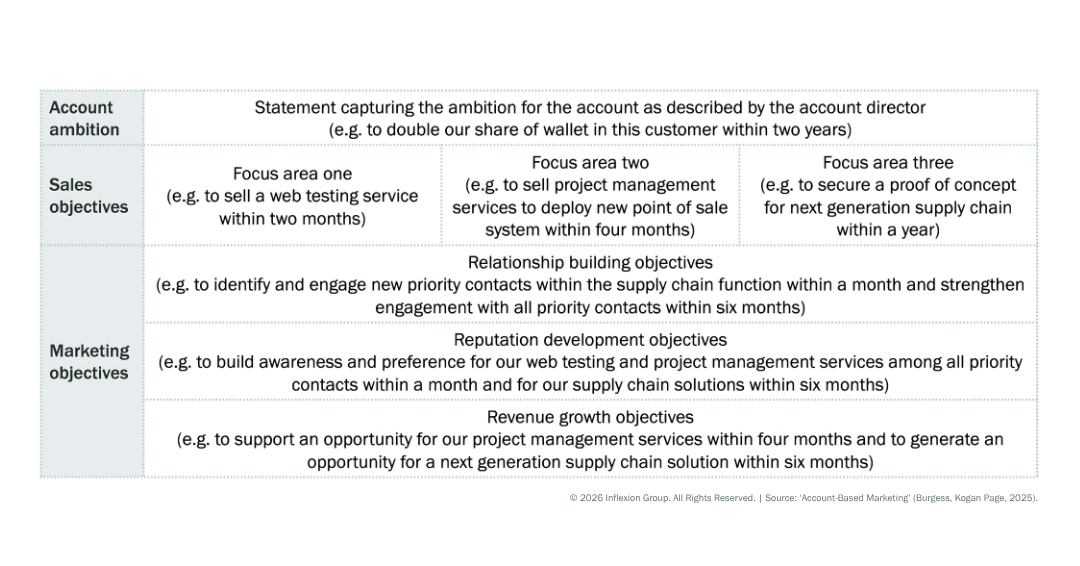
In the relationship space, as part of the integrated account team, marketing activities can help to build contacts and start conversations with new parts of the customer’s business or with more senior executives for example, deepening those relationships with valuable content and experiences along the buying journey.
Reputation is a core area for marketing to influence (brand building is one of the most significant contributions marketing makes to increase the value of any business), increasing awareness of your company and what else it could do for a customer, showcasing the value already delivered to the account to build advocates, and generally building a customer’s preference for your company over any other are core objectives.
Marketing’s influence over revenue growth is less direct, and as such, outcomes in this area often lag improvements in relationships and reputation, which are more directly impacted by marketing activities. As part of the overall team, marketing can identify opportunities and support them as they move through the sales cycle, sometimes accelerating that cycle and improving your win rates to reduce the cost of sales.
Using AI to help
AI can help you move faster from agreed focus areas to a working set of SMART objectives. Feed it the business ambition and sales objectives already agreed for the account, and the marketing focus areas agreed and described in your messaging house, then ask it to draft candidate objectives and metrics across the relationships, reputation and revenue categories. This is a quick way to surface options and check nothing important has been missed
It is also a useful stress-test. Ask it to challenge each objective against the SMART criteria, flag anything too vague to measure or too disconnected from the account’s actual priorities, and suggest realistic targets based on metrics you already track. As with any AI-generated content, treat the output as a starting point for discussion with the account team, not the finished objectives themselves – their judgement about what is realistic and what matters to this account is what will make the objectives stick. As always, handle any customer or account information you feed into AI tools ethically and in line with your company’s data and privacy guidelines.
Find out more about crafting a messaging house in Strategic ABM in ‘Account-Based Marketing’ (Burgess, Kogan Page, 2025) introduced here, or explore our Strategic ABM course available through the ABM Academy.