Once you understand your key stakeholders, the next challenge is deciding what to say to them and making sure the whole account team says it the same way. A messaging house brings your brand promise and the customer’s priorities together into a single, structured story, with clear propositions beneath it that everyone can use with confidence.
What is it and why do you need it?
In our previous toolkit article on building a stakeholder profile, we looked at how to gather the insight you need to engage each priority contact in your ABM account in a way that is relevant, credible, and likely to resonate.
Building targeted messages for the individuals and audience segments that matter once you have a good understanding of them is key to positioning yourself correctly in the mind of the customer. Many successful ABM-ers start by crafting an overarching story or proposition for the account in collaboration with the account team; what do we want to be famous for in three years’ time? Some even build a bespoke visual identity, combining elements of their own brand with that of the customer’s and creating a strapline that summarises their overarching proposition. Individual big bet themes or solution propositions may sit beneath this topline message, communicating the value you will deliver in terms the customer will understand and care about.
A messaging house matters because it forces discipline. Rather than each business unit or region developing its own take on the account, everyone works from the same foundation: a shared promise, a shared story, and a clear line of sight between the topline promise and the specific propositions being pitched to individual stakeholders. This is particularly valuable in global or matrixed accounts, where several people from your organisation may be engaging different parts of the customer at the same time. With a messaging house in place, they can do so consistently, without needing to constantly check in with each other.
How do you use it?
Start by bringing the account team together to agree the topline promise: what you want the customer to believe about you in three years’ time, expressed in a way that reflects both your brand and theirs. Some teams develop this into a bespoke visual identity or account logo that blends the two brands, with a strapline capturing the promise in a single line. Beneath this sits a small number of big bet themes or propositions, each addressing a priority issue for the customer and grounded in the stakeholder profiles you have already built, so that the language resonates with the people who matter most.
This messaging house can be a unifying force, especially for global account teams, ensuring that everyone shows up consistently with the same message for the customer around the world. We use the template shown below.
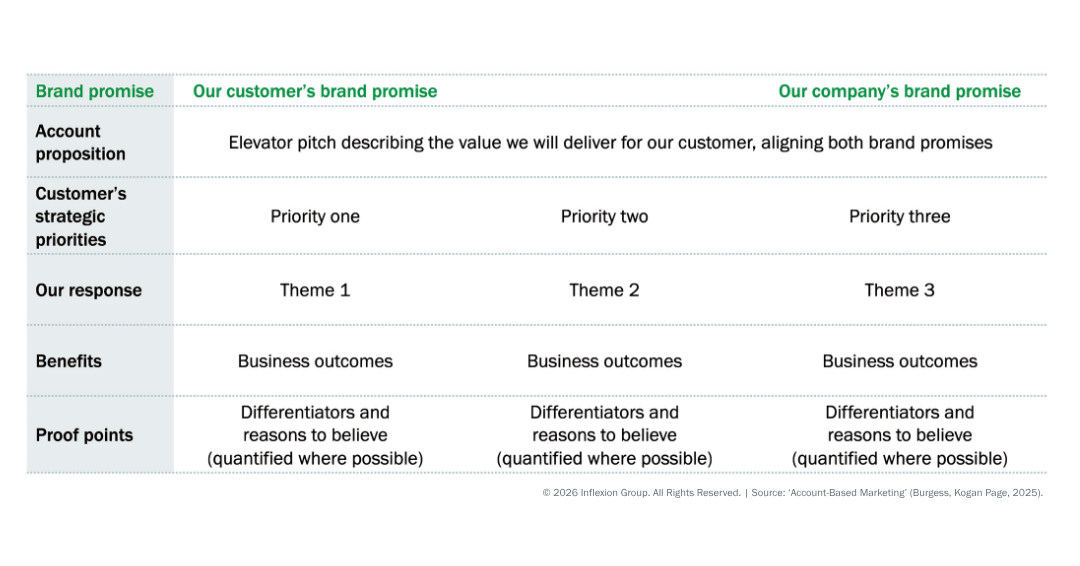
As well as the individual propositions or theme areas. The messaging house forces you to express the business outcomes the customer will get from engaging in each area, which link back to their priorities and the KPIs they’re being measured on. Finally, it demands you back up your story with proof points and differentiators – reasons why the customer should believe you. Wherever possible, these should be quantified.
Establishing this level of focus before beginning to plan your campaign to engage the customer maximises your chances of success and keeps everyone focused on the main objective.
Using AI to craft your messaging house
AI can help you draft and stress-test your messaging house. Feed it your own positioning materials alongside the customer’s public statements – annual reports, investor presentations, press releases, and executive interviews – and ask it to identify the themes and language the customer itself uses to describe its ambitions. This gives you a starting point for a brand promise that genuinely reflects how the customer sees itself, rather than one that only reflects how you would like to be seen.
It can also help you generate and refine options: alternative straplines, different ways of framing a big bet theme, or messaging tailored to the tone and priorities of a specific stakeholder or persona. Used this way, AI speeds up the iteration that usually happens in workshops and email threads, freeing up that time for the account team to debate and agree the version that will work best.
As with any AI-generated content, treat the output as a first draft rather than a final answer. The account team’s judgement about what will land with this customer, in this market, at this moment is what turns a well-worded proposition into one that actually resonates. As always, handle any customer information you feed into AI tools ethically and in line with your company’s data and privacy guidelines.
Find out more about crafting a messaging house in Strategic ABM in ‘Account-Based Marketing’ (Burgess, Kogan Page, 2025) introduced here, or explore our Strategic ABM course available through the ABM Academy.