Once you know who your key stakeholders are, the next step is to understand them as individuals. Building a stakeholder profile gives you the insight you need to engage each person in a way that is relevant, credible, and likely to resonate – turning a name on a list into a real relationship.
What is it and why do you need it?
In our previous toolkit article on confirming your target audience, we covered how to turn your ABM strategy into a plan for engagement: identifying the right individuals, in the right roles, with the right level of influence over the decisions that matter to you.
Knowing who your stakeholders are is only the first step. To engage them effectively, you need to understand them as individuals: their professional background and current priorities, their role in the decision-making unit, and the nature of your existing relationship with them. A stakeholder profile brings all of this together in one place, giving the account team and marketing a shared, structured view of each key individual.
Without this depth of understanding, your outreach risks being generic. With it, you can tailor your messages, choose the right channels, and time your engagement to align with what each stakeholder is thinking about right now. In ABM, relevance is everything – and relevance starts with knowledge.
How do you use it?
In your strategic accounts, you may find that there are tiers of audiences you need to understand and engage with around the issues you have identified and the solutions you can offer. For example, your priority stakeholders may be one or two people within the company’s leadership team, plus a few key individuals who work with or otherwise influence those stakeholders.
As well as key individuals within the organisation, there may also be individuals outside it who have an influence over decision-making, such as third-party advisors. It is important to profile and understand all of these key stakeholders, and your current relationship with them. We use the template shown below.
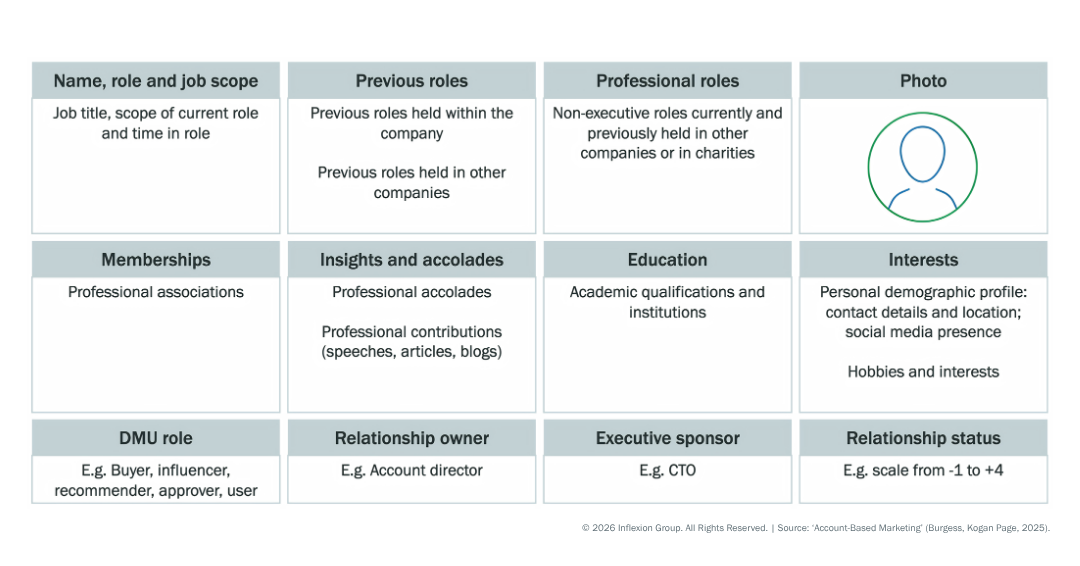
This template prompts you to capture information across several dimensions:
- Professional background – current role, scope and tenure, previous roles within the same organisation and beyond, non-executive positions, professional memberships, accolades, and contributions such as speaking engagements or published articles. This context helps you understand the lens through which a person sees their world, and the experiences and relationships that have shaped them.
- Education and interests – academic qualifications and the institutions attended, alongside hobbies and personal interests. These details can feel incidental, but they often provide the opening for a more human connection, particularly in relationship-intensive account environments.
- DMU role and relationship status – their role in the decision-making unit (buyer, influencer, recommender, approver, or user) and the current state of your relationship, rated on a scale. This ensures the profile is not just descriptive but actionable: it tells you not only who this person is, but where you stand with them and what kind of engagement is needed.
- Relationship owner and executive sponsor – noting who on the account team owns the relationship and which of your executives sponsors the engagement prevents gaps and duplication, and ensures that the right people within your organisation are connected with the right people in the account.
You might also find that everyone within a specific function, or with a similar job role across the business, has some influence on the decision. At this stage you may wish to build out buyer personas that allow you to understand this group of people without profiling them all individually. Personas are particularly useful in larger or more complex accounts where one-to-one profiling of every individual is not practical.
Using AI to build a profile
AI tools can significantly accelerate the process of building a stakeholder profile, particularly for individuals you do not yet know well. Drawing on publicly available sources – LinkedIn profiles, company websites, conference programmes, published articles, and press coverage – AI can help you quickly assemble a picture of a stakeholder’s background, areas of focus, and professional presence.
AI can also help you surface signals of a stakeholder’s current priorities: the themes they are speaking about publicly, the industry conversations they are contributing to, and any recent announcements or changes in their organisation that may be shaping their agenda. This kind of horizon-scanning is time-consuming to do manually but increasingly manageable with the right tools.
Use AI-generated insights as a starting point, not a finished view. The account team’s direct knowledge of an individual – from conversations, meetings, and shared history – remains the most valuable input. The profile should be a living document, updated as the relationship develops and as new information comes to light.
As always, handle data ethically and in line with privacy regulations and your company’s guidelines.
Find out more about confirming your target audience in Strategic ABM in ‘Account-Based Marketing’ (Burgess, Kogan Page, 2025) introduced here, or explore our Strategic ABM course available through the ABM Academy.