Once you have agreed where your company will focus in an account, the next question is who you need to reach. Confirming your target audience is the step that turns your ABM strategy into a plan for engagement: identifying the right individuals, in the right roles, with the right level of influence over the decisions that matter to you.
What is it and why do you need it?
In our previous toolkit article on responding to your account’s priorities, we covered how to connect your company’s capabilities with what the customer actually needs, shaping the focus and direction of your ABM plan. This agreed focus drives your marketing objectives and strategy for the account: what do we want to market, and to whom? How will we position ourselves in the minds of the customer? The next step is to confirm your target audiences.
Without this step, even the sharpest ABM strategy can miss its mark. It is easy to default to the contacts you already know, or to focus on whoever is most accessible rather than most influential. Taking a structured approach to mapping your target audience helps you identify gaps – people you should be engaging but are not, and relationships the account team may not have considered. It also ensures that marketing and the account team are aligned on who matters and why, before you invest in content, events, or outreach.
How do you use it?
In your strategic accounts, you may find that there are tiers of audiences you need to understand and engage with around the priorities you’ve identified and the solutions you can offer. Your key stakeholders may be one or two people within the company’s leadership team, plus a few key individuals who work with or otherwise influence those stakeholders.
We use the template below to think about the individuals and groups we need to engage. It helps structure your thinking across a few key dimensions: who are the named individuals you need to reach, what are their roles and levels of seniority, and what is their relationship to the decision you are trying to influence: are they economic buyers, technical evaluators, end users, or influencers?
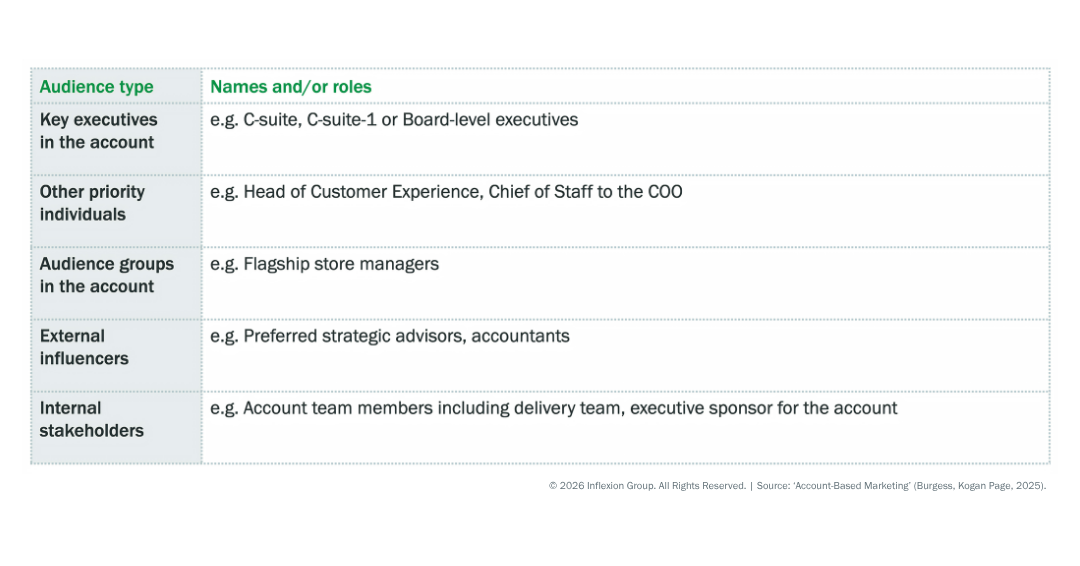
As well as key individuals within the organisation, there may also be people outside it who have an influence over decision-making, such as third-party advisors, analysts, or board-level connections. These external voices can carry significant weight and are often overlooked in account planning, so ABM-ers can add real value here.
A practical starting point is to work through the template with your account team, drawing on their knowledge of the account’s internal dynamics and decision-making structure. Where there are gaps – roles that seem important but where no contact exists – those become priorities for contact and relationship-building, and a useful input into your ABM plan.
Using AI to build your audience picture
AI tools can help you build a more complete picture of your target audience before you engage. LinkedIn and other professional networks, combined with AI-assisted research, can surface relevant individuals by role, seniority, and area of responsibility, helping you identify people you may not have on your radar. AI can also be used to analyse publicly available signals, such as conference speaking slots, published articles, or commentary on industry issues, to give you a sense of an individual’s priorities before you make contact.
As always, handle data ethically and in line with privacy regulations and your company’s guidelines. Use AI-generated insights as a starting point for the account team’s own judgement, not as a substitute for it.
Find out more about confirming your target audience in Strategic ABM in ‘Account-Based Marketing’ (Burgess, Kogan Page, 2025) introduced here, or explore our Strategic ABM course available through the ABM Academy.