Responding to your account’s priorities is where insight becomes strategy. This is the moment your ABM work starts to connect your company’s capabilities with what the customer actually needs, and where the focus and direction of your ABM plan begins to take shape.
What is it and why do you need it?
Deciding where to focus your ABM efforts in an account can be tricky. You are working at the intersection of what the customer wants to achieve and what your company wants to sell, and everyone on the account team is likely to have a view on where the focus should be.
This phase of the ABM process involves collaborating closely with the account team to prioritise which of the issues facing the account – uncovered during your insight phase – your company wants to focus on. Where do you have capabilities that could help, either in-house or across your own ecosystem of partners and suppliers?
When this step is skipped or done quickly, ABM programmes can end up promoting solutions the account doesn’t recognise as relevant to its most pressing priorities. Campaigns miss the mark, the account team loses confidence in marketing’s value, and the opportunity to position your company as a genuine partner rather than just another vendor, is lost. Taking the time to do this well is what separates ABM that delivers outcomes from ABM that simply generates activity.
How do you use it?
In our previous toolkit article on confirming your account’s priorities, we covered how to validate the account’s key issues and resulting business priorities with the account team. Now we turn to the next step: deciding how your company responds.
We use the template below to link the environmental and market factors shaping your customer’s world with their resulting priorities as a business and their performance to date. The next step is to decide on how you could help – where you’re able to respond with a solution for the customer, as illustrated here for a retail account.
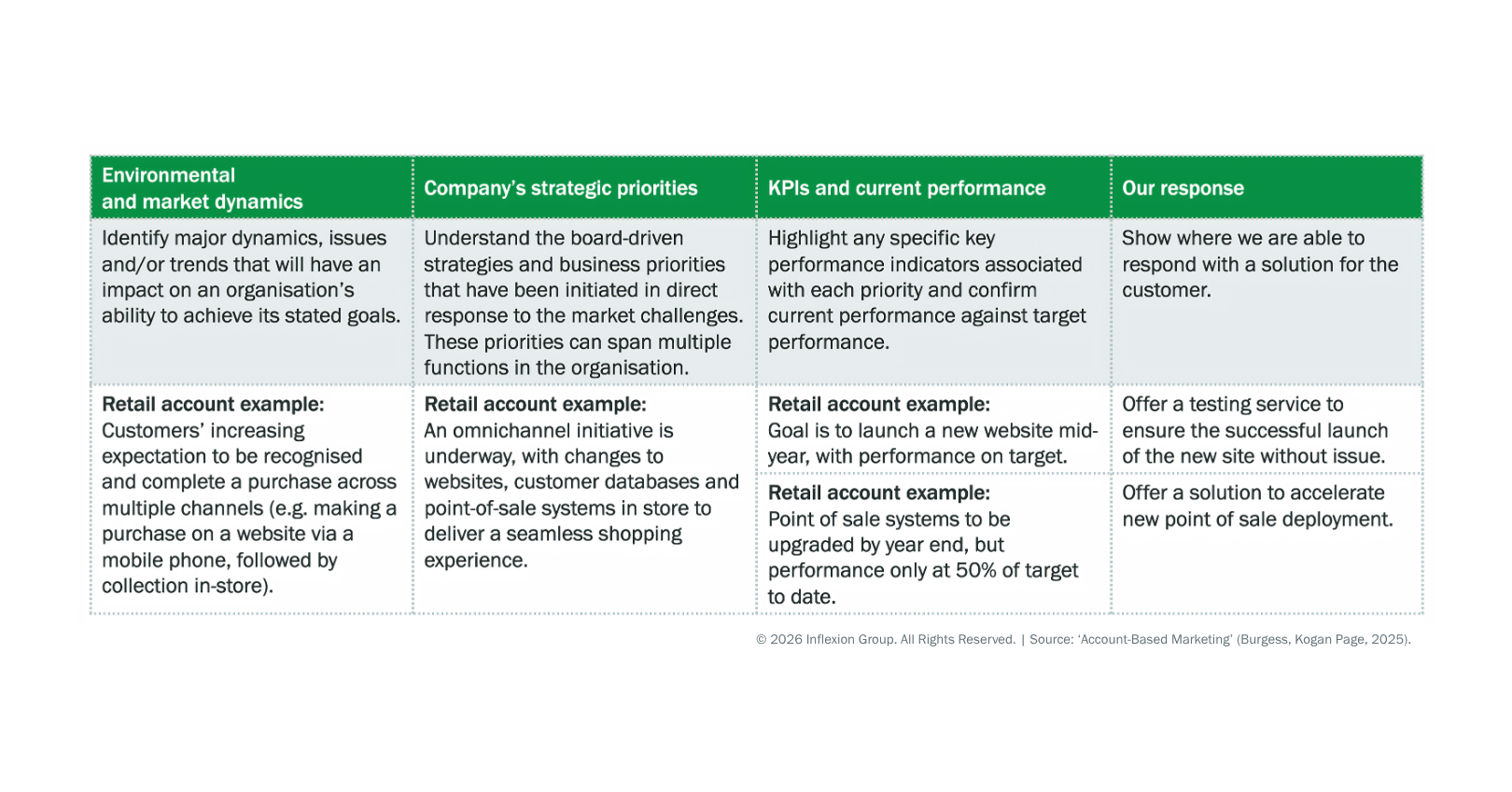
Working through this template with your account team, column by column, is a powerful exercise. For each of the account’s identified priorities, you are asking: do we have something that could genuinely help here? This might be a product, a service, access to your partner ecosystem, or even a relevant point of view or piece of thought leadership. The goal is not to map every capability onto every priority – it is to find the most credible and compelling intersections.
Of course, if you have a broad portfolio or partner ecosystem, you may be able to support many of the customer’s priorities. In that case, the question becomes where to focus and how to phase your response. A useful discipline is to ask: where can we make the greatest difference to this account, and where are we most credibly differentiated from competitors already in the account? Trying to cover too much ground dilutes your impact and makes it harder to build a coherent story for the account.
A SWOT analysis can help you identify your best opportunities in the context of your relative strengths and weaknesses compared to your competitors in the account. Used at this stage, it is less about a generic company-level view and more about your specific position with this customer: where you are trusted, where you are under-represented, and where competitors are vulnerable. This makes your response more targeted and more likely to resonate with the buying group.
This agreed focus will then drive your marketing objectives and strategy for the account: what do we want to market, and to whom? And how will we position ourselves in the minds of the customer’s buying group?
Using AI to sharpen your response
AI tools can add real value at this stage. Large language models can be used to rapidly cross-reference an account’s stated priorities – drawn from your insight pack – against your company’s portfolio of solutions and published thought leadership versus that of your competitors, surfacing potential areas of fit that might otherwise be missed.
As always, handle data ethically and securely, complying with privacy laws and your company’s guidelines. And treat the output as a starting point, not a final answer. Ultimately, the judgment about where to focus, and why, needs to come from people who know the account.
Find out more about responding to account priorities in Strategic ABM in ‘Account-Based Marketing’ (Burgess, Kogan Page, 2025), which you can read about on our article introducing the book. Or explore our Strategic ABM course available through the ABM Academy.