Executive engagement is often reduced to an occasional dinner or a courtesy call before a renewal, but for your strategic accounts, that’s trust left on the table. A well-built executive engagement plan turns ad hoc access to your most senior contacts into a deliberate, orchestrated sequence of touchpoints, one that builds credibility long before there’s a deal to close, and keeps it long after.
What is it and why do you need it?
Over the past few years, executives have increasingly been involved in buying decisions. In most complex purchases where some form of business change is involved, particularly leveraging technology, a wider group of executives takes part in the decision-making unit, beyond the traditional IT, finance and procurement domains and into the leaders of business units or other functions.
Engaging with the C-Suite is therefore no longer optional for many suppliers. There are an increasing number of reasons why this is key to growth, including the shift from selling transactional products to integrated solutions, the need to open up new buying centres in a customer organisation, the need to develop loyalty and advocates in a more competitive market, and the fact that large purchases – particularly in the AI transformation area – are increasingly board level decisions.
Executive engagement is about building relationships with senior buyers in the organisations with which you want to do business, and with other senior executives who those buyers trust. It is a long-term business development strategy aimed at creating mutual value for everyone involved, and aligns beautifully with ABM, especially in strategic accounts.
Simply put, executive engagement focuses on having conversations and building relationships with your most senior clients and prospects. At its heart lies a belief that sustainable business success comes from really understanding these senior customers and collaborating with them to deliver value for both companies.
How do you use it?
A well-constructed executive engagement plan enables you to cut through the noise of the market to attract the attention and engage the interest of the executives you want to serve, to secure their permission to meet and talk about their priorities and challenges, and to shape their understanding of your organisation and the value it can offer. Ultimately, it’s about building your future business with the most senior clients in your ABM accounts.
These executives are typically responsible for defining the goals and strategy of the organisation, and for ensuring that the strategy is executed well and the goals achieved. Typically, executive engagement activities target the board of directors, executive officers and senior leaders in a company – all of whom fit this description.
For the handful of individual executives you have pulled out as key to your ABM plan, you may want to show their individual engagement journeys, ensuring that you orchestrate the touchpoints for them across your own executive sponsor meetings, conferences, roundtables, workshops or online activities. An example template is shown below.
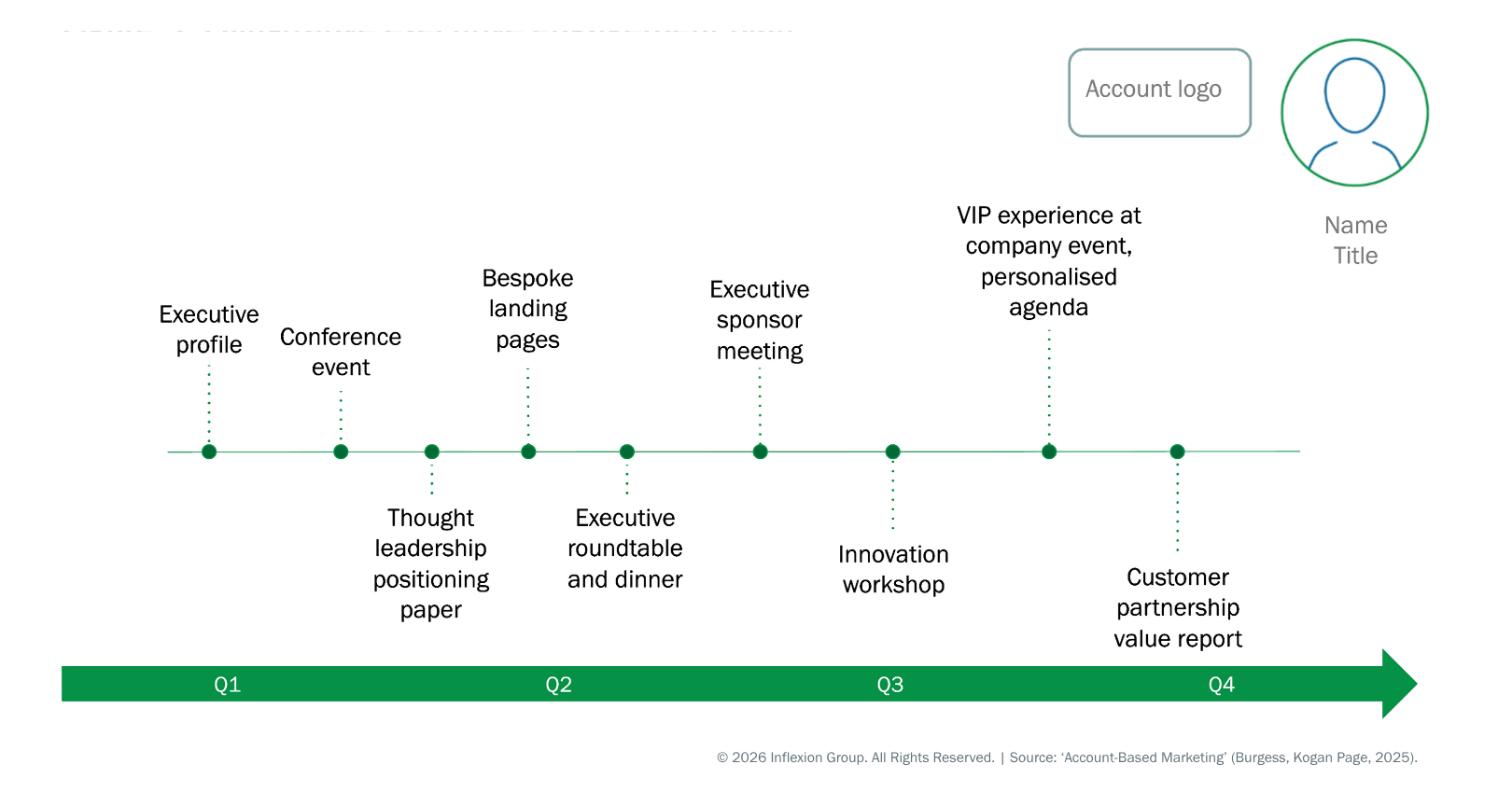
Broadly speaking, there are three main ways to engage with your top customer executives: as a peer network or community; in a smaller group; or individually. A well-orchestrated executive engagement plan will leverage all three approaches.
Engaging individual executives
Business buyers are people who buy from people, especially when they’re spending a significant amount of money. So, it makes sense that they need to trust those people before they’ll buy from them. They need some form of relationship in place.
The most straightforward individual engagement is a peer-to-peer relationship of equals, where both parties are sharing their challenges and ideas. Use your own executives as ‘sponsors’ for ABM accounts, where they invest time in building relationships with their peers in the customer rather than meet only when there’s a deal to be done or a problem to solve.
Engaging executives in small groups
Executives tend to prefer small group settings. This is hardly surprising. They get to dig deeper into their issues, ask more questions, and participate in hands-on activities to bring them to life and map out a route to solving them. They work side-by-side with their peers and your experts, with everyone benefiting. Using customer advisory boards, roundtable events and innovation workshops works well here.
Engaging networks of executives
Peer networks are powerful. Executives trust their peers to tell them the truth about suppliers and their solutions, and to share ideas, challenges and lessons learned in a way that they simply won’t do with those they don’t consider to be peers.
Collaborative research, large scale conferences and events, and new or existing communities (including alumni networks) provide the right setting to engage executives in a network.
Using AI to help
AI can help you build a first draft of your executive engagement plan quickly. Give it your account plan, your list of priority executives and details of any programmes you already have access to, such as executive sponsorship and customer advisory boards, then ask it to map an individual engagement journey for each executive and suggest orchestrated touchpoints across the individual, small group and network approaches.
It’s also useful for stress-testing what you already have planned. Ask it to flag executives with no clear owner or next touchpoint, a plan that leans too heavily on one format, or opportunities to reuse an existing programme rather than starting from scratch. As with any AI-generated content, treat the output as a starting draft for the account team and executive sponsor to refine, it’s their judgement on what will genuinely land with each executive that turns a plan into real relationships.
As always, handle any customer information you feed into AI tools ethically and in line with your company’s data and privacy guidelines.
Find out more about designing your executive engagement plan in Strategic ABM in ‘Account-Based Marketing’ (Burgess, Kogan Page, 2025) introduced here, or explore our Strategic ABM course available through the ABM Academy.
learn about building a campaign flight path in our previous toolkit article.