Once you’ve built a quantified value proposition for your buyer, the next job is to sequence how you’ll actually deliver it. A campaign flight path turns your messaging house and value proposition into a coordinated plan of activity, showing what happens when, and by whom, across every stage of the customer lifecycle (not just the pre-sales journey).
What is it and why do you need it?
Today, much of a customer’s engagement with you as they research how best to solve some of the issues they face will be done before your account team ever has a conversation with them, making your marketing content and channels even more important during the early stages of the buying process. An aligned and integrated approach to the moments that matter during their buying process is critical.
But the emphasis on customer success and successful delivery of the outcomes customers are looking for from their strategic suppliers means that ABM should not just be seen as a ‘pre-sales’ activity, but rather one that engages and delivers value to accounts throughout the customer lifecycle.
So, consider the tactics that will be useful through the customer lifecycle, from where they are unaware of you and your capabilities through to considering and evaluating you as a supplier, to adoption of your solutions and realising value from using them. Ultimately you are trying to build loyalty and advocacy among your customers, before you seek to introduce the next solution that could help them and create new value.
How do you use it?
The best way to pull together the integrated marketing, sales, executive engagement and customer success activities you will use to engage your buyers and influencers is in a campaign flight path like the one below.
Illustrative Strategic ABM flight path
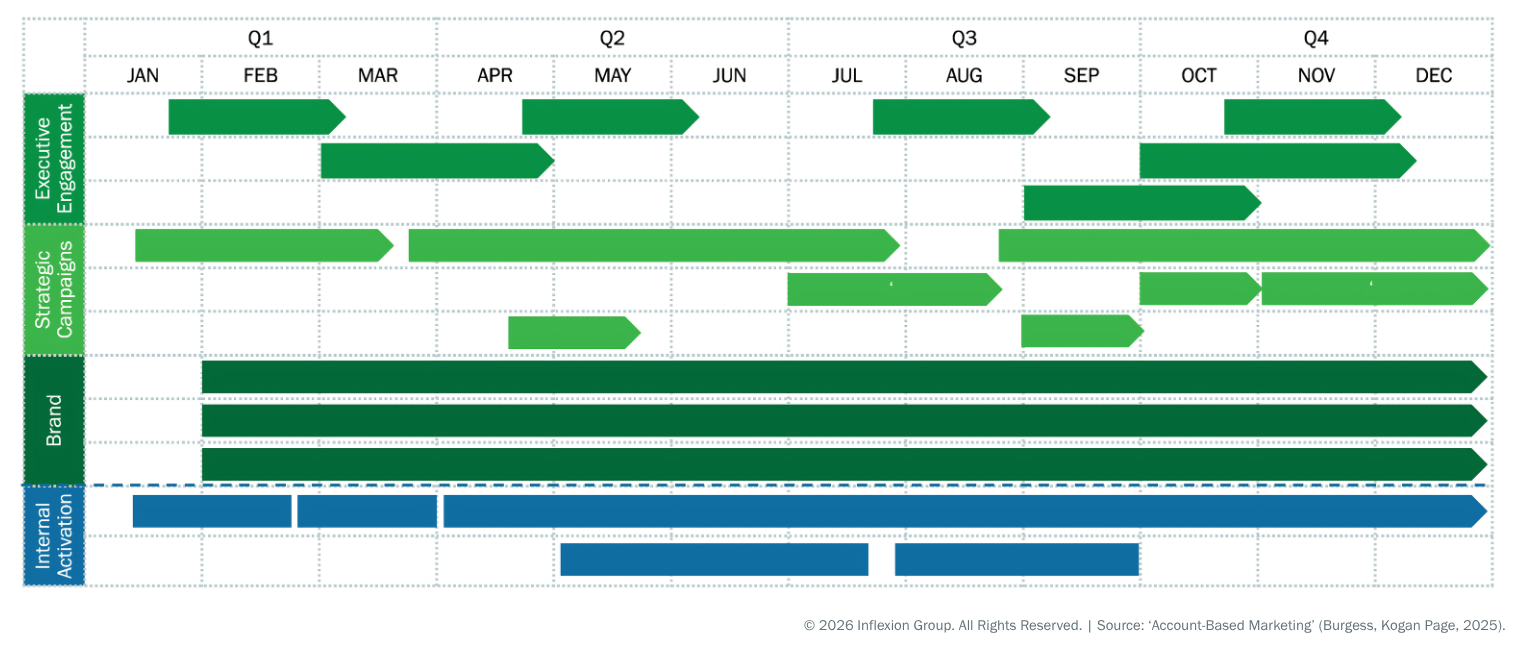
This is an easy way to visually communicate with the account team the sequence of activities you plan to use to engage the account across all customer facing touchpoints, on one slide. It often forms a part of the account business plan once agreed.
When thinking about your mix of activities, don’t start from scratch. Consider what other marketing teams are doing that you can leverage for the benefit of your account, then identify the gaps and decide what else you should create as a bespoke activity for your account.
Each stage of the customer lifecycle calls for a different mix of activity, so it helps to plan your flight path across four categories throughout.
Executive engagement
You may be able to collaborate with teams running existing activities such as executive sponsorship programmes, strategic customer advisory boards, executive hospitality options from key sponsorship agreements, VIP streams at flagship events and executive innovation centres.
Additional activities may include programme governance meetings, executive briefings, executive roundtables and other hospitality events.
Strategic campaigns
Existing campaigns such as thought leadership, industry or solution campaigns may be a great fit for your account and possible to tailor for your decision makers. You may also build bespoke campaigns to take in your bespoke value proposition.
Brand activities
Brand activities can provide useful aircover for your account and also opportunities for great experiences such as around flagship events and sponsorships.
You may need a specific focus on (re)positioning your brand in your account to ensure you are known for and considered for more than what you’ve always done for that customer – or even to recover your reputation after a service issue or crisis.
Internal activation
Internal alignment and readiness is a key pillar of any ABM campaign. In global or large accounts, for example, just getting everyone who touches the customer on message with what you’re trying to be famous for in that account is a huge win.
Strategy briefings, talking points, executive profiles, competitor battlecards, event briefings and deal workshops or pitch rehearsals are just some of the activities that might fall into this category.
Using AI to help
AI can help you pull together a first draft of your flight path quickly. Give it your account plan, value proposition, key stakeholders and any existing campaigns, brand moments or customer success milestones already scheduled for the account, then ask it to map likely activities across executive engagement, strategic campaigns, brand and internal readiness, sequenced across the customer lifecycle.
It’s also useful for finding the gaps. Ask it to flag quarters that are light on executive engagement, activity that clusters around the sale rather than spreading across the full lifecycle, or opportunities to reuse an existing campaign rather than building bespoke. As with any AI-generated content, treat the output as a starting draft for the account team to prioritise and sequence – it’s their knowledge of what’s actually deliverable, and by whom, that turns a plan into a flight path the account will use. As always, handle any customer information you feed into AI tools ethically and in line with your company’s data and privacy guidelines.
Find out more about building your campaign flight path in Strategic ABM in ‘Account-Based Marketing’ (Burgess, Kogan Page, 2025) introduced in our news article announcing The definitive handbook for B2B marketers, or explore our Strategic ABM course available through the ABM Academy.
See our previous toolkit post on crafting your value proposition.