Once you’ve set aligned objectives for your campaign plan, the next job is to build a value proposition for the buyers and buying groups you’re targeting. A strong value proposition translates your messaging house into a story that speaks directly to an individual executive’s world – their priorities, their language and, wherever possible, the financial outcomes they care about.
What is it and why do you need it?
In our previous toolkit article on setting aligned objectives, we looked at how to turn your messaging house into a campaign plan built around SMART objectives. One of the most important pieces of content you will create to bring that plan to life is a value proposition for a specific solution to an individual buyer or buying group. Professor Malcolm McDonald, who has written extensively about how to develop strong value propositions, recommends that wherever possible, your proposition should be financially quantified.
This is particularly powerful in ABM when linked to a challenger sales approach or provocation to a customer, where your understanding of the customer’s landscape is deep enough to model the likely business outcomes of your solution and help build the business case that gives them the confidence to buy.
How do you use it?
All of us make subjective judgements about value every day. It is a personal calculation of the benefits of anything we buy against the cost to purchase it. For B2B buyers, these benefits may be tangible, such as a percentage reduction in travel costs by using online collaboration tools, or intangible, such as minimising the risk of changing your telecoms supplier by staying with the incumbent. Wherever possible, if your value proposition offers tangible benefits to a client, you should try and quantify those benefits and show where other clients have received them from you in the past.
Your buyers take a broad view of costs beyond the price they actually pay for a solution. There are costs to consider about the time involved in taking on a new supplier, for example or relating to potential risks to reputation to be considered, such as if a supplier has questionable sourcing strategies or sustainability policies.
Some prompts for building a strong value proposition are shown below.
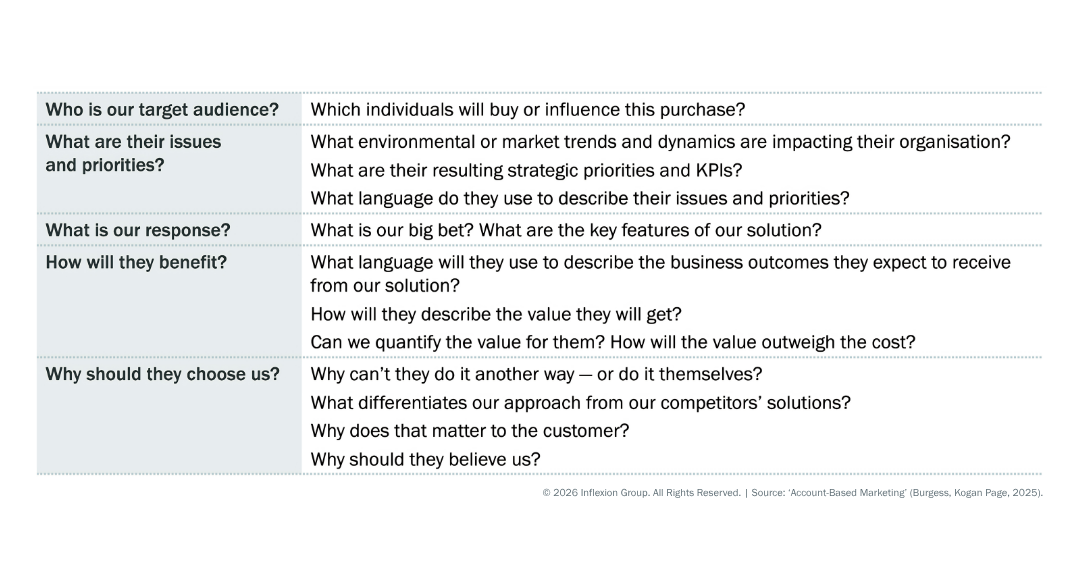
Crafting the value proposition is a multi-step process. First, answer the questions in the table. This ensures that all the elements of a good value proposition are present.
Who is our target audience?
Many value propositions are generic, talking to ‘large enterprises’ or ‘government organisations’. This is poor even at a segment or role-based level. You should ensure that your ABM propositions are for a specific executive buyer or group of buyers. So, use language like ‘as CMO of the world’s largest bank’, or ‘as the management team tasked with transforming the way your people work’.
What are their issues and priorities?
Once you’ve identified them, connect with them by showing that you understand their main priority. And again, use the language they would use themselves, not your own.
By including a statement about their priorities, you are demonstrating your understanding of their situation. In addition, by using the language that they are using about their problems (perhaps in their statements to shareholders, for example), you are starting to build a rapport with these executives, so don’t talk about cutting operational costs if they are talking about driving efficiencies in operations, for example.
What is our response?
Having identified who you are talking to and what matters to them, state plainly what you are proposing to do about it. This is a single, clear description of your solution or offer, written in the language the executive would recognise, not your own internal product names or category jargon. Keep it high level at this stage – the specifics belong in the benefits and differentiation that follow – but be precise about what is actually on the table, whether that’s a technology, a service, a partnership, or some combination of the three.
How will they benefit?
This step is about describing the benefits that your offer, or solution, will give the executive. It shouldn’t be a description of your solution comprising a list of features, but a summary of the business outcomes you’ll provide, written in their language. The key here is to understand how they are measured and how they define success, linking the benefits you are offering with those things.
The more you can quantify the value of the tangible benefits on offer, the greater the interest generated. People like to see numbers – credible, hard numbers. However, even relative or qualitative numbers (e.g., improved efficiency and higher satisfaction), if backed up with proof, are acceptable. It is better not to use adjectives but to use stories that demonstrate your claims. Value propositions should be underpinned with real-life testimonials, success stories, and references.
Why should they choose us?
To be successful, your value proposition must explain why your solutions are superior to your competitors’. What makes your offer unique? Most marketers find this question hard to answer. In many cases an inside-out focus is to blame. You need to start with the account or executive’s point of view and examine what your competitors are saying to them in order to focus on the things you know are important to them where you have a distinct advantage.
Review competitor materials to help you identify and prioritise your differentiators and build a case as to why the client should work with you and not them. What do they offer in the same area as you? What are their value propositions? What assets do they have in terms of client references, intellectual property or subject matter experts? What do they claim to be their key differentiators? Where are you stronger?
Don’t forget to leverage case studies and other proof points to give them reasons to believe you are the best choice.
Using AI to help
AI can help you build financially-grounded value propositions faster. Feed it what you know about the buyer or buying group – their priorities, how they’re measured, and any public statements about their goals – alongside details of your solution and relevant case studies, then ask it to draft candidate propositions across each element of the framework: audience, priorities, response, benefits and differentiation.
It’s also useful for stress-testing what you already have. Ask it to check whether your language matches the customer’s own, flag any benefits that read as features rather than outcomes, or challenge whether your differentiators would actually stand out to this specific buyer. As with any AI-generated content, treat the output as a starting point for the account team to refine, not the finished proposition – it’s their judgement about what will resonate with this executive that makes a value proposition land. As always, handle any customer information you feed into AI tools ethically and in line with your company’s data and privacy guidelines.
Find out more about crafting your value proposition in Strategic ABM in ‘Account-Based Marketing’ (Burgess, Kogan Page, 2025) introduced here, or explore our Strategic ABM course available through the ABM Academy.
Read our last toolkit article on setting aligned objectives.