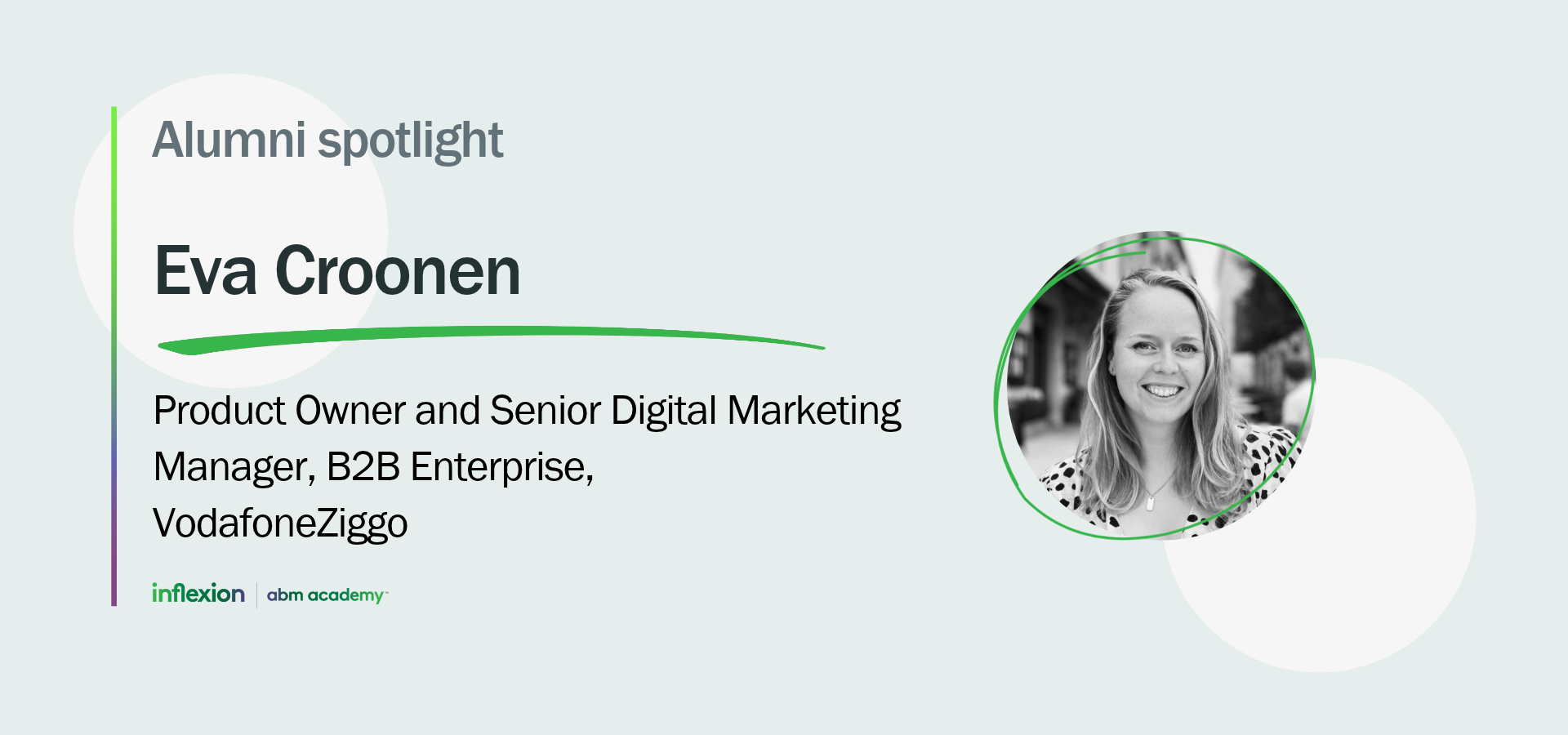
Eva Croonen is Product Owner and Senior Digital Marketing Manager, B2B Enterprise at VodafoneZiggo, where she works within a well-established ABM programme. Unlike many in the field, her route into ABM was entirely intentional, starting at a Silicon Valley tech company before she brought her experience to the Netherlands. Along the way she has made a habit of getting close to customers herself, and has built her practice on rigorous, data-driven account selection. We asked her to share what that journey has looked like, and what she has learned along the way.
Interview
You’re at a dinner party and someone asks what you do – how do you explain ABM?
I explain it as sales and marketing working together around the accounts that matter most. Rather than broadcasting to everyone, we focus on fewer accounts and take the time to understand what each customer needs and where we can genuinely help.
How did you get into ABM? Was it intentional or by accident?
Completely intentional. At a tech company in Silicon Valley, I saw how much more effective it was to focus on fewer accounts in real depth. When I joined VodafoneZiggo, a programme was just getting underway, so I immediately volunteered.
What’s the biggest risk you’ve taken in your ABM career, and did it pay off?
Running customer interviews myself. It meant asking sales to trust me with their relationships, with no guarantee of what I’d hear. It paid off: far richer insight than second-hand feedback, and real credibility with customers and sales alike.
What was your ‘lightbulb moment’ during the Academy course?
The account selection process. I hadn’t appreciated how detailed and data-driven it could be. The Inflexion approach showed me that selection is a discipline in its own right, and it sets up everything that follows.
What’s in your ABM toolkit that you couldn’t live without, and what’s the most overrated thing everyone raves about?
Can’t live without: account selection templates and simple dashboarding. They keep selection objective and show at a glance how each account is progressing.
Most overrated: elaborate reporting platforms and over-reliance on intent data. Neither replaces actually understanding the customer.
Fast-forward five years – what does success look like for you?
Doubling the number of ABM leads across the business, so the approach reaches more of our key accounts. I’d also love to see our customer advocacy programme grow, with more customers championing what we’ve achieved together.
If you could give aspiring ABM-ers one piece of advice, what would it be?
Build trust with your sales team first. ABM only works when sales and marketing truly work together, and that starts with sales trusting you with their accounts. Once that trust is there, the joint wins follow.
Final thoughts
Eva’s story is a reminder that ABM is, at its heart, a partnership. From stepping in front of customers to run interviews herself, to the careful, data-driven way she selects accounts, her approach is grounded in getting close to the customer and earning the trust of sales along the way. Her advice to build that trust first, and win together second, is a thread that runs through the whole conversation.
Want to see how Eva’s experience compares with the wider market? Explore our 2026 ABM Benchmarking Study, or hear how experienced practitioners run ABM at scale in our ABM Programme Leaders interview series.
Ready to start your own ABM journey? Get in touch with us or explore our ABM Academy courses to find the programme that’s right for you.
Read our previous Alumni Spotlight where we chatted to Natalie Rowe, Programme Lead at PwC.