Three decades at Accenture. Global responsibility for ABM and Pursuit Marketing. A consulting career spent leading clients through some of the most complex transformations. Stephanie Winters McConnell has seen what works – and what doesn’t from every angle.
This month’s edition continues a theme I keep returning to: that account-based thinking is now at the heart of B2B marketing transformation and, increasingly, of go-to-market strategy more broadly. I’ve seen this play out in my research and client work across sectors and geographies, including in one of the most complex global ABM change programmes I’ve ever been part of which Stephanie helped lead from the inside.
Stephanie Winters McConnell is one of the ABM and Pursuit Marketing leaders I respect most in the world. As a managing director at Accenture, she led both functions globally, while earlier in her career she was a consultant helping major clients navigate significant commercial and organisational change. She’s a practitioner in the truest sense: someone who has done this work, at scale, over the long term.
I’m sharing our interview in full this month. Stephanie’s perspectives on the convergence of ABM and Pursuit Marketing, on leading teams through AI adoption, on operating models and sales-marketing alignment, are grounded, honest and genuinely useful.
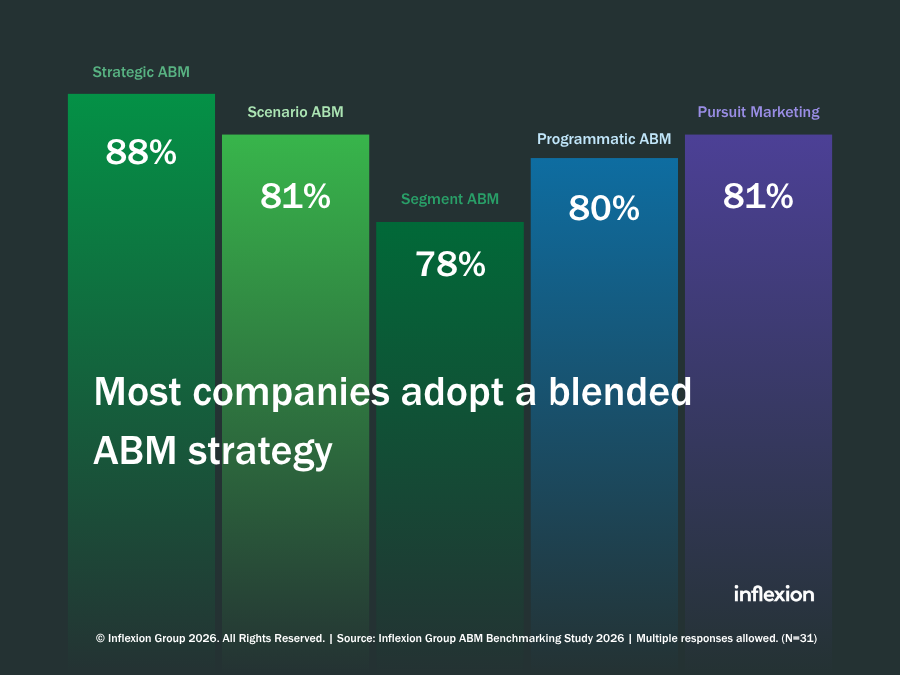
Our research shows some convergence between ABM and Pursuit-based marketing. From your experience, how do these two functions come together to redefine the customer experience at an account?
It’s easy to think about interacting with the customer in discrete phases: build awareness, deepen relationships, sell products and services, deliver that service, and start all over again. The challenge with that model is it implies a sequential approach that doesn’t reflect the different ways clients engage and purchase.
The lines between traditional account and pursuit-based marketing are blurring to reflect this shift. Marketing teams are expanding beyond their traditional scope of responsibilities to collaborate and create more meaningful and approaches to engage and bring value to the client.
Rather than pursuit-based marketers joining an account when a sales opportunity is “real” and fully qualified, they come in earlier to deepen a clients’ understanding of capabilities and services, create messages and a storyline that sets the foundation for the upcoming sale, help the client envision the future, and work hand-in-hand with the ABM Lead to keep the deal sole sourced. And, when the opportunity closes, the pursuit-based marketer doesn’t immediately move to the next deal. Instead, they stay to make sure the client understands and experiences the value that was promised during the sales phase. They work closely with the ABM Lead to define key milestones, messages and moments to reinforce value delivered.
AI is making a significant impact in how marketers approach ABM, with 70% of programmes actively using it for content creation. Behind these numbers is the challenge of bringing marketers along the AI journey. What insights do you have about leading a marketing function through this type of change?
AI fluency, familiarity and adoption is a mindset shift. While tools and technology are important, embracing AI requires new ways of thinking, believing, and behaving.
We’re wired to prove our value through “busy-ness.” We feel important and needed when we’re inundated with a lot of activities at the same time, from data analysis to campaign strategies and execution. AI gives us something we’ve never had before: the power of the pause, which can be very unsettling for many people. Research that used to take hours can now be done in minutes. Reports that typically take days to create can now be completed in hours with some smart prompts and human editing. Instead of seeing this acceleration as a threat, Marketers can embrace this level of support, use what AI produces and take those moments to think. Move from the frenetic speed of aggregating to analysing the information and critically thinking about how, when and where to apply it.
To do this, you need to invite AI to the table. Include it in everything you do, remembering that you’re in charge of it, not the other way around. We often hear about keeping humans in the loop, which sounds passive and implies that a Marketer would be the recipient of AI’s decisions. Turn that around. The Marketer is accountable and, in the lead, directing, asking, challenging, and interacting with AI.
In addition to embracing the pause and including AI in everything you do, Marketing functions need to bring everyone along on the AI journey. Painting the vision at the top is critical to help the function see the big picture and the overarching goal, all while leaning into individuals at all levels who are embracing AI, experimenting with it, learning from it, and experiencing great value from it.
As Leaders we need to stay curious, lead from the front, and embrace superusers and innovators from all levels of the organisation. In my past role, I had a few AI rockstars on my team who I would meet with regularly so they could teach me, show me, and help me expand my own AI fluency.
Ignite this enthusiasm. Find the superstars who are innovating and experimenting with AI. Embrace it and know it won’t be perfect. Celebrate the mistakes, learn from them and keep moving forward.
The 3 Rs (reputation, relationship, and revenue) are a cornerstone of measuring ABM success. As we evolve, are there other metrics or success factors you think should be taken into consideration?
I think we could consider two new Rs: Relevance and (Win) Rate.
With the proliferation of data and insights, we know more about our clients than ever before. We know their perceptions, intent, interests, and where and how they are engaging. Our challenge as Marketers is to connect the data in a way that makes our messages, content, and interactions more relevant.
Meaningful and relevant content is key to increased engagement rates, client satisfaction scores, and client perceptions of favourability. Position thought leadership, a point of view, or a roundtable discussion in a way that reflects a deep understanding of the client.
The other R I like to measure is win rate. While we often measure revenue, when Marketing is involved in sales opportunities the win rates should be higher than when an account or sales team pursues the deal on their own. Tracking win rates across the different types of deals, by size and complexity for example, is a quantitative way to measure the value marketing brings to pursuits.
Striving for both industrialisation and customisation creates dissonance for ABM-ers. What are your thoughts on how marketers can balance this in an AI world?
There’s an adage that two things can be true at once and this is a perfect example. We need both industrialisation and customisation in ABM.
Many core processes can and should be standardised and repeated across accounts. Processes that enable ABM-ers to seamlessly work across accounts, collaborate, create, analyse, and report in similar ways are all important for ease of doing business, efficiency, and effectiveness.
We need to celebrate the reuse of materials, ideas, and templates. Something as simple as a tagline or a creative asset that worked well for one account could easily be applied somewhere else. If an approach or activity worked well before or if a past project sparks a new idea, let’s use it. There’s no need to start from scratch every time.
However, reusing ideas only works if its relevant to the client – one of the new Rs I mentioned in a previous question. It’s incumbent on the marketer to make sure the context and content are tailored to what the client needs, at the right time.
I always tell my teams to unapologetically reference and reuse, so they can spend their energy and time on making it make sense for the client.
Some organisations see ABM and Pursuit Marketing as discrete skillsets and capabilities, while others have brought it together. Can you share your perspective?
ABM Leads are deep experts in the client, are part of the account leadership team and serve as the CMO of the account. They are keenly focused on increasing brand awareness, broadening share of wallet, deepening relationships, and building the sales pipeline. ABM Leads are dedicated to a discrete set of accounts and orchestrate the marketing and communications engagement across the entire account.
Pursuit-based marketers are more project-based, possess deep commercial expertise, understand the rhythm and nuances of the sales cycle, how to message and tell stories that will differentiate your organisation from the competition. Pursuit marketers typically work on the most important deals for an organisation, defined by either the sales amount, the type of sale, or even the client.
As I mentioned earlier, these two capabilities are converging in new ways, which is helping to redefine the end-to-end client experience.
Operating models and organisational structures are continuing to evolve with the need to support global/local demands. What should companies consider as they look to evolve their marketing operating models?
Many clients are global, with headquarters in one region and operations around the world. But even clients that mainly operate in one region often share similar challenges and opportunities with companies in other parts of the world.
For both account-based and pursuit-based marketers who support clients day-to-day, creating global ways of working is critical for efficiency and effectiveness. Processes, tools, agents, best practices, common templates and playbooks all help to avoid redundancy and enable teams to work seamlessly across regional boundaries.
Companies face similar challenges and opportunities, regardless of where they are located, and keeping the Marketing team connected on what’s working and what’s not helps with ongoing learning and reusability.
A client in Japan, for example, may be going through a merger and employee transition that is similar to a client in the UK. Putting systems in place that allow the Marketers to collaborate and learn from each other not only saves time but also builds team engagement.
Taking these global processes and applying them through a local lens is equally important. There are language differences, cultural nuances, and local norms and mores that are critical for relevancy and credibility. Clients want to know that we understand their business, industry, service, and local market.
Success in both ABM and pursuit-based marketing depend on new ways of working between sales and marketing. What are the keys to this success?
With the amount of data available, there are new opportunities for sales and marketing to work together to redefine the customer experience.
First, both functions must trust each other to provide actionable, real-time data and information. I’ve seen marketing misuse sales data and vice versa, which results in limited transparency and impact.
The data then needs to be brought together in a way that elicits action across the full lifecycle of an account. Where is Marketing seeing spikes in intent data, where are clients or prospects engaging with content, what ideas were discussed during meetings, or what metrics are we seeing from campaigns? On the sales side, what business challenges has the client mentioned, what solutions or assets are they most interested in, what does the pipeline of opportunities look like and what is the perception of key buyers and influencers?
Bringing this information together in a way that helps both functions gain a broader understanding of the clients’ challenges, interests and opportunities helps to tailor and target client-centric campaigns.
Additionally, marketing needs to be positioned as a business partner on the account and be empowered to shape the account strategy for growing the account portfolio.
This level of partnership, starting with trust and transparency of data and shared accountability for the success of the account will help to accelerate the impact and value both sales and marketing can bring.
Hear more from Stephanie in this article on putting the 80/20 rule into practice.