Navigating B2B marketing transformation
Inflexion Group is kicking off a CMO interview series exploring how complex, global B2B businesses and firms are transforming marketing, and especially their go-to-market models. We’re asking their advice for all marketing leaders navigating transformation today.
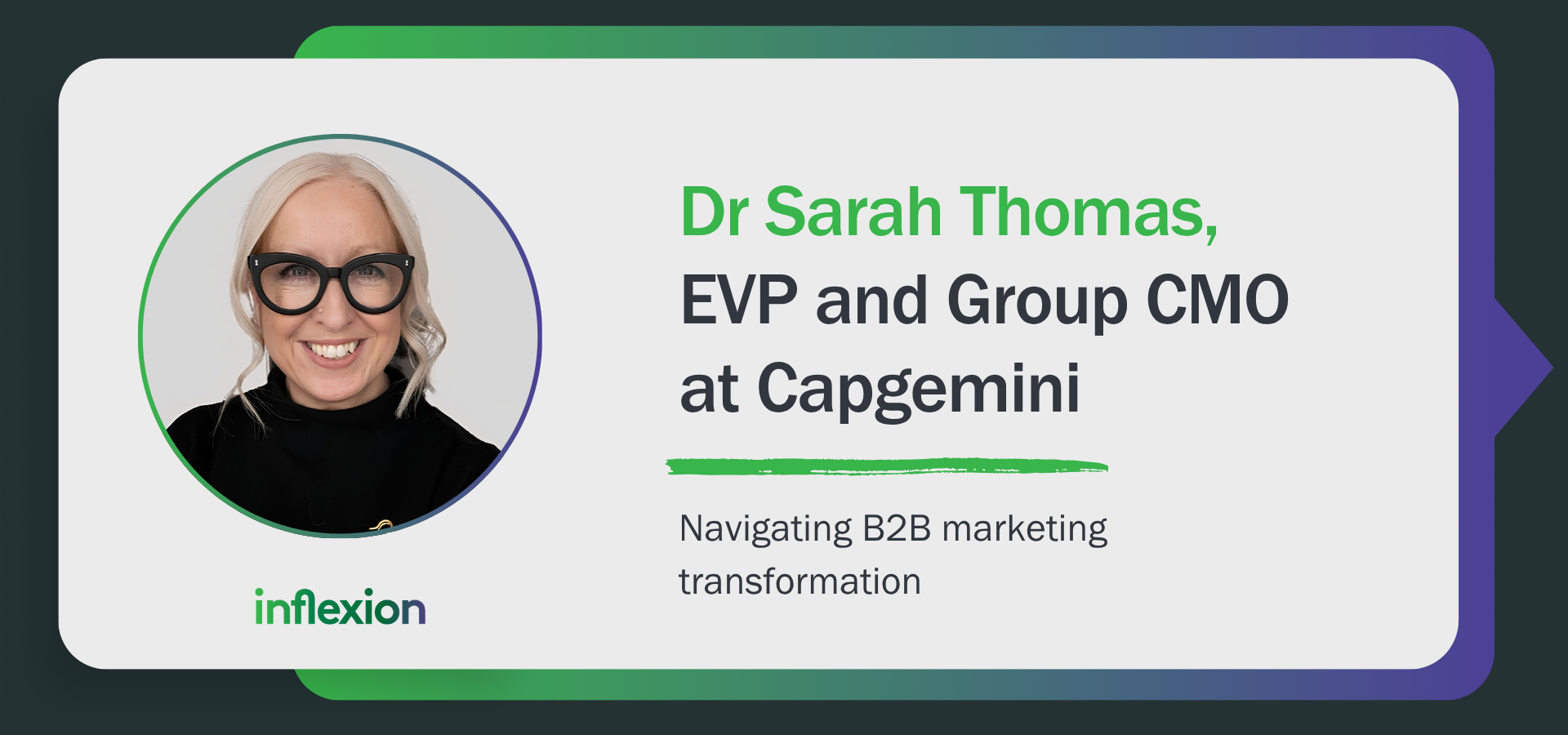
Our first interview is with Dr Sarah Thomas, EVP and Group CMO at Capgemini. Sarah joined Capgemini to drive change and transform the Marketing & Communications function and is responsible for the full marketing mix with a particular focus on driving growth, a superior client experience and relationship marketing including ABM, pursuits and client advocacy.
What’s the biggest shift you’ve seen in how your customers want to buy and what has that changed about what’s expected of you as CMO?
With the advent of AI and the ability to consolidate a large number of data sources, buyers are often making their decisions before even engaging with Sales or issuing RFPs. That means that brand positioning, client experience and ongoing relationship building and retention are more important than ever. In fact, much of the dialogue amongst my peers at Cannes Lions this year was around AI-fatigue. The reaction to that was a resurgence of what I call ‘going back to basics’, the foundations of marketing and tactics many of us were using at the start of our career. For example, in person activity, be it events, roundtables or even direct outreach campaigns that cut through the digital ‘noise’ that surrounds our target clients in the market. We can’t forget that while we want to be discoverable from an AI lens, we are still marketing to human beings not robots – for now.
So while we are using thought leadership, opinion pieces or client stories to engage with clients and running the digital campaigns we always have done, at an account level we are actively curating the client experience with personalised views and insights and in person experiences that are designed at a client or individual level. For example, co-innovation days with clients to spark new ideas on the topics they care about.
Marketing functions are changing shape with new structures, new skills, and new ways of working. What does that transformation actually look like inside your team right now, and how are you bringing people with you?
We are forming new and more agile teams across our marketing community. We’ve looked at our past structures and processes and essentially started again with a blank page to redesign how we work. At the same time, we’re driving scale – industrialisation and repeatability – with rigour around templates and standards. Despite it being deeply ingrained in our consulting DNA, we don’t want to reinvent all the time.
The mindset shift needed around something like this can’t be overestimated. This is not age or experience related, it’s character-led. We’re asking, “Are you an intellectually curious marketer. Do you see what’s coming and can you lean in? Can you fundamentally reimagine how we work? Can you imagine an AI-first way of doing things?” It’s a great opportunity to take all those day-to-day things that cause friction and frustration within teams and solve for a new, different way of working.
AI is changing how you execute marketing and how your customers evaluate suppliers, sometimes before a human is even involved. What does that actually look like inside your organisation today, and where is it still messy?
Our guiding principle for our market positioning and internal programs is that AI augments the human. If AI can better help Sales by delivering insights and data that enables them to better use their time and industry experience to shape opportunities and proposals, then we use it. The same is true in marketing. If for example, it can help our marketers work more efficiently, deliver insights that mean our campaigns are better targeted, perform better and resonate more with clients, or can identify trends that we haven’t considered, then we are embracing it. We are all very cognisant of quality and nobody wants to be serving up ‘AI-slop’ as it’s so affectionately called. For us, it still very much remains human plus AI and as marketers, we’re still the decision makers on our campaigns and programmes.
Account-based marketing used to sit with a specialist team. Is that still true for you, or is account-based thinking changing your go-to-market model? What’s driving your approach?
We are absolutely growth marketing – or relationship marketing – focused. Account-based marketing is an important part of our go-to-market model in delivering the ‘last mile’ to our clients and we really have a client-centric marketing mindset across the whole organisation. So it’s infused everywhere. We have a very focused approach across a key set of Capgemini priorities and all of our marketing programmes are aligned by industry – so they are always in context for our clients – and designed to then feed ABM programmes.
We work as a single integrated and industry-aligned client-centric team, with both global and local marketers sharing plans, best practice, ideas and expertise. We have industry-led ABM communities that ensure everyone stays connected and understands top-down what’s in the strategic industry business plan, and bottom-up what campaigns and activities are performing and resonating with clients. So yes, it’s a specialist team by way of skill set but it is integrated (global + local) and essentially embedded across the organisation.
Many marketing leaders tell us they’re being asked to prove commercial value in board-level language, while their operating models are in flux. Does this resonate with you? How are you handling it?
This has always been the case. We aren’t living in a perfect world, and we also can’t measure everything or else we’d be lost in the detail and miss the big picture. It’s about picking the priority metrics that the business cares about and ensuring you move the dial on those.
The problem marketing often has (especially in complex global organisations) is getting meaningful metrics with any rigour behind them. For example, you may not be able to definitively show how much you contributed to a sale, or the absolute ROI on a piece of collateral versus a broader campaign, depending on the tech tools available to you. How well things are tracked, how well CRM is used and sales discipline and behaviour is an ongoing focus for every organisation I have ever worked in. AI helps accelerate insights but the behaviour gap is often a human one! AI analysis of huge amounts of data definitely helps. Then the insights need to be converted from marketing speak to business impact to really show the value.
Fast forward two or three years. What does success look like for your marketing function by then, and what has to change inside the business to get there?
In my ideal scenario we’d have built a marketing growth engine and client-focused marketing programmes that are an integral part of every client account plan. If I’m not able to meet the demand from our business colleagues and they are hammering down my door asking for marketing help because they know it adds value to their business, then my job is almost done!
Success for my team means a relentless focus on showing up as a business-savvy marketer and a partner to the business with a seat at the table with the client teams. Understanding our clients and really designing campaigns and opportunities that deliver a superior and distinctive experience: content that resonates, business, industry and technology expertise that is relevant and professional relationships that mean our clients want to work with and stay with us. Inside the business or outside, it’s fundamentally about building relationships that are built on trust and value.
What’s one thing you’d tell a fellow CMO who’s trying to navigate this level of transformation?
It’s easy to get focused on the mechanics of designing your new organisation and building all the elements of your target operating model (TOM), to over complicate things and to forget the human element. Firstly, be clear on your guiding principles and the outcomes you want to drive and always challenge yourself to keep things simple. That’s an ongoing battle in a complex organisation.
Secondly, prioritise the change management workstream so that you take people on the journey with you. Don’t underestimate the effort required and make sure that you plan to address each persona including the advocates and naysayers to change, just as you would any campaign. Test your communications and put change management front and centre in your project plan.
Finally, save your energy, pick your battles and remember that any transformation is a marathon, not a sprint. It’s ok to supplement your team with specialist help as you need it, including finding a great technology, operations or finance guru who can navigate any changes that need to be managed with other parts of the business.
When you are 80% there, set your switchover date for the new model and org – and go! Get comfortable with imperfection in the short-term and continue to refine and redesign as you go while celebrating all the small and big wins along the way!
Keep an eye out for our next interview, and check out our ABM programme leader interviews in the meantime.