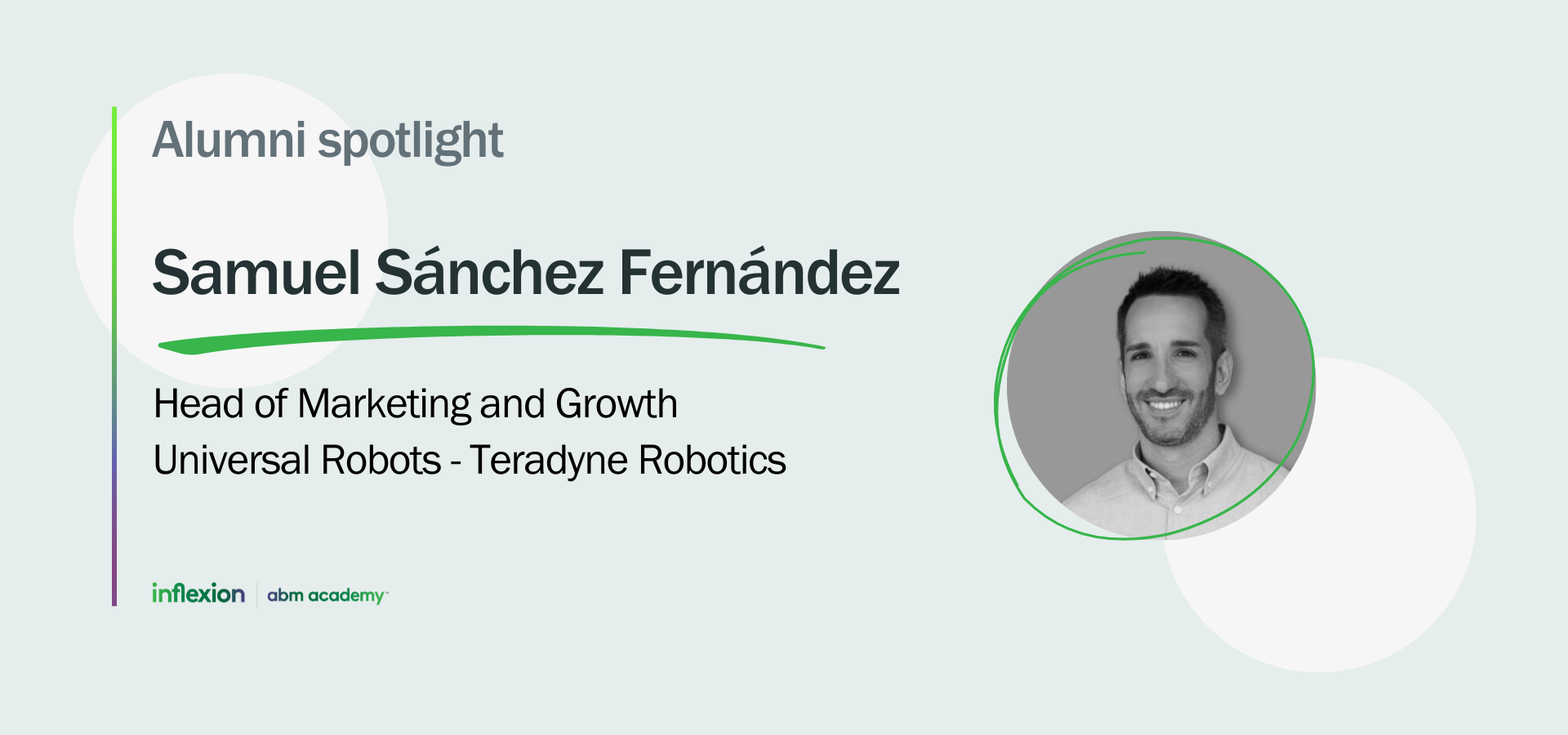
Samuel Sánchez Fernández, Head of Marketing and Growth at Universal Robots – Teradyne Robotics. His path to ABM wasn’t driven by trends — it was born from necessity.
Working in complex B2B, Samuel hit a wall with traditional demand generation. The approach simply wasn’t delivering results. What followed was a deliberate pivot to ABM, one that would fundamentally reshape how he thinks about marketing’s role in business growth.
We spoke with Samuel about making the shift, weathering the storm of dropping KPIs, and why the best ABM practitioners think less like marketers and more like business leaders.
The interview:
You’re at a dinner party and someone asks what you do – how do you explain ABM?
I usually explain ABM as focusing on being relevant to the whole buying group, not just one contact.
It’s about helping different stakeholders inside the same company make sense of a complex decision — at the right time, with the right message.
How did you get into ABM? Was it intentional or by accident?
It started intentionally but caused because I needed to find a solution to market our solutions.
I was working in complex B2B and realized traditional demand generation wasn’t working.
ABM wasn’t a trend for us — it was a necessity to sell better.
What’s the biggest risk you’ve taken in your ABM career, and did it pay off?
Shifting focus from lead volume to fewer, strategic accounts.
It felt risky at first, and we had a period where the short-term KPIs plunged. But later it paid off in better conversations, stronger alignment with sales, and higher-quality pipeline.
What was your ‘lightbulb moment’ during the Academy course?
Understanding that ABM is not a campaign or a tool.
It’s a system that connects strategy, buying groups, content, and sales execution — all around business outcomes.
What’s in your ABM toolkit that you couldn’t live without – and what’s the most overrated thing everyone raves about?
What couldn’t I live without? Deep account insight and alignment with sales.
The most overrated: tools without a clear strategy — technology never fixes lack of focus.
Fast-forward five years – what does success look like for you?
Helping B2B companies build predictable, scalable growth by connecting marketing to real business impact.
And being trusted as a strategic business partner, not just a marketing leader.
If you could give aspiring ABM-ers one piece of advice, what would it be?
Stop thinking like a marketer and start thinking like a business leader.
ABM works when it helps buyers decide and sales close — everything else is secondary.
Ready to make your own ABM transformation?
Samuel’s journey from under performing demand generation to building a strategic account programme shows what’s possible when you commit to ABM as a strategic initiative , not see it as a marketing tactic. His success at Universal Robots demonstrates the courage and conviction required to drive real change.
Our ABM Academy provided the strategic framework that helped inform Samuel’s approach. To find out more, explore our range of courses here.
Read our previous Alumni Spotlight where we speak with Kelly Schermerhorn, Senior Manager, Communications & Account-Based Marketing for Healthcare & Lifesciences at Pegasystems.