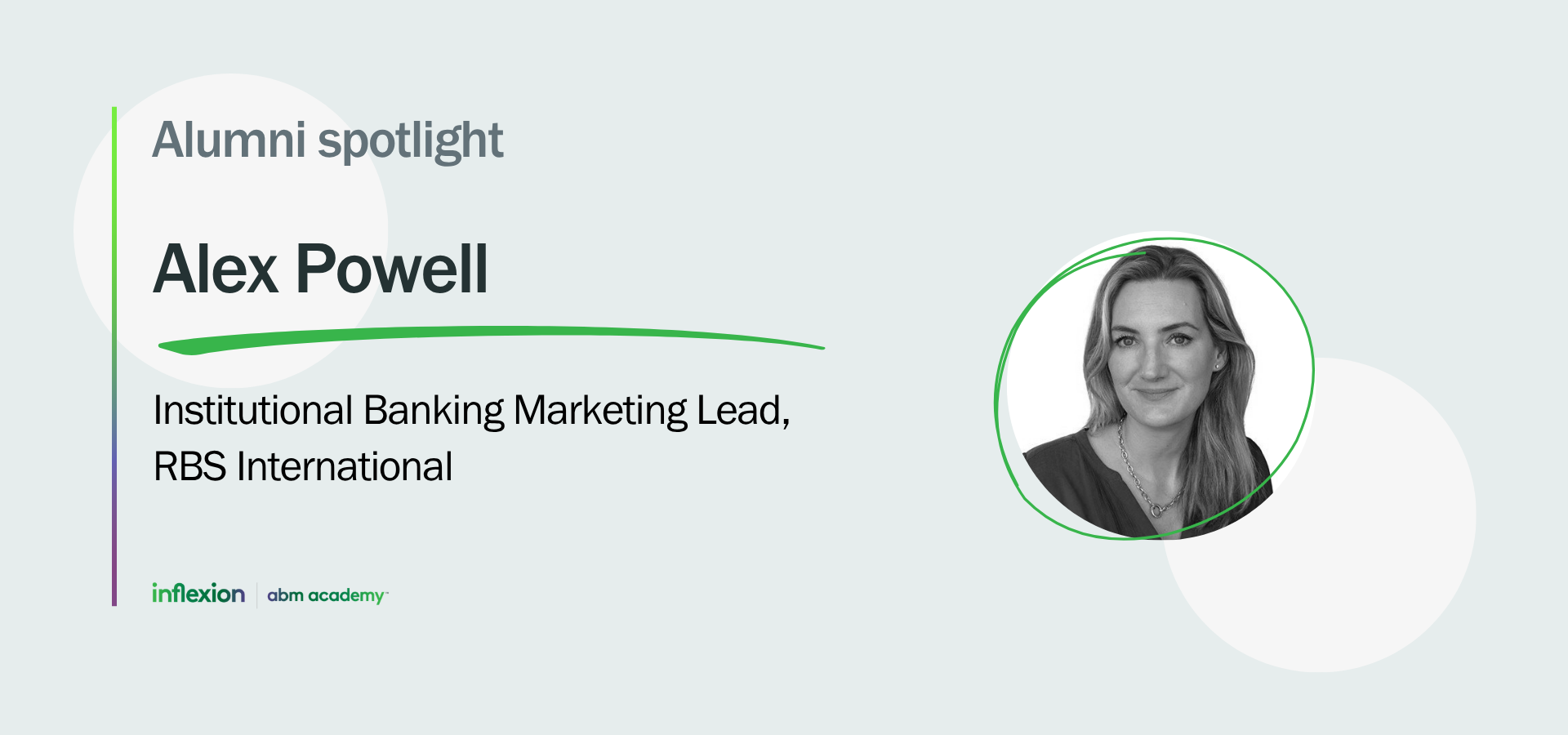
Alex Powell is Marketing Lead for Institutional Banking at RBS International. She first encountered ABM around ten years ago and never really let it go — attending conferences, following the field, and quietly building a business case while working in roles where ABM wasn’t yet on the agenda. When the opportunity finally came to pilot the approach at RBS International, she was ready. We caught up with Alex to hear about that journey, what clicked for her during her Academy course with mentor Catherine Ahern, and the advice she’d give anyone starting out in ABM.
Interview
You’re at a dinner party and someone asks what you do – how do you explain ABM?
I describe it as a way of helping our client-facing teams better understand their most important clients. Getting to know what matters to them, what their challenges are, what their organisation is trying to achieve — so that when we think about how we engage with them or help them reach their goals, we do it with a much broader base of insight. What makes ABM distinctive is that it works both ways: it helps our clients grow, but it also helps us as an organisation achieve our commercial objectives. I’ll admit I need to make it snappier at a dinner party, but that’s the idea.
How did you get into ABM? Was it intentional or by accident?
Intentional — it just took a while. Around ten years ago I was lucky enough to be part of an ABM team, and it immediately made sense to me: the clarity it brought to how marketing could align with business teams, and the much more visible way it could demonstrate value to the P&L.
When I moved to a new company, there wasn’t a dedicated ABM role available, so I kept it on the side of my desk — going to conferences, following people active in the field, and quietly building a business case internally. I just kept plugging away until an opportunity came along to present that case and get a pilot off the ground. So yes, it was intentional. It just took longer than I’d have liked.
What’s the biggest risk you’ve taken in your ABM career, and did it pay off?
Getting this programme off the ground was the bold move for me. This wasn’t a small side project or a new tactic — it was something much bigger, and I was asking people to back me, to come on a journey with me. I’d seen how ABM worked elsewhere and understood the value it could bring, but there’s still a real leap of faith in putting yourself out there in your organisation and asking people to trust you.
Taking an initial idea through to a business case, and then into a live pilot — that risk of putting yourself forward is very real. When people do trust you with it, you feel the weight of having to deliver. It’s a good kind of pressure, but it’s pressure nonetheless.
What was your ‘lightbulb moment’ during the Academy course?
For me it was the importance of the internal onboarding piece — really thinking about all the stakeholders who need to understand and buy into ABM, not just the senior leaders you’ve been working hard to influence.
When you’ve been building a business case for a long time and working hard to get senior buy-in, it’s easy to lose sight of the teams you’ll actually be working with day-to-day — the people who will be delivering a lot of the work, the operations teams, the colleagues who need to understand what ABM is and why it matters. That broader breadth of stakeholders who need to be brought along was an absolute lightbulb moment for me.
What’s in your ABM toolkit that you couldn’t live without – and what’s the most overrated thing everyone raves about?
AI, without question — especially at pilot stage or when you’re a small team. Whether it’s summarising documents, synthesising research, or helping with presentation materials, the operational time-saving is significant. It means you can spend more of your time on the relationship-building and delivery side of ABM, which is where the real value sits.
Most overrated? ABM-specific martech — at least for where I am right now. I’m not rushing in to invest in dedicated platforms, because I think you need to understand how ABM actually works in your organisation before you know what you need help with. That understanding takes time. AI is already plugging many of those gaps for smaller teams, and the technology landscape is shifting quickly enough that it’s worth waiting to see where it lands.
Fast-forward five years – what does success look like for you?
Looking back at what started as a small pilot and seeing it grow — rolled out across different service lines in the business, recognised internally for the value it delivers. A good problem to have would be more demand for the programme than we can meet. Seeing that growth trajectory is what success looks like for me.
If you could give aspiring ABM-ers one piece of advice, what would it be?
Stay close to the business. Understand the strategy and where it’s going commercially, so you can spot the gap or the opportunity where ABM can genuinely help. That’s often what gives you the foot in the door — the ability to go to senior leaders and say, this is where I think I can add value.
And then just do it. Don’t wait until everything is perfectly in place, because you learn through doing. Be brave, start the pilot, and let the work speak for itself.
Final thoughts
Alex’s story is a reminder that the best ABM programmes aren’t built overnight — they’re earned. A decade of attending conferences, following the field and quietly building a business case before the right moment arrived is not a detour; it’s exactly the kind of preparation that makes a pilot land well. Her advice to stay close to the business and spot the opportunity before you make your move is grounded in experience, and her instinct not to rush into ABM-specific martech before understanding what you actually need is one more practitioners would benefit from hearing.
Ready to start your own ABM journey? Get in touch with us or explore our ABM Academy courses to find the programme that’s right for you.
Read our previous Alumni Spotlight where we chatted to Susan Konings, ABM Lead at VodafoneZiggo in the Netherlands.