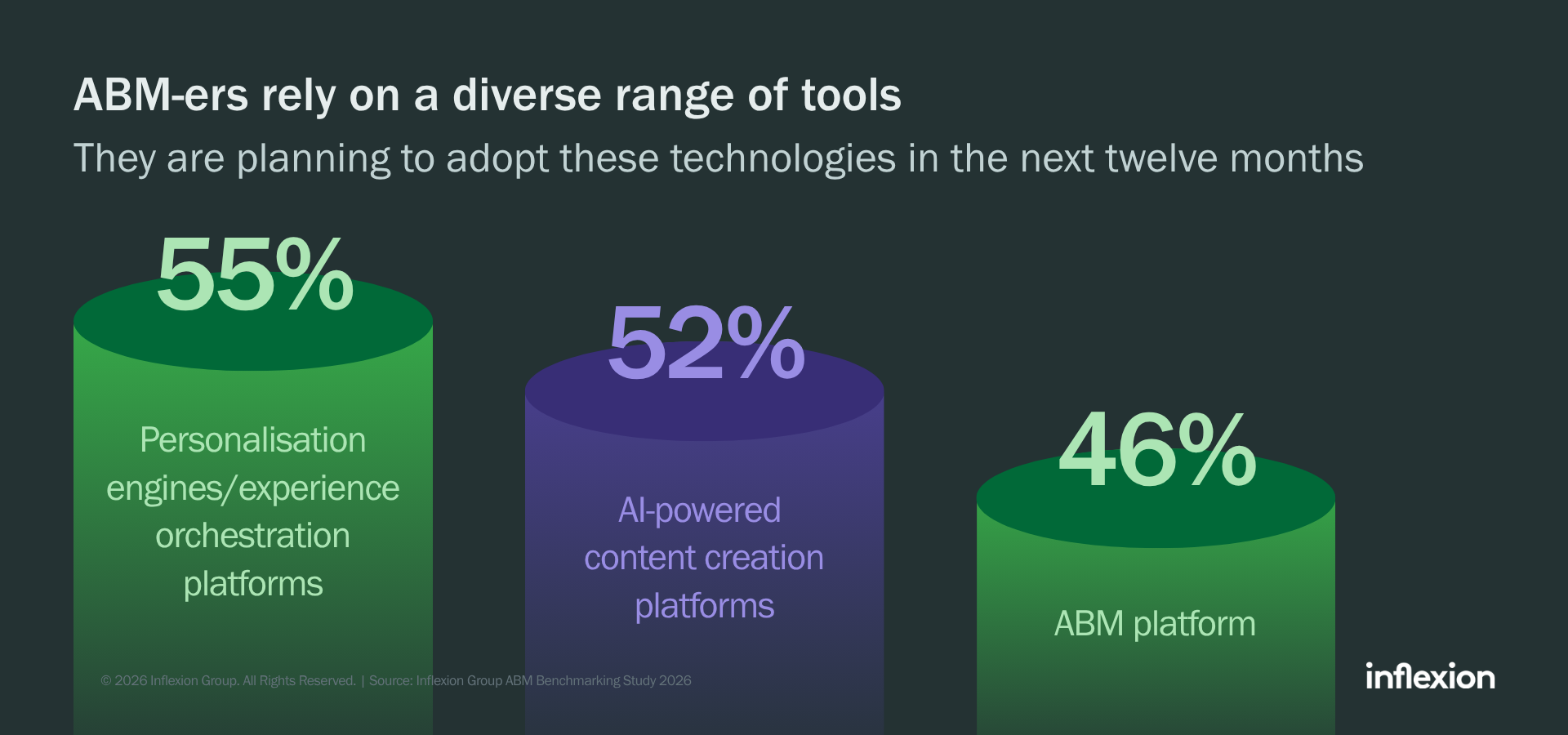
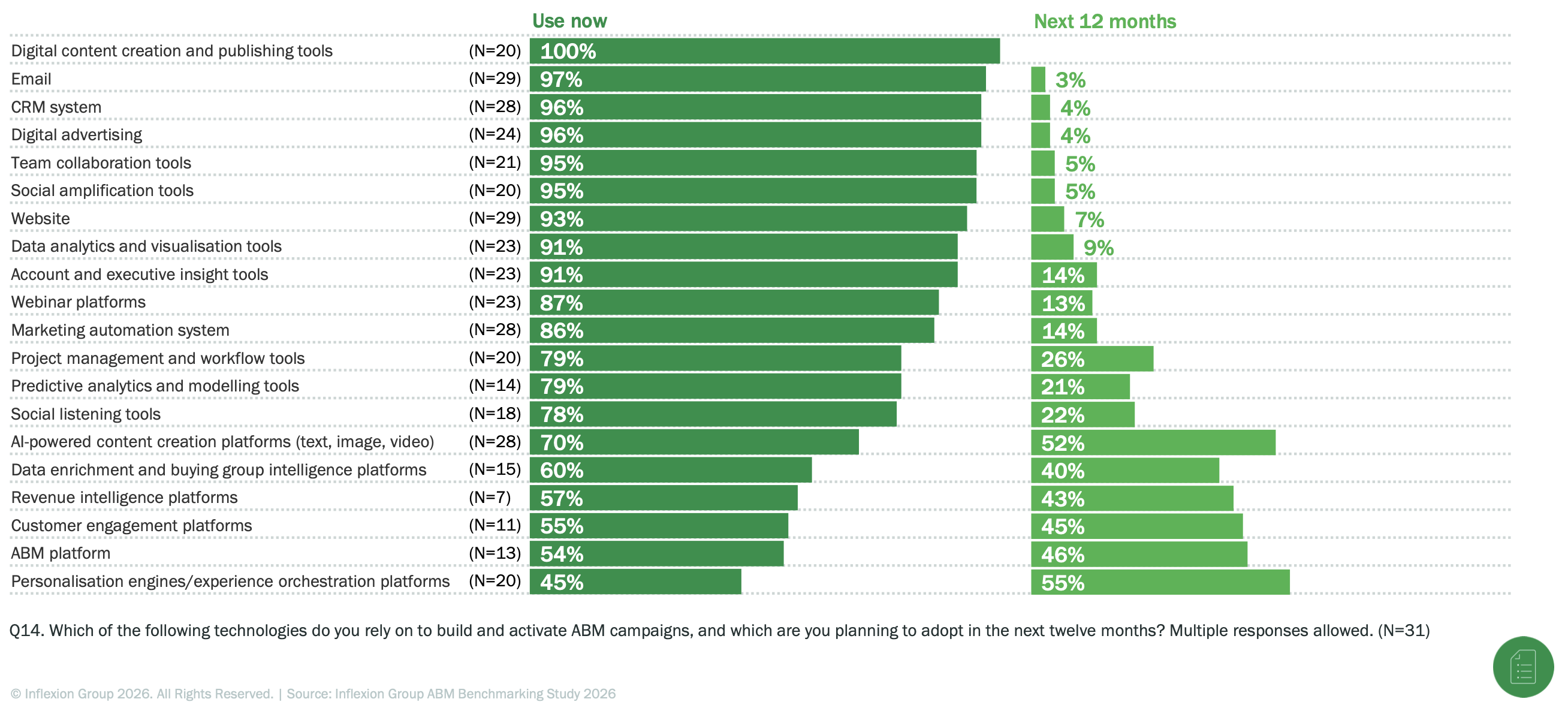
AI is rewiring the ABM stack — and governance, data and integration haven’t kept pace. ABM-ers rely on a sprawling range of tools: our study tracked over 20, and more than half of teams use 19 of them. In 2026, investment priorities are shifting toward personalisation platforms (55%) and AI-powered content creation (52%).
How are ABM teams building their AI-enabled stack?
Here are some highlights from the research:
- Data is used to improve ABM effectiveness by 79% of teams but AI is accelerating the need for work to be done in this area.
- For 47% of teams, data governance could be improved, while 60% of client facing teams still don’t have a single source of truth.
- AI is already being used in many ABM workflows. Journey orchestration and project management dominate plans for the year ahead with 63% and 42% respectively planning to invest in them. Interest in super agents for ABM is limited to 22% of teams in 2026.
- Fully AI-driven ABM remains a future state. In 2026, the direction is toward more automation, integration and day-to-day AI support as front offices begin to transform.
- AI-enabled orchestration is outpacing what the traditional tech stack can support. Teams use data, agents and GenAI across workflows, but integration remains an issue.
Our interviews reveal the way that ABM processes are being reworked with AI and teams enhanced with agents:
“We have agents across the ABM process all accessible through a super-agent. We’re working towards AI-native across all marketing.”
“Our ABM planning tool has agentic AI infused in it, so it can pull together a brief for creative, for example and kick off activation.”
But AI adoption doesn’t happen in isolation — it requires alignment across functions and strong governance:
“The AI madness is declining in the business. If everyone builds their own agent and no one controls this process, it will be a disaster. We need governance.”
“We are thinking hard about front-office transformation as a company. We have already rebuilt the back office.”
Read more about our new research in our 2026 ABM Benchmarking Study.