What is it and why do you need it?
There is no one way to create a marketing plan, never mind an ABM plan. Every company has its own planning horizons, approach, systems and templates, and even within the same company, business plans and individual account plans can vary enormously in both format and quality (longer is rarely better).
But an ABM plan often needs to both stand alone and exist as part of a wider account plan, BU plan or marketing plan. So, a strong summary slide – or plan on a page – becomes critical as a short, sharp guide to explaining how marketing will be used to deliver the results that the business needs.
At Inflexion Group, we use the slide template below, created by our experienced team of ABM practitioners and used in our client engagements and our training courses.
How do you use it?
This summary slide sits at the front of your ABM plan and is completed last – once you’ve finished the detail of your plan. It can be used to brief senior stakeholders on the approach you are taking to support an account team, and can also sit within the wider account plan, showing how marketing is collaborating with the broader team to strengthen relationships, build reputation and grow revenues in an account.
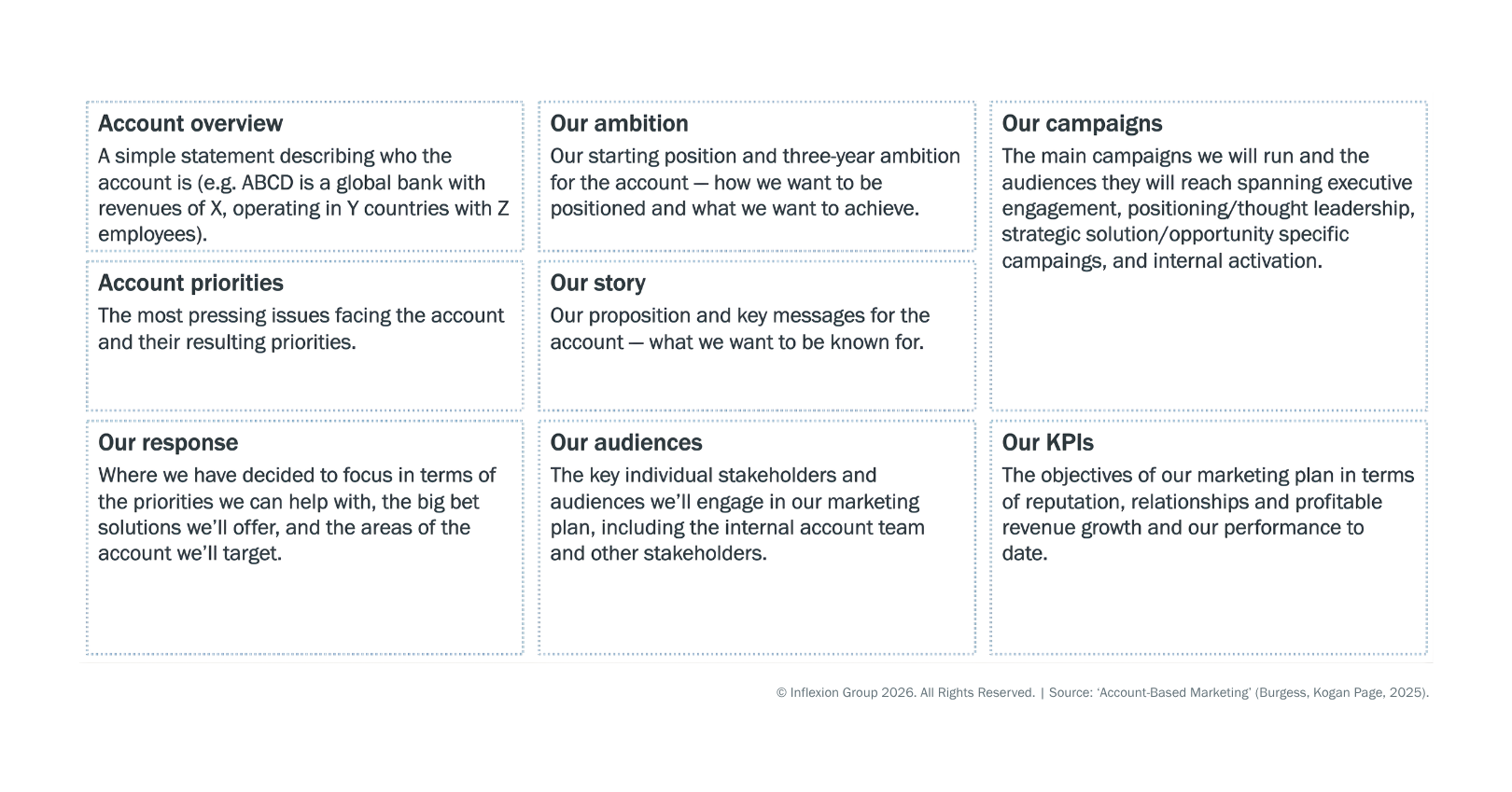
The sections in the template below mirror the sections in the ABM plans we create. It starts with an overview of the account (not needed when the slide is part of the account plan document), providing context for anyone unfamiliar with the customer organisation.
The next sections are created in collaboration with the account director and their team. The first summarises the ambition your company has for the account over the medium to long term – and where you are starting from today. Then comes a look at the top issues facing the account, whether externally or internally driven, and their resulting business priorities. This is followed by a description of how your company will respond to those priorities: where you will focus and what you will offer the customer to help them meet their objectives.
Then comes the marketing strategy and plan, starting with our ‘story’ for the account. What do we want to be known for, what is our proposition for the customer and what are our key messages? Of course this is dependent on the audiences you’ll target, often a combination of individual executives and influencers, buying committees, and wider audience groups, such as everyone in a particular function. And don’t forget your internal audience – often one of the most trusted and important channels for your marketing communications.
A summary of the campaigns you will run comes next, spanning executive engagement, positioning campaigns, offering campaigns and any internal enablement and activation. This can include existing campaigns you have selected or are tailoring for the account – such as for your brand or solutions – as well as bespoke campaigns you are running just for this account.
Finally, list your marketing objectives and KPIs, highlighting your performance to date – the bottom line of your plan! Keeping these up to date will ensure your plan is a living document, as you adapt your approach based on what’s working best.
If you’re asked to present your plan, and you’re given just five minutes to do so, this summary could be your anchor slide. But make sure you use it to tell a story – don’t just read it!
Find out more about how to build and summarise a strategic ABM plan in ‘Account-Based Marketing’ (Burgess, Kogan Page, 2025), or take the on-demand course on Getting Started with Strategic ABM from the ABM Academy.