It has now been over two decades since ABM emerged as a proven way of accelerating growth with key customers and prospects, and yet some companies are still discovering it for the first time. Most programmes start with a pilot of one or more types of ABM and then move on to scale across the business, ultimately ending up as a standardised approach – effectively business as usual.
But this is much easier to say than do. To build your company’s competence in ABM and align everyone around your approach takes time and commitment. There are many foundations to lay along the way. In fact, I’ve identified 20 building blocks across five key pillars that I regularly use to design a new ABM programme with my clients or assess how an existing programme might need to evolve.
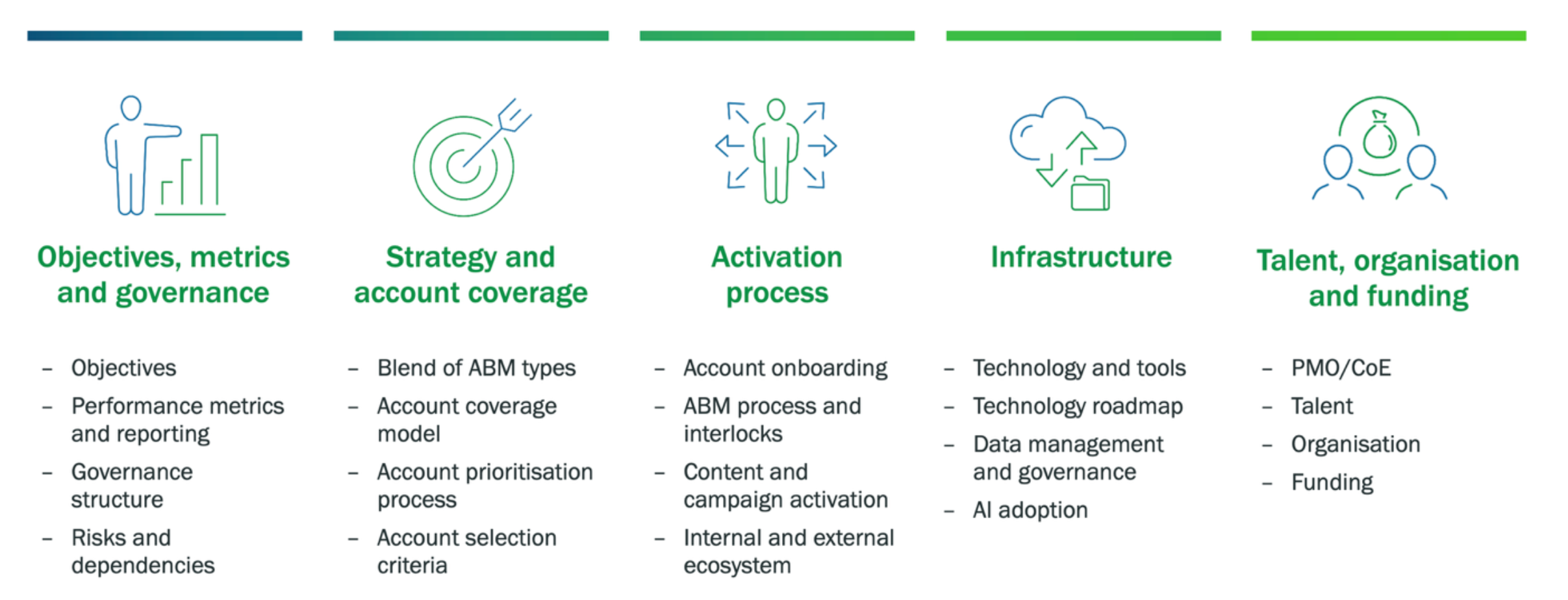
A framework for ABM programme success
The first pillar involves confirming the objectives for your wider programme, agreeing performance metrics and setting up the right governance to ensure your success, including managing the risks and issues you’ll face as you scale, and identifying your programme’s dependencies.
The second is about confirming your ABM strategy, coverage model and account prioritisation process.
The third is about how you will activate ABM across your business, from onboarding new ABM accounts, agreeing your processes and interlocks, confirming how content will be created and campaigns designed and built, and establishing the internal and ecosystem your ABM activation will rely on.
Fourth is the necessary infrastructure, starting with your existing technology and tools before creating a roadmap for what you will need. Data sits at the heart of this process and is pivotal to making any technology infrastructure effective – along with culture. Cultural factors are also important in your attitude to AI adoption as we redesign workflows and include AI agents in our teams.
Finally, the fifth pillar deals with the talent and funding you need to deliver impact with ABM, and the right organizational model, starting with a centre of excellence (CoE) or programme management office (PMO) – either of which may be a key part of your programme governance.
***
A well run PMO can make the difference between success and failure as you set up your programme, and Lorraine Legros from Red Hat shares some advice for would-be PMO leaders.
Perspectives from a global PMO leader
What do you think are the critical success factors in setting up a successful ABM programme?
The first is to establish the right criteria for selecting the accounts. Suppose it’s not clear from the outset which criteria you are using to establish the prioritisation. In that case, the lack of clarity can persist and become a recurring point of contention with sales. You also have to strike a balance between global and regional priorities, which may differ. Just because an account is important globally doesn’t necessarily mean it’s an account of major significance regionally.
And then you need to factor in the success criteria. What sales say they want can be very short-term, whereas we know that ABM is a long-term game. For example, sales might say they want quarterly demand generation programmes. We need to show them that it’s about establishing a long-term play that’s going to have a bigger impact. You have to state the priorities clearly and make sure that there is a common understanding of what success looks like.
What role does the PMO play in a successful ABM programme?
The PMO is key to getting alignment with the regions. My focus is on the most strategic accounts globally and trying to get everyone to rally around this priority for the company. If they understand the 80/20 rule, that revenue growth is driven by these big customers, it’s easier to get everyone aligned. Get the key people in the regions onboard early and brief them often. Get everyone behind the objectives, strategy, and success criteria. The PMO isn’t responsible for the execution in the field, but it can and should be instrumental in bringing a workable structure, providing resources, and giving guidance to the regions to help them achieve their goals.
How do you think teams should be structured?
At the end of the day, I’m not sure it matters where they sit. It’s more about establishing relationships and rapport. And that’s where the governance framework is so useful. You build rapport with the regional ABM and vertical leaders. And they’re the conduit to the regional VPs of marketing who should always be kept abreast of whatever is relevant to their regions.
It probably depends on the company size and structure. In a complex organization, do dotted lines matter? Not really. There are different ways to do this that aren’t just about reporting and hierarchy. For example, holding the budget can also be a way of managing things. I think in the end it’s about the willingness of everyone involved to work with each other and collaborate to drive results.
What advice would you give to ABM programme leaders in terms of how they track and report the impact of their programmes to their internal stakeholders?
Think about the performance and development conversations you are going to have and get everyone aligned on what the success metrics look like. And once you’ve done that, stick to them in regular reporting, whether people want them or not.
Bring people on the journey. Discuss, discuss, and discuss again, and not just with the steering committee and those executing from an ABM marketer perspective, but also with their managers. They need to be included because they’re managing the ABM-ers as teams.
The narrative that accompanies the report can be adapted for different audiences and should be. Maybe with sales, you emphasize a pipeline multiplier on your scorecard, which is really important to them. For marketing, you might want to emphasize how a specific campaign is performing. You just highlight different things to different parts of the organization.
***
Building consistency of capability and approach is a core role for an ABM PMO or CoE, and was at the heart of NTT DATA’s award-winning global programme.
Building an award-winning programme at NTT DATA
NTT DATA, Inc is a $30 billion IT services and consulting company with 85 per cent of the Fortune 500 as customers. It was formed in October 2022 with the merger of NTT Ltd and NTT DATA Services within the Japanese-headquartered NTT Group. Present in over 50 countries, NTT DATA offers end-to-end IT solutions on a global scale and is the world’s leading internet backbone provider.
Making ABM the driver of growth
The story of the organisation’s ABM journey starts well before the recent merger. NTT Ltd itself had been formed from 28 different companies in 2019 and faced several challenges in its determination to hit ambitious goals for growth and profitability. It needed to alter the perception of its brand as that of a ‘technology’ business and instead be seen as a world-class provider of high-value managed services. While it had strong relationships with IT departments, it had relatively little engagement with other important functions.
As Rachael Bell, now VP ABM at NTT DATA, Inc, recalls, “Originally, Dimension Data was the biggest part of NTT Ltd and from the client’s perspective it started to disappear. When we merged we had to prove to those key clients that we would be a bigger, better, much-improved organisation. Instead of having 28 different company representatives coming to see them, we would be giving them a joined-up story of NTT Ltd as a world-class provider of high-value, end-to-end services across the whole technology stack.”
The new CEO, Abhijit Dubey, decided that a centrally coordinated account-based growth strategy for the company’s most important global customers was key to achieving its ambitious objectives. He and the new CMO, Matt Preschern, wanted to put in place a marketing approach that was more revenue-generating, data-driven and insight-led to support that growth agenda.
Embedding an ABM framework
At the time there was some ABM around in various regions and parts of the company, but with different definitions and approaches. It also tended to be more about deal-acceleration than a strategy to increase presence in the biggest accounts. So, Bell was asked by the CMO to set up a global Centre of Excellence (CoE) for ABM to enable teams around the world to focus on key customers through consistent principles, frameworks, methodologies and expertise.
She worked through an ABM ecosystem to support the CoE comprising technology partner Terminus, agency partner Agent3 and consulting partner Inflexion Group, which resulted in a range of initiatives including ‘Introduction to ABM’ webinars, ‘Essentials of ABM’ training sessions, ‘ABM Practitioner Accreditation’ training for the 25 ABM-ers in the CoE, and ‘Marketing Leader Accreditation’ training for the CMO and his leadership team.
Bell wanted to demonstrate the impact of Strategic ABM on key accounts early on and set up a pilot with dedicated marketing resource leveraging full-on data insights, creating value propositions, and planning engagement. It wasn’t easy, she recalls: “We began by working very closely with the sales team on one key account. It took a long time for them to see the value because of the heavy investment upfront. But once they started to appreciate that value, and the potential ABM offered, they became our biggest advocates among their other sales colleagues. And that’s how we slowly and steadily grew the programme.”
Following the creation of the CoE and ABM ecosystem, more than 500 new contacts were established in priority accounts, including among the much-coveted C-level audience. The pipeline target was nearly doubled, with over a quarter converting into won business.
The ABM programme in action
The company now has a blended ABM programme that works on a number of levels, comprising one-to-one ABM, one-to-few ABM, and deal-based marketing. Getting the split right between the one-to-one and one-to few accounts, which are still considered strategic but get a lighter touch, is critical, says Bell: “We have a really solid one-to-one programme and now we are focusing on one-to-few to drive scale. I see scaling up as almost like the sweet spot of where we are headed: can we evolve the ABM model into getting that scale but still deliver the right level of personalization?”
ABM is now the most requested marketing programme from sales, while there is also increased demand across the business to scale ABM in all regions and across all sectors.