What’s always been a pain in the neck for account-based marketers? Account research.
Right from the earliest days of ABM, it’s been true that account insights, the thing that sets apart the most impactful marketing (and selling for that matter), is also the thing we wish was a lot faster and easier to deliver.
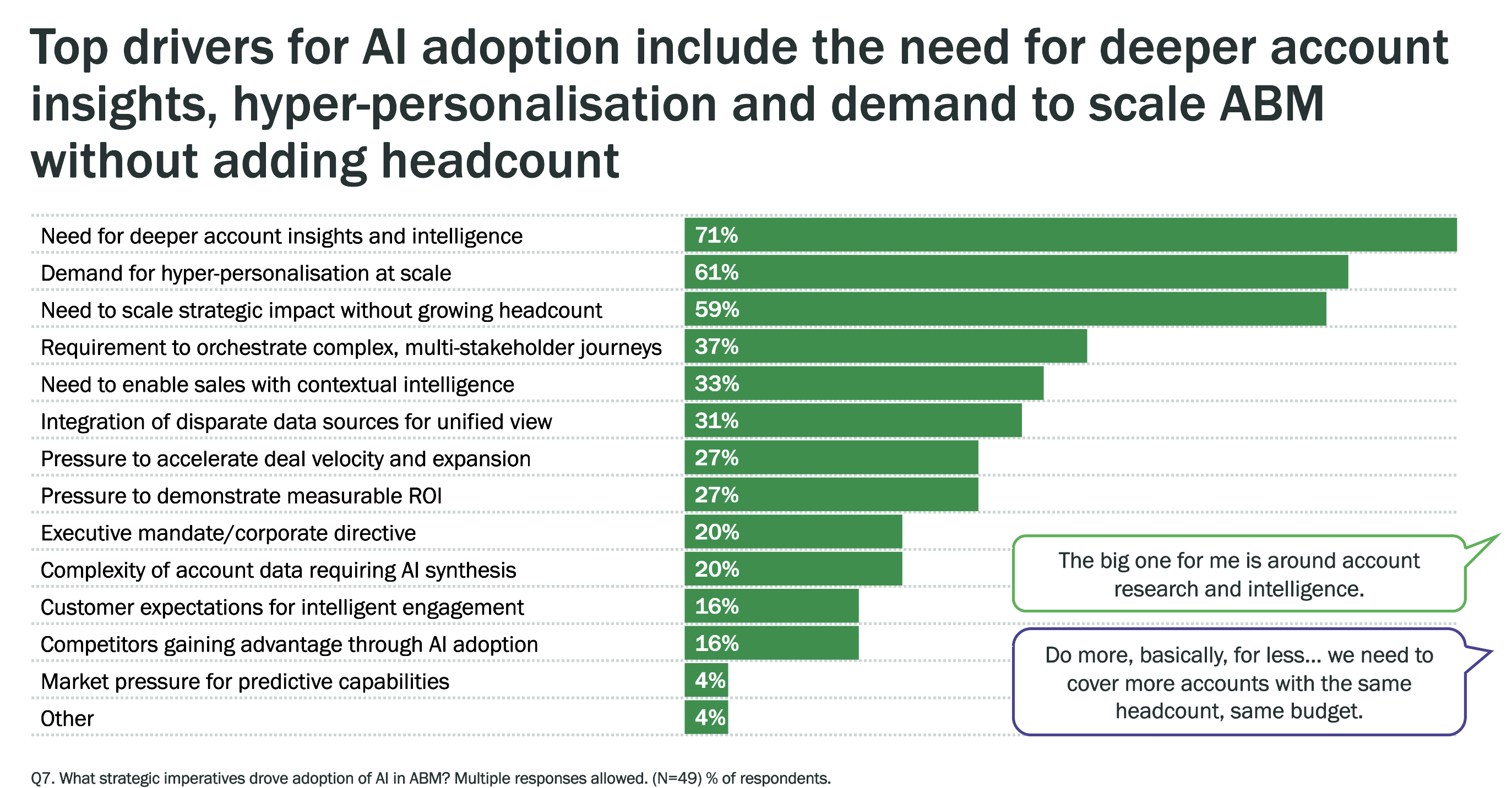
Inflexion Group’s recent AI in ABM Benchmarking Study practically shouted it from the rooftops: Account research and the need for personalization at scale are the top drivers for AI adoption. Looking at the rest of the list, a lot of the other drivers are connected to these. But what does it look like to deploy AI to support these needs?
Scaled account research using AI is not about gathering more data. We’ve been able to do that for a while now. It is about filtering out noise and turning meaningful signals into orchestrated, cross-functional plays that engage buying groups at all stages of their journey.
What’s different about today’s AI-enabled research workflows? Let’s think about the challenge with traditional insights.
Manual research, like that which ABM teams often do for Strategic ABM, is certainly comprehensive. It’s also quickly out-of-date and usually not part of standard workflows for sales and marketing. Many teams treat research as either a sales prep activity or a segmentation exercise, such as defining an ideal customer profile (ICP) that never gets embedded in ongoing activity.
The three-layer approach
A scaled account research engine needs to function as a central nervous system that allows marketing and sales, and ideally other functions, to take actionable cues from it. The primary goal is to automate without overwhelming your team or bypassing some human quality control. Your workflow and tech stack need to support both sourcing insights and taking smart, personalized action on them.
Building an automated insights engine that can scale across your revenue team involves three layers.
Layer 1: Insight gathering
This is your always-on analyst. It monitors the public web, second and third-party data sources for specific trigger events or other meaningful data points across your target accounts (both prospects and existing customers).
Examples of data from this layer include signals such as executive hires, hiring surges, office expansions, technology stack changes, competitive movements, and various intent signals.
The goal is to aggregate data from multiple sources and flag trigger events automatically. For scaled, actionable data, it must convert these to structured formats that can be stored, updated and acted upon within platforms the revenue team uses every day.
Word to the wise: While it’s possible to collect a ton of information, your goal is quality, not volume. Marketing and sales need to identify and agree on the data points that are most meaningful to your accounts and in your sales cycles. Don’t make assumptions: conduct data-driven analysis to find the signals that lead to pipeline conversion and closed revenue. You might be surprised at what matters most.
Layer 2: Insight synthesis
This layer combines external signals with internal, first-party data such as website behaviour, content engagement, product usage, sales conversation insights, and relationship mapping. This layer transforms raw data into actionable insights so you can move quickly and automatically from “why does this matter?” to “what should we do?”
This layer solves for the old problem of marketing building campaigns without knowing what sales is hearing in conversations, and neither of them acting on up-to-the-minute external signals. Combining all the insights in real time makes it possible to infuse scaled outreach with context and consequently improve sales and marketing coordination.
Building this layer involves connecting external and internal sources via APIs and plenty of testing to be sure it’s working reliably. Security and privacy requirements need to be addressed in this layer as well.
Word to the wise: While you won’t want to wait for your internal data to be perfect (it never will be), some housekeeping is likely needed. If the foundational data (such as website domains, current account owners, etc.) is broken or inaccurate, synthesis won’t mean much and routing will be broken. Test and clean up the most critical data points first.
Layer 3: Workflow integration
This layer pushes insights to where teams work and automates actions based on them. This is also the layer most likely to have challenges. Most of us have proven that we can deliver amazing research, but if it requires sellers to leave CRM or check another tool, adoption suffers.
Look to incorporate CRM, marketing automation or ABM platforms, communication platforms, and/or revenue intelligence tools as you define this layer. This takes intelligence from “something I should check” to “something I can’t miss” as the first thing sales and account teams see when looking at an account.
Here are examples of tools and combinations that allow teams to build up to this layer:
- Research: Clay, Apollo.io, ZoomInfo, 6Sense, Klue, Demandbase, LinkedIn Sales Navigator, Dynamics insights
- Synthesis: Zapier + ChatGPT API or Claude API, Claude CoWork, Microsoft Copilot Studio, custom AI orchestration
- Distribution: Native CRM workflows + Slack, Zapier/Make + CRM customization, Workato + full CRM customization + Gong integration
Word to the wise: Leave ample time for a pilot. Building AI-enabled tech stacks is a new muscle for most revenue teams, and the platforms involved are relatively new to the market. Leave time for learning curves all around.
Enablement and measurement: Critical success factors for scaled success
Maintaining and acting on insights at scale is not just about technology. Enablement, measurement and ongoing optimization are essential to business impact.
Think of the layers this way: Your research layer handles continuous external monitoring. Your synthesis layer combines it with internal context. Your integration layer puts intelligence into workflow.
Next, with these in place, we need enablement to help with best practices and pattern recognition, and measurement to diagnose effectiveness and prove impact. We’re all learning about what works with AI in ABM. Measurement and enablement help us stay on top of learning and continuous improvement as technology and skills evolve.
Our AI in ABM benchmark study showed that many ABM teams are not tracking the ROI of AI deployment. It’s essential to have metrics in place to track progress and impact, or teams risk losing budget and patience for their efforts to deploy AI.
Word to the wise: Avoid siloed vanity metrics with AI deployment. This is a team effort. In the early stages of deploying your scalable engine, track shared revenue behaviour to optimize performance, not just keep score. Here are metric examples:
- Velocity: What is the time-to-action from when a signal is detected to the first outbound outreach?
- Effectiveness: Are response rates or other outcomes such as meetings booked higher on intelligence-assisted plays versus generic outbound?
- Revenue impact: What is the win rate and average deal size of opportunities initiated by this engine compared to before the engine was in place, or for accounts not involved in it?
Now I’d love to hear: What’s your current tech stack for account intelligence? What’s working and what’s frustrating? How well is it delivering account research at scale?
Want to learn more? The Inflexion Group ABM Academy has excellent options, from getting started with an on-demand course to expert-level communities. Several live courses start again in May.
Read Megan’s previous ‘Ask the expert’ on maximizing scale and cost effectiveness with Programmatic ABM.