Our recent benchmarking research among complex, global organisations revealed that ABM is recognised as essential to long term, sustainable growth. Anchored in Inflexion Group’s proven framework for designing an effective ABM programme, the research covered five key areas. Here are the highlights.
- Programme objectives, metrics and governance. Most ABM programmes are beyond the pilot stage now and are focusing on building relationships that drive sustainable growth in existing customers. Revenue outcomes linked to relationship improvements are used most to report impact, but measuring reputation outcomes remains a challenge. Approaches to programme governance vary and most are not set up with all the foundations needed for success. However, programme leaders are actively managing risks, taking actions to mitigate misalignment with the business, unclear ROI, lack of resources, or the need to rely on poor data and technology.
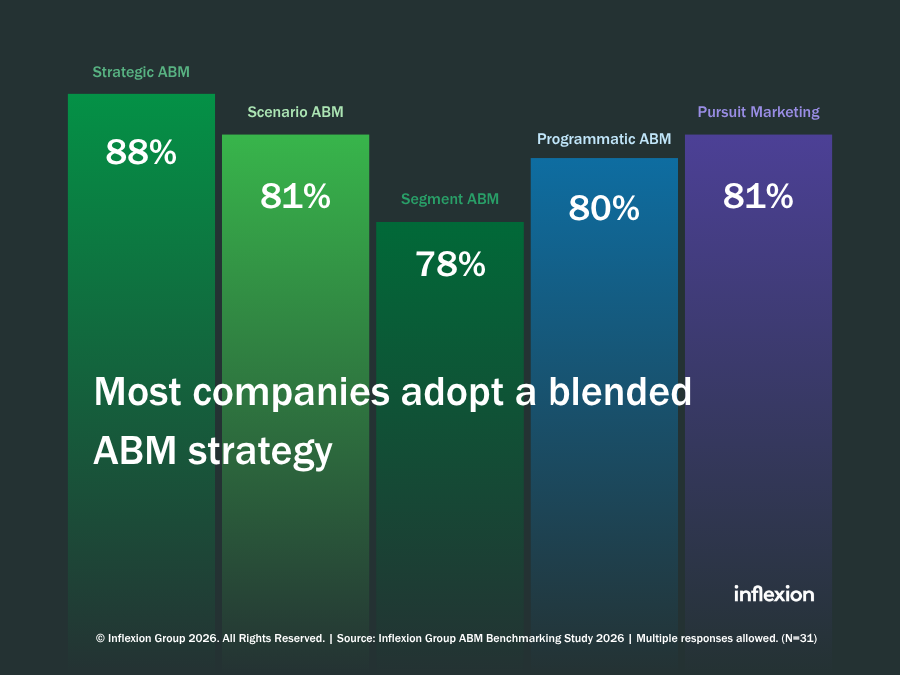
- Strategy and account coverage. With marketing budgets under pressure, different types of ABM are evolving to enable companies to scale their programmes further across their top tiers of customers and prospects. Figure 1 shows five types in the new blended model. Scenario ABM is emerging, plus ‘grandfather-led’ clusters in Segment ABM. Prioritisation of accounts for ABM investment is data-driven, with criteria around future growth potential and current revenues dominating decisions, along with competitive strength. Softer criteria are used to evaluate each account for ABM readiness.
Figure 1: The new blended ABM model

© Inflexion Group 2024. All Rights Reserved.
- ABM campaign activation. Programme leaders make processes, toolkits and templates available to ABM-ers everywhere, varying them by type of ABM. ABM-ers create custom content for Strategic ABM accounts, tailoring existing content more often for Scenario and Segment ABM accounts. Most companies use the same overall set of tactics, with VIP event experiences, exec engagement, innovation workshops, digital advertising and paid social media the most common. Bespoke, high touch activities are used more in Strategic ABM and Pursuit Marketing.
- Infrastructure. ABM-ers rely on a range of tools to deliver ABM, and while most have their technology foundations in place, it’s now about integrating tech and using it more effectively. They are currently investing in predictive analytics, marketing automation, insight and web platforms. Data from various sources is combined and used to inform ABM, but data governance could be improved, and client facing teams still don’t have a single source of truth. Attitudes to adopting AI tools are mixed, but leading ABM-ers have already adopted GenAI for content creation and insight development plus AI for analytics.
- Talent, organisation and funding. ABM is taking an ever-increasing share of the marketing budget, and in some cases field marketing is now entirely ABM based. A hybrid mix of a centre of excellence (CoE) and field staff in full and part-time ABM roles is not uncommon. Fully centralised teams are rare.
This invitation-only study focused on established technology, telecoms and professional service firms with $5bn or more in annual revenues. Co-created with the ten members of Inflexion Group’s ABM Leadership Forum, it used a combination of in-depth interviews and an online survey among 32 hand-picked organisations during March-April 2024. We’ll share more findings over the coming weeks.