In this edition of our ABM Academy alumni spotlight series, we feature someone who took one of the boldest organisational moves in ABM – and watched it pay off spectacularly.
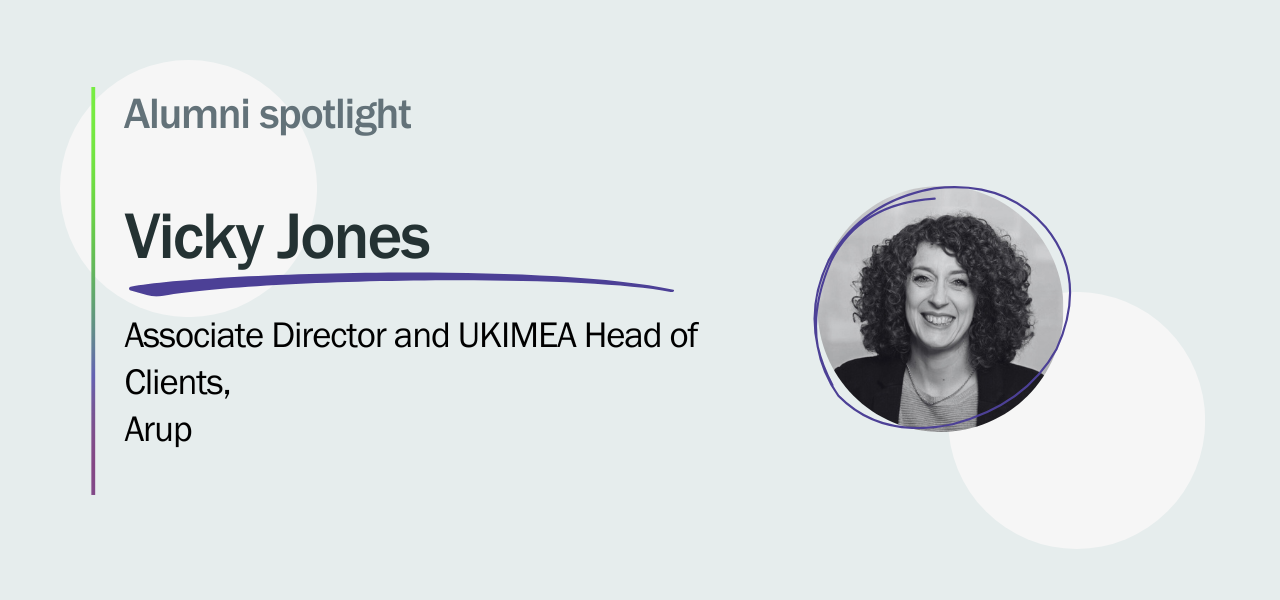
Meet Vicky Jones
Vicky is associate director and UKIMEA head of clients at Arup, a British multinational professional services firm founded in 1946 by Sir Ove Arup. Headquartered in London, Arup employs over 17,000 professionals across more than 90 offices in 35 countries, providing design, engineering, architecture, planning, and advisory services across every aspect of the built environment.
As an employee-owned business with a unique trust structure, Arup has delivered some of the world’s most iconic projects, including the structural engineering for the Sydney Opera House and Beijing’s “Bird’s Nest” Stadium. The firm’s “Total Design” philosophy integrates various disciplines to deliver holistic solutions, working on projects spanning transportation networks, buildings, energy infrastructure, and water systems in over 160 countries.
Vicky is a chartered marketer who has held many different roles at Arup throughout her career, with strategic marketing always being her passion. Her journey into ABM began when she openly shared with the head of marketing that she was ready for a new challenge, asking if there was anything more strategic she could lean into. The response changed everything: “Do you want to go and figure out what ABM is for Arup?”
We sat down with Vicky to explore her intentional path into ABM, the organisational gamble that reshaped her programme, and why building an external ABM network has been crucial to her success.
The interview
You’re at a dinner party and someone asks what you do — how do you explain ABM?
I keep it really simple and true to the definition and refer to it as client-centric marketing where you treat a client like its own market. If someone asks for more detail, I explain that it’s highly bespoke messaging that is hand-delivered to a client.
How did you get into ABM? Was it intentional or by accident?
I’ve held many different roles at Arup, but strategic marketing has always been my passion. When I moved into a region-wide role, I felt like I couldn’t add value in the way I wanted to. I shared this with the head of marketing, as I was ready for a new challenge, asking if there was anything more strategic I could lean into. She said, ‘Do you want to go and figure out what ABM is for Arup?’
As soon as I started researching it, I was hooked. I loved how strategic it is, how it focuses outwardly from Arup, and how it enables me to drive business outcomes. It was a pivotal moment in my career that pushed me in the direction I wanted to go. So yes, I guess it was somewhat intentional.
What’s the biggest risk you’ve taken in your ABM career, and did it pay off?
I took a huge gamble early on. Our key account management programme sat in business development, whilst my team sat in marketing. I asked for the full team to be moved out of marketing and into the business development team. I wanted to ensure we were aligned with the programme and the accounts, and I didn’t want ABM to be seen as just another marketing initiative. I was concerned that if we stayed within marketing, the key account management programme would view us as simply ‘marketing’ rather than recognising the specialism of ABM.
I also wanted to disrupt the status quo! I knew that for ABM to land properly, it needed something different. From a business perspective, the move made absolute sense. We were right in the thick of building our key account management programme with a clear differentiating offer, and we had direct access to client knowledge within the key account practice. Even though it was early days, we were in the right conversations with an ABM lens supporting the programme.
It absolutely paid off because it created the alignment I wanted. Now I lead both the key account management programme and the ABM programme, and the two work seamlessly hand in hand.
What was your ‘lightbulb moment’ during the Academy course?
I attended the AI boot camp, but my lightbulb moment actually came before the course. I was an AI novice and realised I needed to understand AI fundamentals because I can’t build an ABM programme without truly understanding what forms of AI are available to help us. That realisation was the trigger.
The boot camp was brilliant for understanding the breadth of opportunities and how to create efficiency gains and agility. Currently we are using AI for client insights using both our internal AI tools and the external ones we’re permitted to use.
What’s in your ABM toolkit that you couldn’t live without — and what’s the most overrated thing everyone raves about?
For me, it’s stakeholder and perception mapping rather than a specific tool. It’s very easy for people to think they already know who they need to know, but when we’re looking at account diversification and penetration, sitting down with account teams and really thinking through that growth creates such clarity and focus. Because we do predominantly strategic one-to-one ABM, you need to know those individual people really well.
This is a big area I want to push over the next financial year. I want it to be done really well in every single one of our accounts. In professional services particularly, where it’s not just about engaging with the client but also coordinating with the people on the ground doing the delivery, it helps everyone get real clarity on where they need to focus.
The most overrated thing is an overcomplicated tech stack. We do have a tech stack and we use it in our campaigns, and I know it’s fundamental. But the one-to-one direct engagement and two-way conversation is what’s most important to me. I think people can get swept into a tech-led programme, and that’s not the direction I want to go. I want to keep it authentic and personal, focused on gaining genuine two-way engagement.
The interaction between the people on the ground delivering the work and the client is crucial. These are long-term projects – sometimes 10 or even 20 years. Making sure everyone is on the same page and has that connection is such an important aspect of delivering successful projects and generating value for clients.
Fast-forward five years — what does success look like for you?
We’re currently building a scenario ABM approach into the programme to build speed and agility and generate more value for the business. We also want to increase our client coverage model to support more clients.
In five years’ time, I hope ABM will be across all our regions, aligned with our global key account management programme and particular client segmentation. Through scenario ABM, we will enable people who aren’t fully dedicated to ABM to pick up really valuable campaigns and deliverables to support our key accounts.
If you could give aspiring ABM-ers one piece of advice, what would it be?
Build your ABM network outside of your company. This has been such an important aspect of building the programme for me. Being an ABM-er is tough and takes so much patience and perseverance. It’s really hard. The minute you connect with other people who are living and breathing ABM in another organisation, everything changes. I don’t think it matters whether it’s the same industry or not.
I always say my external network are my cheerleaders. I always feel lifted and more motivated after speaking to people within my network because they get it. They understand the challenge. There have been numerous times where I’ve thought I’m not really making progress, and then I speak to someone else who thinks what I’ve achieved is amazing. From a confidence perspective, I would say utilise all the ABM forums, events and speak to people, because that’s where you can gain a lot of value.
I’ve got ABM friends in competitor organisations, and it is not threatening one another’s ability to deliver ABM. It’s actually quite reassuring talking to other people within professional services because it’s very different. Hearing how they’ve delivered successful programmes and the challenges they’ve faced is invaluable. At the recent ABM conference, I tasked my team to have at least two conversations with somebody they didn’t know. They all came back saying they really enjoyed it and that it was such a valuable day.
The takeaway
Vicky’s journey demonstrates that sometimes the boldest ABM moves happen in organisational structure rather than campaigns. Moving her team from marketing into business development was a gamble that created the alignment needed for ABM to truly land at Arup – proving that organisational positioning matters as much as strategy.
Her focus on stakeholder and perception mapping over sophisticated platforms reflects a deeper truth about professional services ABM: when projects span decades, understanding relationship networks is what matters. This prioritisation of authentic engagement over tech-led programmes keeps ABM grounded in what actually drives long-term client value.
Most significantly, Vicky’s candid acknowledgement that ABM is “really, really hard” – requiring patience and perseverance – alongside her recommendation on building external peer networks. Her external network now serves as cheerleaders who understand the unique challenges and can offer perspective.
At Arup, Vicky has demonstrated that strategic courage, prioritisation, and peer support can transform both ABM programmes and individual careers.
Ready to build your own strategic ABM programme? Our next ABM Academy cohort is now enrolling. Discover our upcoming courses here Add link
Join us in the new year for more alumni spotlight features.