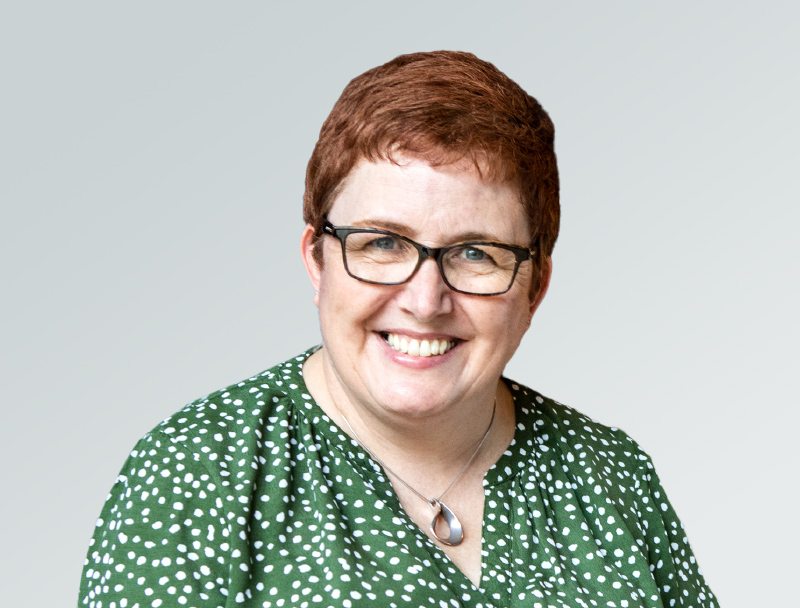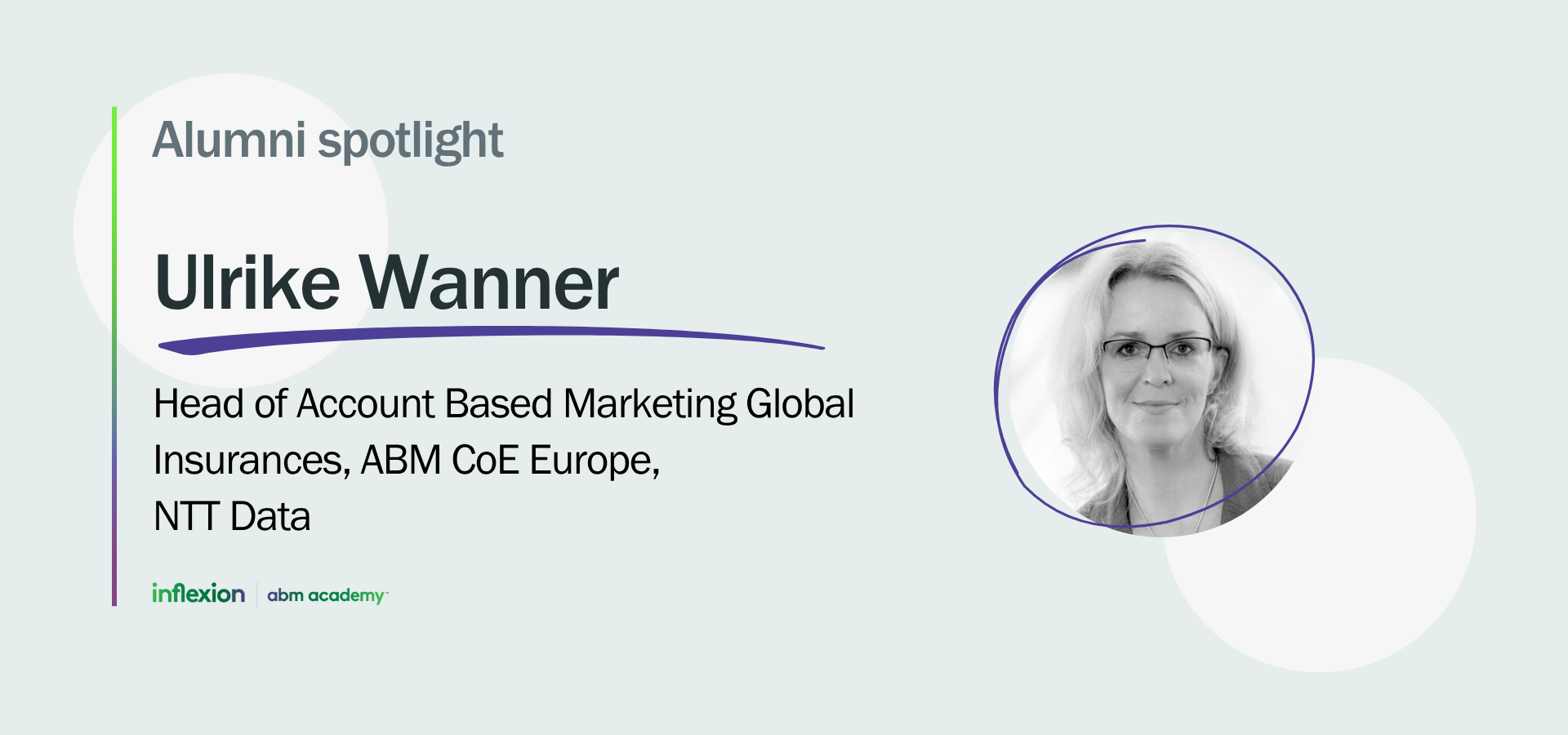
Ulrike Wanner, Head of Account Based Marketing Global Insurances, NTT DATA, and a member of our wonderful ABM Academy alumni community, is one of those marketers who was practicing ABM long before she knew what to call it. Now a proud member of the ABM Academy alumni community, we sat down with Ulrike to hear about her journey, her philosophy, and what she thinks the future of ABM looks like.
The interview
You’re at a dinner party and someone asks what you do – how do you explain ABM?
In ABM, I work closely with sales, delivery, and executives to make sure we all show up to the client as one coordinated team with an aligned, consistent message and not as different departments with different stories. Or to put it figuratively: ABM is like a tailor-made dress, perfectly tailored to the customer, with attention to detail that’s unmistakable! This means ABM ensures our clients feel understood and valued through personalised strategies that fit their specific needs.
How did you get into ABM? Was it intentional or by accident?
I had been working self-employed for almost 20 years serving midsized companies and start-ups in different industries build their positioning and marketing. Doing this, I always worked closely with leadership and sales. In other words, my background has always been about strategy, storytelling and deep client understanding.
One day someone said, “What you’re doing is actually account-based marketing,” and I had this moment of clarity: “Ah, now, my professional life has a name.” So when I was offered the role to shape ABM in DACH team of former NTT Ltd. I didn’t hesitate. It was like discovering a label for the work I already loved doing.
What’s the biggest risk you’ve taken in your ABM career, and did it pay off?
I pushed for ABM and DBM to be treated as complementary in an ABM account we were setting up. This was long before the organisation had processes or structures for this kind of approach. It meant onboarding sales leads from different legal entities and making them commit to the strategic ABM program, and aligning executives, so that everyone was pulling in the same direction.
It felt like trying to synchronise an orchestra that didn’t yet realise it was playing the same symphony. And yes, it absolutely paid off: it deepened trust, reputation, relationships, close collaboration, improved win rates, and helped our teams look more coordinated (by design, not coincidence).
What was your ‘lightbulb moment’ during the Academy course?
I really enjoyed the teamwork in the Inflexion Group sessions, and how we incorporated the different strengths of the various team members to ultimately achieve common, client centric goals. It is clear to me that when building the strategic ABM program, we should pay attention to internal engagement and team collaboration.
I realised that account insights are not one-off “project inputs” – they are renewable energy for the entire go-to-market engine – and ideally fuel outreach, content and the engagement of sales and executives in ABM and DBM throughout the whole process. This is what develops a classical campaign marketing into a real client experience.
What’s in your ABM toolkit that you couldn’t live without – and what’s the most overrated thing everyone raves about?
What I can’t live without: Stakeholder and intent insights, they tell me who truly influences a deal, what they care about, and how we can stay relevant to them. AI enhanced analysis saves time, adds depth, and makes precision possible even when budgets are tight. Plus, cross team rituals, demo hours, dependency walls and decision broadcasts as they turn siloed teams into aligned teams.
What’s overrated: Fancy campaign metrics that look impressive but don’t move any real conversation forward, and beautiful assets with zero client impact created for the sake of being created.
Fast-forward five years – what does success look like for you?
Sales, marketing, delivery, and executives collaborate instinctively, without needing three plus reminders, doing escalations etc. In strategic ABM, I would love to see ABM and DBM being fully fused into a (global) growth engine and not ‘two marketing approaches’, but the way the organisation naturally works.
Plus, I would like to further shape our ABM strategy in different industries, mentoring teams, and driving innovation in how we connect meaningful insights to client value. And ideally, to still be enjoying the ride as great collaboration should feel energising, not exhausting!
If you could give aspiring ABM-ers one piece of advice, what would it be?
First, focus on people, not processes. Try to establish cross functional trust. This is your superpower!
Spend time understanding your client’s world. Their pressures, priorities, and what success means to the buying committee before you even think about tactics or campaigns. Then help your internal teams see the client through the same lens. That shared clarity is what turns marketing into client experience and makes teams pull together. When people are aligned, everything else follows. And with this we experience better client conversations, better decisions, and – finally – better pipeline!
Final thoughts
We loved hearing Ulrike’s perspective — her passion for people-first marketing and genuine belief in the power of collaboration really shines through. Thank you for sharing your story with us! If you’d like to connect with her or follow her work, you can find her on LinkedIn tagged at the top of the article.
Ready to start your own ABM journey? Explore our ABM Academy courses and find the programme that’s right for you.
Read our previous Alumni Spotlight where we chatted to Katrin Marquardt, Associate Director for Account-Based Marketing and Field Marketing Kyndryl.