It’s twelve months since the wonderful Joanna Moss hosted my book launch event on the Ohana floor Salesforce Tower in London, with guest speakers including Andrew Fitzgerald of Kyndryl, Charles Forte of MoD, Rachael Bell of NTT DATA, Antonia Wade and Rhiannon Blackwell of PwC, Lorraine Legros of Red Hat, and Wiebke Macrae of Thales and Nimmi Bhalla of VMO2.

Looking back on three predictions
In the final chapter of the book, I looked ahead at how I thought ABM would evolve over the coming year, with three main focus areas.
The first, and no surprise to anyone, was the adoption of AI changing the way we do ABM. My ever-insightful colleague, Jaspreet Bindra of AI and Beyond kindly shared his perspectives, despite knowing that almost as soon as the book went to print, some of them would be out of date. He talked about how generative AI would help ABM-ers generate insight, messaging and content, making them potentially more effective and efficient, and stressed the need for ABM-ers to become AI literate. He also gave a nod to the emergence of agents, and Jo Moss was able to share some of the exciting work underway to build agents at Salesforce, both in her case study in the book and in her presentation on the day.
Today, while some ABM-ers are still getting to grips with how best to use AI day-to-day in their work, others are leaping ahead, with agents carrying out many of the more administrative and repetitive workflows in the ABM process (gathering insight, mapping buying groups. building stakeholder profiles, crafting talking points, planning campaigns). And now ‘super agents’ are being used to co-ordinate the work of other agents and provide a single interface for the ABM team.
As McKinsey and others have noted, the challenge with AI is no longer how to get people experimenting with and using the tools available, but rather how to scale and standardise use of the tools to deliver a compelling ROI.
The second prediction I made was that ABM could become part of the service companies offer their top clients – part of a distinctive or differentiated client experience, if you like. My work for my MBA thesis (and my early career teaching services marketing to teams around the world), leads me to believe that the way we provide insight, experiences and communications to top clients could be part of the ‘flower of service’ as proposed by Christopher Lovelock.
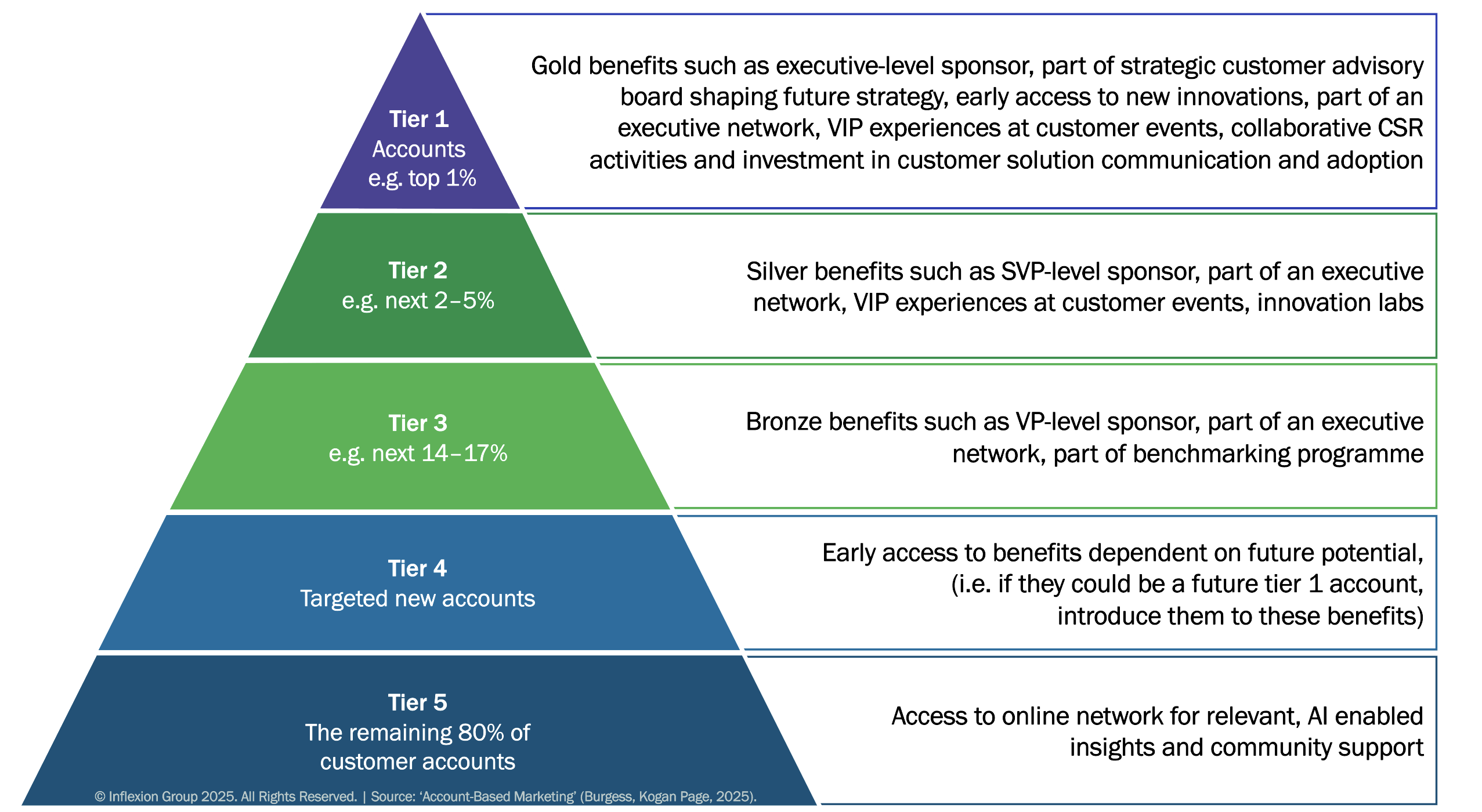
This is a change of mindset, from seeing marketing as a lead generation machine working at scale (which is being pushed further with AI), to being a precision activity core to the long-term, mutually valuable relationships created with top customers. Think of it as a frequent flyer programme, where the top tier of customers get the best benefits, as shown in the figure below.
Finally, the third suggestion I made as to how ABM-ers could really make a difference in future was to think beyond both their own and their client’s business to wider societal impact. We can’t leave tackling our environmental and social issues all to government, even in those countries where government is used to providing a safety net for its citizens. But we can work with our largest customers and partners to collaborate with public sector bodies to make a difference. I chair a customer advisory board made up of CIOs and CTOs from my client’s most important customers across many sectors, both public and private, and the interest they have in collaborating to solve issues such as digital equality and inclusion is amazing. The appetite is there, and the opportunity exists for us as ABM-ers to do something with it alongside our colleagues across the business.
William Eggers has written about this need for collaboration in the Harvard Business Review, confirming that it is already happening, such as in the quest to eradicate Malaria. He notes that ‘unprecedented networks of governments, NGOs, social enterprises, health professionals and international development institutions (and yes, big businesses) are coalescing around….complicated, dynamic and seemingly intractable social challenges.’
Vodafone is no stranger to working this way, having discovered that in the UK at least, the way you deliver social value with and for your key customers is becoming more important to long-term business relationships.
Evolving relationships with key customers at Vodafone UK
Vodafone UK is part of Vodafone Group, one of the largest technology communications companies in the world, providing telecoms and IT services to corporate clients in 150 countries.
Why top accounts matter
Nick Gliddon, Director for Business at VodafoneThree UK, has given a great deal of thought to how the 80/20 rule plays out with the company’s biggest accounts — specifically, how just one per cent of customers can account for half of profitable revenue. But it’s not just the ‘what’, it’s the ‘why’: why do those customers buy from us, and what do we do to resource these relationships properly?
These accounts are critical for several reasons. They matter in their own right because of their scale and complexity, so Vodafone has to ensure what it offers makes a measurable impact on their value chain. Many of these customers are also central to the UK’s macro-environment, opening up opportunities to influence public policy in areas like cybersecurity and SME support. And a number of top clients actively want to work with Vodafone’s SME customers, making these relationships a lever for broader growth.
Building the right account model
Vodafone runs several initiatives to support its top accounts, including the Vodafone Enterprise Programme, customer advisory boards, and a tailored engagement programme that connects with clients around the issues they care most about. Account teams are structured to reflect the individual needs of each client. As Gliddon puts it: “We don’t want the type of key account management that is a bit generic. We make sure the way we structure the account teams is supportive of each of these accounts and the opportunities they present.”
Insights from customer advisory boards have directly shaped how Vodafone operates — driving changes to its change management process and deepening its understanding of clients’ sectors. The company also brings account teams together for ‘stop sell’ days at its UK headquarters, where groups from up to four different teams collaborate on a shared account, surfacing new perspectives and opportunities.
The role of marketing
Marketing sits at the heart of these top account relationships, overseeing customer-facing programmes and championing Vodafone’s values. One of its key challenges is extending the strength of the consumer brand into the enterprise space. Gliddon explains: “I can have a conversation with a CEO who knows Vodafone as a wonderful consumer brand but wonders how a mobile phone company can help them. It’s marketing’s role to embed that brand awareness and understanding of what we offer — and drive consideration, which they do really well through account-based marketing.”
Going beyond the transaction
Vodafone’s biggest customers increasingly expect their suppliers to demonstrate purpose, not just performance. That means moving into areas of public policy and social contribution. In the UK, Vodafone works with clients in energy, utilities and banking to ensure struggling consumers can access financial support services digitally. Its ‘everyone.connected’ programme has committed to helping four million people cross the digital divide by 2025, while its ‘V-Hub’ has already supported over a million small businesses with free digital transformation services.
This approach has had a tangible commercial impact too. As a strategic government supplier, Vodafone is measured on social value as well as financial performance. After being challenged on its delivery, the company moved from one of the government’s lowest-scoring strategic partners to its highest.
What comes next
Looking ahead, Gliddon sees three priorities: a broader embrace of society and public policy; a stronger emphasis on the two-way value flow between Vodafone’s 20 million UK consumers and its enterprise clients; and conversations about technology that connect firmly to business outcomes. “Our large customers expect a 360-degree view that combines the technical, operational, brand and societal benefits of our relationship — in a way that ensures the whole is more than the sum of its parts.”
Read Bev’s January ABM-er article here, where she talks through setting up your ABM programme for success.
Discover more about the making of this book here.