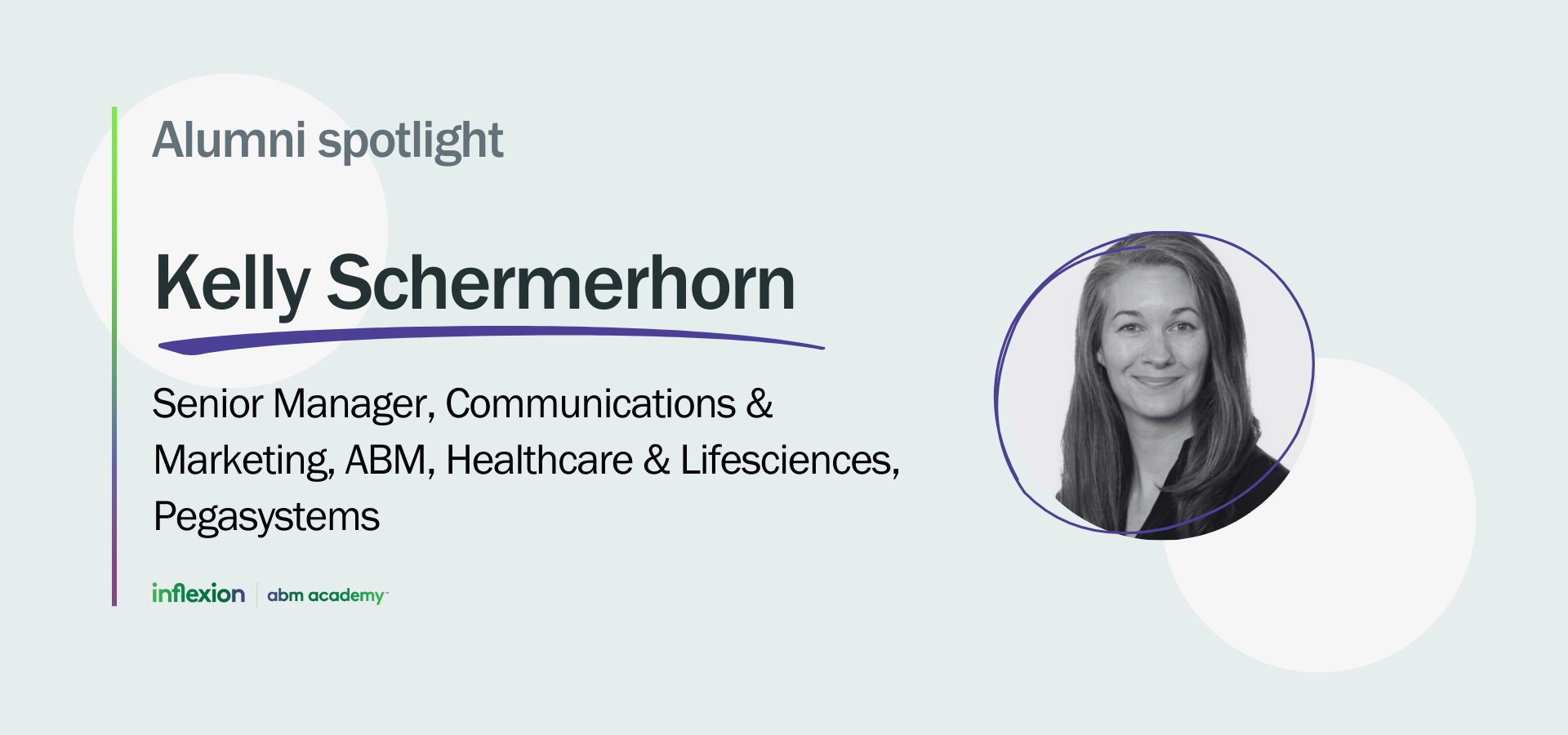
Kelly Schermerhorn is Senior Manager, Communications & Account-Based Marketing for Healthcare & Lifesciences at Pegasystems, where she works with some of the largest healthcare insurance providers in the U.S., helping them use technology to improve customer experiences.
We caught up with Kelly to learn about her approach to ABM, the risks that have shaped her career, and what success looks like in the years ahead.
The interview
You’re at a dinner party and someone asks what you do – how do you explain ABM?
When I’m at a dinner party, I think about my audience first. Most of the time, I’m talking to friends or family who don’t work in marketing, so I explain my role in a way that’s relatable. I usually say that I work with some of the largest healthcare insurance providers in the U.S., helping them use technology to improve the experience people have with their health plan.
I’ll often give a concrete example — like how frustrating it can be to call your insurance company — and explain that our software helps call center agents show up with more context and empathy during those interactions.
If I’m talking to another marketer, I describe my role a bit differently. I talk about partnering closely with account teams to support our most strategic customers and ensure we’re delivering content and experiences that are truly relevant and useful to them.
How did you get into ABM? Was it intentional or by accident?
It was a mix of both. I first came across ABM while listening to a B2B marketing podcast, where the guest was talking about its focused, customer-centric approach. That idea immediately resonated with me.
What started as curiosity became intentional quickly. I pursued ABM certification and later helped launch ABM at a company because it aligned so closely with how I already thought about marketing — starting with the customer.
What’s the biggest risk you’ve taken in your ABM career, and did it pay off?
Our careers are often not defined by one big risk, but a series of smaller risks. One memory that stands out to me involved a highly personalized executive brochure we were creating for a customer.
There was a specific word I strongly advocated for using in the copy — a word our internal teams were uncomfortable with, but one the customer themselves used frequently. I felt it was important to reflect the customer’s language, even if it felt slightly uncomfortable internally.
When we shared the brochure with an internal client champion, they passed it along to their CIO, who responded by asking to have his photo included in the piece. That moment confirmed the risk paid off — the message resonated so strongly that the executive wanted to personally be part of it.
What was your ‘lightbulb moment’ during the Academy course?
The Academy course built on my initial ABM certification, so it was both a valuable refresher and an opportunity to go deeper. My biggest takeaway was how newer tools, like GenAI, can be used thoughtfully to help us learn about our customers more efficiently — not to replace human insight, but to accelerate it.
That connection between strategy, technology, and customer understanding really clicked for me.
What’s in your ABM toolkit that you couldn’t live without – and what’s the most overrated thing everyone raves about?
I couldn’t live without customer success stories. Sharing customer wins energizes me, elevates our customers, and helps other organizations see what’s possible when challenges are addressed in the right way. Success stories ground everything we do in reality; they turn strategy into something tangible and credible.
The most overrated thing in ABM is relying too heavily on tools or dashboards — they’re only as good as the relationships, alignment, and judgment behind them.
Fast-forward five years – what does success look like for you?
Success for me looks like reducing friction in the buying process by making it easier for sellers and marketers to activate the right content and experiences at the right moment. When the work we create actually gets used, supports real conversations, and helps move things forward in a meaningful way, that’s success.
If you could give aspiring ABM-ers one piece of advice, what would it be?
Celebrate the small wins. ABM progress often shows up in subtle ways — a customer reposting your LinkedIn content, a sales leader shifting from skeptic to advocate, or a C-suite executive asking to be featured in a piece of content.
Those moments matter. They’re signals that trust is building, and that’s where real impact starts.
Want to follow in Kelly’s footsteps?
Kelly’s journey from curiosity to confident ABM practitioner shows what’s possible when you commit to customer-centric marketing. Her success — from launching ABM programmes to creating executive content that resonates so strongly clients want to be part of it — demonstrates the real-world impact of structured ABM training.
Ready to start your ABM journey? Explore our upcoming courses and join a global community of ABM practitioners across 36 countries.
See our previous Alumni Spotlight featuring Selina Moutia, Senior Principal Vertical & ABM Enterprise Strategy Marketing, EMEA, at Red Hat.