Resources:

Ask the Expert: How can I maximize scale and cost effectiveness with Programmatic ABM?

IFG_MH_AskTheExpert_Jan26
Insight
Published January 27, 2026

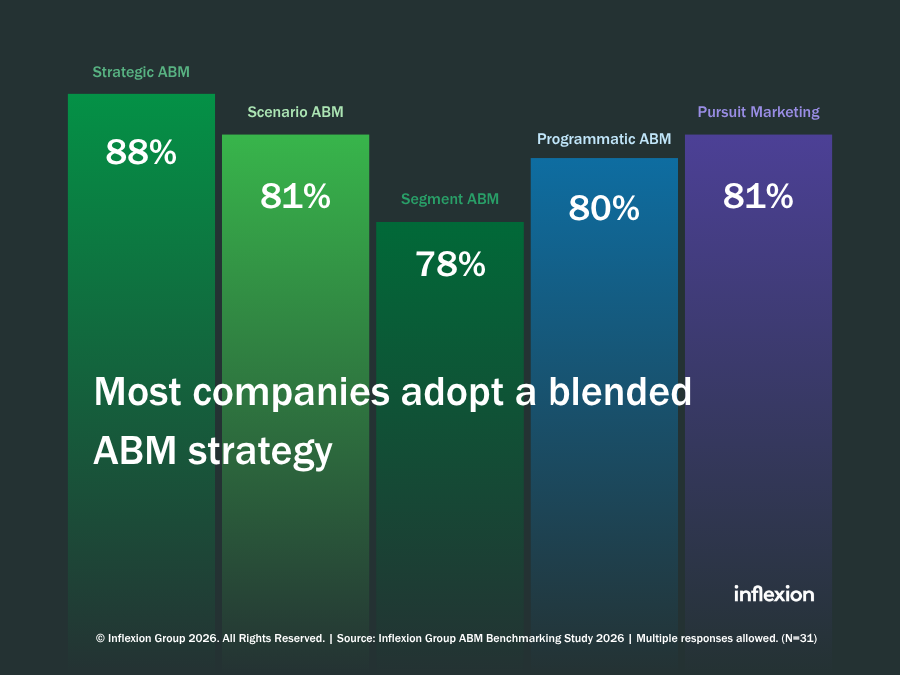
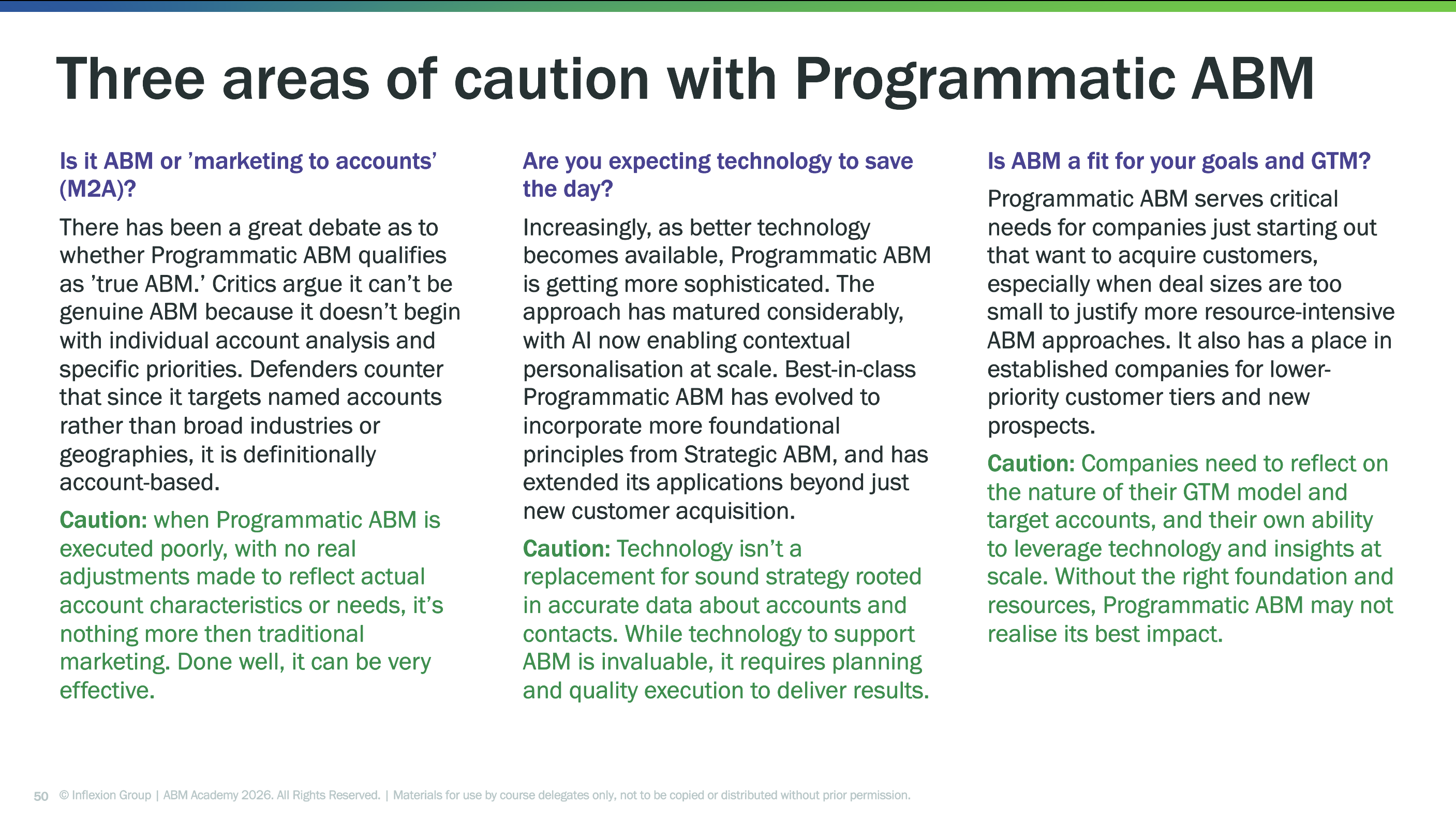
During a recent training course, we discussed the types of #ABM each company is deploying. Given that most were complex #B2B companies with a range of offerings and go-to-market (#GTM) motions, it’s no surprise that they are using multiple ABM approaches. What was surprising was the lively discussion around whether they were doing Programmatic (1:Many) ABM, or whether the reality was simply general outbound demand creation. 

What prompted the discussion? As part of the course content, we covered the definition of Programmatic ABM as defined by Inflexion Group. That sparked interest in thinking through the reality of their Programmatic outreach and how it might be enhanced to better reflect ABM principles. The goal is to deliver ABM at the scale their pipeline goals and volume of target accounts require, ideally without adding people or budget.  
IFG_MH_AskTheExpert_ProgrammaticABM_Jan26

Here are three tips for delivering more impactful Programmatic ABM while managing real-world resource challenges. 

  • Truly understand your ICPs, account buying groups and their needs: What sets apart account-based programs, no matter the scale, is whether you actually adapt your outreach based on the account and people in it. It’s not about what you want to say or sell, but what the account and its buying group members need. If you are making a list of accounts and sending general messaging based on internal perspectives, it’s not account-based. If you are researching, analyzing, and developing messages and offers based on knowledge of the accounts, then timing your outreach based on the signals they’re showing, that’s account-based. Please note that I’m not saying it’s inherently bad to do general outreach. Just don’t call it account-based when it’s marketing to accounts. Both have their place in B2B marketing plans. A good place to start is with your ideal customer profile. How was it defined? If it’s more of a wish list of target accounts and not an accurate reflection of who actually buys from you, that might be causing problems with both sales and marketing efficiency. Note the difference between an ICP built from current state vs. an aspirational ICP.

    What’s the difference? A current state ICP can be based on analysis of your most valuable existing customers based on revenue, profitability, and renewal and expansion potential, including propensity to become advocates. An aspirational ICP is based on who you’d like to sell to but may not deliver actual revenue today. Examples include if you’re looking to enter a new geographic or vertical market or expand an offering to a new buying group. It’s likely you’ll need both types for scaled ABM efforts. Make sure you know what type of ICP foundation you need before you develop campaigns. 

  • Use what you have from other ABM efforts and share what you know to optimize resource deployment: Don’t start with a blank page. Top of mind for the training course group was how to build upon the efforts they’ve put into high quality Strategic (1:1) and Segment (1:Few) ABM programs. If your top target accounts have a set of needs or goals, chances are other accounts have similar needs. While you may not leverage more expensive, custom tactics, messaging and content may be easily converted to something appropriate for use at scale. At the same time, make sure you’re sharing what you learn about target accounts and buying groups with other teams such product and content marketing, events, field marketing and sales enablement. They may be making assumptions about what will be helpful that don’t match what you know about actual accounts. If you make them aware of key needs and goals and the data behind these insights, they can adapt. This prevents wasted resources because what gets built isn’t a match for what customers, ABM-ers and sellers really need. 
  • Deploy AI to support complex orchestration: Scaling ABM efforts gets a major boost from technology, and in particular #AI. In many ways, it’s what makes ABM at scale possible. Our recent Inflexion Group AI in ABM Benchmarking Study found that AI is delivering on productivity promises, with 93% of teams reporting time savings, 84% seeing productivity gains in core ABM activities, and 96% citing improved account intelligence depth. Nealy a third (30%) of companies are testing (23%) or actively using (7%) AI agents in ABM processes. Another 23% plan implementation within 12 months. Agents address the 38% of companies in our study who are seeking help with orchestrating complex, multi-stakeholder journeys. It’s also supporting the 31% who need to integrate disparate data sources, and the 27% working to accelerate deal velocity and expansion. The key is to ensure that you’re taking a fresh look at your workflows for Programmatic ABM. Some efforts to scale ABM with AI break down when it’s applied to processes that aren’t optimized for your buying reality, including internal and customer friction points.  

Just like our course attendees, take advantage of the need to scale account-based efforts as your reason to clear out old approaches that aren’t serving you or your customers well. Gain a clear understanding of what is (and isn’t) truly account-based, then make sure you carry forward what you’ve learned and built from other types of ABM programs as you deploy AI and other technology to meet your revenue goals. 

Want to learn more? The Inflexion Group ABM Academy has excellent options, from getting started with an on-demand course to expert-level communities. Several live courses start again in early February. Take a look and let us know if we can help you choose. 

Meg Heuer

Meg Heuer

Megan is a B2B leader and expert with more than 25 years in industry and professional services roles. She knows first-hand how new ideas, technologies, and well-managed change can improve business results.

Megan’s experience includes a combination of advisory, practitioner and consulting roles. She is best known for leading the Research and Advisory organization at B2B analyst firm SiriusDecisions (acquired by Forrester), where she founded and led their account-based marketing (ABM) practice.

Megan has held several senior marketing roles in the technology, business services and manufacturing industries as well as consulting roles at Winning by Design, Gartner, Satmetrix, and The Peppers and Rogers Group. Today, Megan co-hosts a weekly video podcast on LinkedIn (Account-based Fridays), featuring advice from go-to-market leaders and experts.

Privacy notice

Your privacy is important to us and we are committed to protecting your personal data. This privacy notice sets out how Inflexion Group Ltd uses and protects any personal data you give to us when you use this website.

Inflexion Group is committed to protecting your privacy and complying with the UK General Data Protection Regulation (“UK GDPR”) and the Data Protection Act 2018 (“DPA 2018”). This privacy notice sets out your rights, and the basis by which we collect, use and disclose the personal data on you. Inflexion Group will always aim to be transparent about how we process personal data.

Who we are

INFLEXION GROUP LTD is incorporated and registered in England and Wales with company number 13253251 and whose registered office is at Pantiles Chambers, 85 High Street, Tunbridge Wells, Kent, TN1 1XP, United Kingdom.

How do we collect personal data from you?

We collect personal data on this website in the following circumstances:

  1. data which is collected and stored during normal use of the site, such as your IP address and the pages you visited when you opt to submit personal information, in order for us to send you further information or email alerts;
  2. when you request to view certain content, such as white papers, or research; or when you register for an event, conference or webinar.

Any information you provide, or which we request in order to fulfill legal requirements, will only be used in accordance with this privacy notice.

What data about you is collected and stored?

The personal data we might collect and store includes;

  • your basic information and contact details. This may include your name, the organisation to which you belong or represent (if applicable), your contact phone number and email address. Information about your computer, such as your IP address, operating system and browser type.
  • details of your visits to our website, the pages you view and resources you access or download.
  • if you contact us with an enquiry, or for information, we may keep a record of that correspondence.
  • we may ask you to complete surveys that we use for research purposes, although you do not have to respond to them.
  • if you are a delegate or attendee, we may also hold any special requirements you may have regarding the event(s) you are attending.

How is your data used?

We may use your personal data in the following ways:

  • we analyse browsing activity data to understand how people use the features and functions of our website to identify improvement so that we can provide you with a better website experience
  • we analyse how you interact with website and email content to enable us to provide you with better and more relevant content
  • to fulfil your requests for more information, e.g. white papers, articles, or other content. Pages that collect this type of information may provide further information as to why your data is needed and how it will be used.
  • for surveys or research questionnaires to help improve our content or our services to you.
  • to contact you for marketing purposes where you have agreed to this.

How we protect your data

We are committed to ensuring that your personal data is secure.  To prevent unauthorised access or disclosure your data is held securely on credible, established Cloud Services in accordance with our IT Security Policy. Access to Inflexion Group’s Cloud storage areas is restricted and controlled.

All our employees, Associates, partners and suppliers have signed non-disclosure and confidentiality agreements with Inflection Group, which in particular cover your personal data.

How long will we keep your personal data?

Whenever we collect or process your personal data, we will only keep it for as long as is necessary for the purpose for which it was collected unless we need to keep it longer to comply with our legal obligations.

At the end of that period your data will either be deleted completely or anonymised (e.g. by aggregation with other data so that it can be used in a non-identifiable way for analysis and business planning).

What legal basis do we have for processing your personal data?

When we collect your personal data we will make it clear to you which data is necessary in connection with a particular service.

The law on data protection sets out a number of different reasons for which a company may collect and process your personal data, including:

Consent

In specific situations, we may collect and process your data with your consent (e.g., when you consent to receive marketing materials or make an enquiry).

Legal Compliance

If the law requires us to, we may need to collect and process your data. For example, we can pass on details of people involved in fraud or other criminal activity to law enforcement.

Legitimate Interests

In specific situations, we require your data to pursue our legitimate interests in a way which might reasonably be expected as part of running our business and which does not materially impact your rights, freedom or interests.  For example, where you have provided us with your business card, we may use your address details to send you information on our products, services or research. 

With whom do we share your personal data

We may share your data to support your attendance at one of our events, but only where necessary (e.g. with representatives of a venue where our event is being held).

We will ensure that appropriate arrangements are in place to protect your privacy before sharing your data.

We may share your data with government authorities and/or law enforcement officials if required to do so by law or to meet regulatory requirements.

We will not otherwise share your data with any third party unless we have your consent. We will not sell your data to any third parties.

Your rights

You have the right to ask us for a copy of the data we hold about you, you may request that it be corrected if it is inaccurate or to ask us to delete any or all of your Data or to stop processing it.  However, your rights may be limited if we have a compelling legitimate interest in keeping your Data.

Please contact us at tim@inflexiongroup.com to do so. We will provide you with an electronic copy of your Data or carry out your deletion instructions, in the absence of a legitimate reason for not doing so, within a month of receiving you request.

How to contact us

If you have any questions or concerns about how Inflexion Group handle your personal data then in the first instance you can contact tim@inflexiongroup.com.  We are registered as a tier 1 organisation with the Information Commissioner’s Office, registration number ZB222816.  If we are unable to satisfy your concerns, then under the General Data Protection Regulation you have a right to complain to the Information Commissioner’s Office at:

Information Governance Department
Information Commissioner’s Office
Wycliffe House
Water Lane
Wilmslow
Cheshire
SK9 5AF

URL: https://ico.org.uk/

Changes to our Privacy Notice

Inflexion Group may change this notice by updating this page. You should check this page from time to time to ensure that you are happy with any changes. This privacy notice is effective from November 2021.