From reacting to redesigning across the integrated enterprise
Over the past year, the conversation about AI in account-based marketing has matured. Adrenaline levels are dropping and hype has thinned. In their place is something more useful: purposeful curiosity, practical experimentation, and a clear-eyed view of the real challenges.
Our benchmark research work reflects that shift.
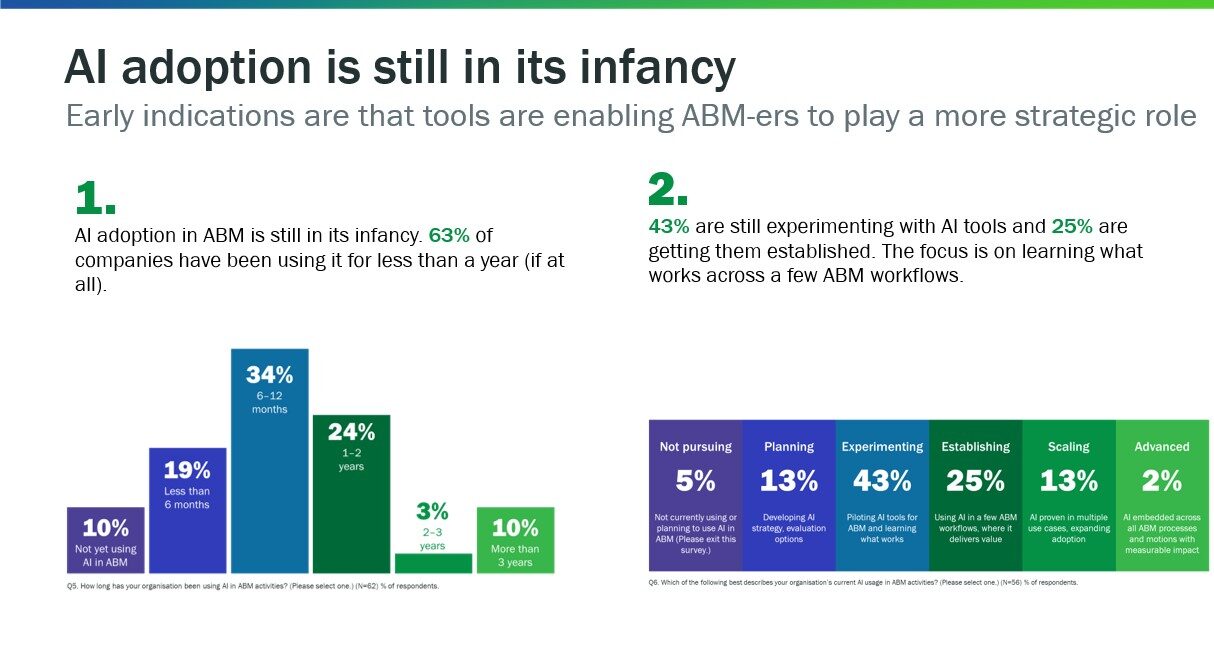 AI is delivering tangible benefits in ABM today, particularly in insight generation, content support and productivity. At the same time, adoption remains uneven, ROI is modest, and many teams are wrestling with friction around data, skills, trust and governance.
That’s the context for this final post in our series sharing results from the Inflexion Group AI in ABM Benchmarking Study. Instead of a “how-to,” it’s a reframing of what we need to maximize impact in the next phase. My goal is to share context for why we’re feeling the way we do, and what actions can help us to embrace the opportunity, rather than just brace for it.
Agents of change as catalysts and builders
When we think about the next phase for AI in ABM, agents of change are what drive the narrative. But when I say agents of change, I don’t mean AI agents. I’m talking about human agency. While AI agents matter too, the important point is that the true “agentic” shift in ABM isn’t technical. It’s organisational, and it’s about people. We need to understand how people will drive the changes we need to make.
What being an agent of change means in today’s B2B environment
If you want a single organising thought to carry forward, it’s this:
AI will raise the baseline of “competent”. Your advantage will come from how deliberately you redesign work with your colleagues across functions, protect trust, and create the conditions for good thinking.
That’s what human agents of change do. And it’s work that starts with a conversation, not a plan.
Being an agent of change means refusing to optimise your corner of the workflow whilst everyone else’s remains untouched. It means convening the right people, naming the friction, and redesigning end-to-end for trust-based growth – not just marketing efficiency.
Change means understanding that emotional whiplash around AI is real
If you and your team have felt a mix of excitement, fatigue, scepticism, and low-grade anxiety, congratulations: your nervous system is functioning.
In our research and conversations with ABM leaders, the emotional landscape keeps showing up in consistent patterns:
- AI is already useful, but it’s not magic.
- Teams are under pressure to “do something” with AI, often without clear guardrails.i
- ABM-ers are trying to protect trust in high-value relationships while being told to scale faster.
- Many marketing teams are not measuring ROI, which is turning uncertainty into risk.

It’s tempting to treat these emotions as noise. They’re not. They’re signals that organisations are operating in threat mode versus exploration mode, and it’s holding us back.
It’s a well-established pattern in psychology: perceived threat narrows thinking while safety expands it. When humans perceive threat, we become defensive and cling to existing routines. When we feel safe, our cognitive range expands. We become curious, playful, and experimental. It’s when breakthroughs are made.
What does this mean for the next phase of AI-enabled ABM? We need to understand that while it’s partly about capability and operating models, it’s mostly about helping smart people stop bracing for the worst and start thinking creatively.
The real inflection point is design, not “more AI”
In our earlier posts, we’ve been deliberately blunt about where AI in ABM is today:
- Most teams are still in early-stage adoption, with activity concentrated in a handful of workflows.
- Barriers are systemic, not “tool gaps”: data quality and integration, skills and confidence, trust and authenticity, governance and organisational clarity.
- ROI is still immature, and many teams aren’t measuring it, which is becoming the biggest strategic risk of all.
The next phae can begin when we accept a slightly uncomfortable truth: if everyone can access similar AI capabilities, the competitive advantage shifts away from tools and toward design.
I find myself returning to Andy Grove’s “strategic inflection point” idea: you can be the subject of change, or you can be the cause of it. The point is not paranoia. The point is agency. (Infinite MIT)
For ABM leaders, that means moving from:
- “How do we adopt AI safely?”
to
- “How do we redesign how we create value, with AI in the mix?”
Perspectives, not absolutes
A lot of AI anxiety stems from a desire for certainty: clear answers, proven playbooks, and predictable outcomes. These were the foundations of a lot of the last 10 years of marketing best practices, and also the source of the slowing many companies have seen in their marketing results over the last several years.
But ABM has never lived in absolutes. It has always been a discipline of judgment, context, imperfect data, and partial views of complex buying centres. AI doesn’t change that. It simply makes it more visible.
Carlo Rovelli puts it beautifully in White Holes:
“We have access only to perspectives. Reality is perhaps nothing other than perspectives…”
The practical implication is disarmingly simple: waiting for perfect clarity before acting isn’t caution. It’s abdication. Progress has always come from working intelligently with partial information, testing, learning, and adjusting.
For ABM teams, this is strangely liberating. You don’t need AI certainty to move. You need good design choices and the discipline to learn.
(For the curious: Rovelli’s book is here on PenguinRandomhouse.com)
Why creativity less about output and more about cognitive flexibility
Over the last year, a more interesting pattern has emerged. Many ABM teams are using AI to support creativity in very practical ways: brainstorming angles, testing messages, reframing problems, generating options quickly. That is real value. Being an agent of change means refusing to optimise your corner of the workflow whilst everyone else’s remains untouched. It means convening the right people, naming the friction, and redesigning end-to-end for trust-based growth – not just marketing efficiency.
If you want a single organising thought to carry forward, it’s this:
AI will raise the baseline of “competent”. Your advantage will come from how deliberately you redesign work with your colleagues across functions, protect trust, and create the conditions for good thinking.
That’s what human agents of change do. And it’s work that starts with a conversation, not a plan.
The risk is not that creativity gets dismissed. It’s that we reduce it to “more output, faster”. In high-trust ABM environments, the differentiator is not volume. It’s cognitive flexibility: the ability to see alternatives, challenge inherited assumptions, and make better decisions under uncertainty.
One of the most robust ideas in positive psychology is Barbara Fredrickson’s “broaden-and-build” theory: positive emotions broaden our thought-action repertoire, helping us build enduring resources over time. In plain English: when we’re not bracing, we can think. (prospectivepsych.org)
This matters in ABM because the stakes are high and the tolerance for generic automation is low. Trust is the currency. Relationships are the asset. When teams feel pressured and uncertain, they default to safe output. When they feel able to explore, they design better. The team that runs “what if we’re completely wrong about X?” sessions discovers angles the team churning out “best practice” variations never sees.
This is why “play” belongs in a serious conversation about AI-enabled ABM as a leadership tool.
Four design moves to shift from reacting to innovation
These are not steps. They’re moves. You don’t need a transformation programme to start. You need (to give yourself) permission, focus, and have the willingness to retire work that no longer adds value.
1) Decide what not to automate
Not everything benefits from speed. In high-trust ABM contexts, some moments deserve human primacy: In high-trust ABM contexts, some moments deserve a human making the call: executive-to-executive conversations, interpreting what stakeholders actually mean (not just what they say), shaping how you position your approach for their particular situation.
Use AI to support those moments, not to replace them.
This is also how you protect authenticity, which our research shows is a central concern for ABM teams trying to scale without eroding credibility.
Prompt for your team: Where would a “good enough” AI output create relationship debt?
2) Redesign one workflow end-to-end, not the whole world
The mistake many organisations make is bolting AI onto fragmented, cross-functional workflows and then acting surprised when it produces friction.
Pick one workflow and redesign it end-to-end. A good candidate is account insight generation and activation, because it’s both foundational and already a strong AI use case.
Do it across functions, not just within marketing. ABM lives in the seams between marketing, sales, revenue ops, customer success, and sometimes product. If the seams stay messy, AI will simply scale the mess faster. Incidentally, if you get this right, it could become a great candiate for agentic AI.
Prompt for your team: If we built this workflow today, with AI available, what would we remove first?
3) Create deliberate space for exploration
Curiosity and creativity do not survive back-to-back delivery cycles.
If you want teams to become agents of change, you have to make exploration a designed part of work, not an extracurricular hobby that happens only after hours.
But not all exploration is equal. The activities that genuinely stretch thinking are those that engage your brain differently from the work itself. When you’re staring at another dashboard, another brief, another optimisation task, you’re reinforcing the same neural pathways. Creative activities that require noticing, experimenting, and tolerating imperfect attempts train exactly the cognitive muscles that delivery mode suppresses. Edward de Bono spent decades arguing that we need deliberate techniques to break habitual thinking patterns. He was right – but the technique doesn’t have to be six thinking hats. It can be a sketch pad.
This is where the analogue creativity ideas can be powerful. I’m not asking ABM leaders to become painters. I’m saying: choose something that reopens your brain. Photography on film. Sketching. Cooking without a recipe. Anything that trains your mind to notice, experiment, and tolerate imperfect first attempts.
Prompt for your team: Where do we have “learning time” in our operating rhythm, not just “delivery time”?
4) Treat ROI as a learning system, not a verdict
In our study, a majority of teams aren’t tracking AI ROI, often because it feels too early. That’s understandable, but it’s becoming risky.
The answer isn’t to force premature revenue attribution. It’s to build a simple learning system around what matters in ABM: Relationships, Reputation, and Revenue – the 3Rs we use at Inflexion Group to measure ABM success.
Map your indicators accordingly:
- Leading indicators (efficiency and quality): insight quality, time-to-insight, content iteration speed
- Mid indicators (Relationships and Reputation): engagement quality, meeting quality, account progression signals, how you’re perceived in target accounts
- Lagging indicators (Revenue): pipeline, velocity, revenue, CAC
This turns measurement into agency. t makes AI a design choice you can adjust, not an investment you hope works out.
Prompt for your team: In 90 days, which of these indicators would need to move – and by how much – to earn another 90?
The next rising action
The next phase of ABM is AI-enabled. That much is already true.
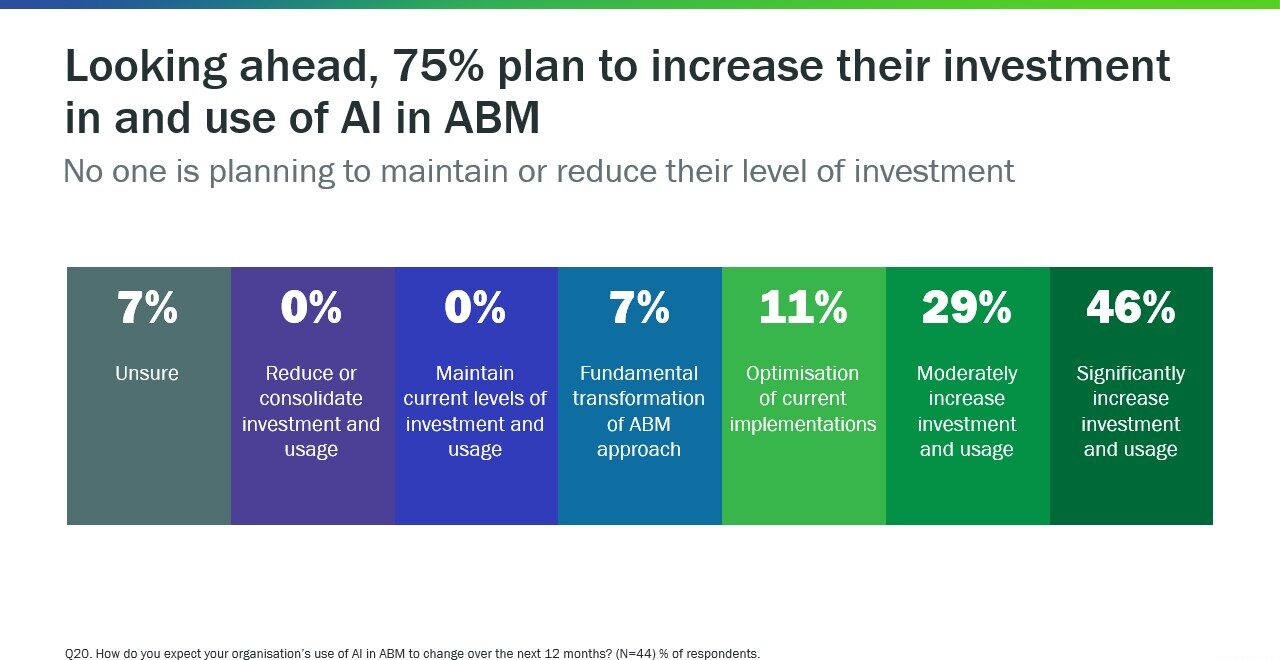
What’s not yet decided is whether ABM practitioners become passive recipients of whatever AI turns into, or active agents of redesign across the enterprise, guided by where ABM teams expect AI to create the most value over the next two years.
This is not work you do alone in the marketing function. The opportunities – and the friction points – live at the intersections: between marketing and sales, between revenue operations and customer success, between strategy and execution. AI doesn’t respect organisational charts. Neither should you.
If you’re coming late to this series written by my colleague Megan Heuer and I on the back of the AI in ABM Benchmarking study that we conducted in collaboration with B2B Marketing, and would like to read it end-to-end:
- From buzzwords to business impact: How AI in ABM is growing up
- AI in ABM: Adoption Foundations Show an Unevenly Distributed Future
- Implementation approaches to AI in ABM: Ask “why” to avoid reducing future impact by settling for today’s returns
- The barriers holding back AI in ABM, what they tell us about marketing more broadly, and how to address the underlying issues
- When not knowing is the biggest risk: 58% of ABM teams aren’t tracking AI’s ROI but three changes could fix that in 2026